

YouTube’s algorithm can produce interesting results. It recently recommended two sharply contrasting podcasts. One was a sober analysis of church decline in rural Illinois by a self-described “old geezer” Christian; the other was an “audit” by a young Gen-Z atheist who raved about his visit to an Orthodox Liturgy. That afternoon I found myself going back and forth between feeling pessimistic, and feeling hopeful as I watched the two videos.
The purpose of this article is to stimulate discussion about the current religious situation in the United States. Do we indeed have a church attendance crisis in America? Does Christianity have a future in America? Can Orthodoxy help reverse church decline in America?

“The Coming Church Attendance Crisis” [54:12]
Tom Wadsworth, a former pastor and independent scholar, presents the findings of his survey research which he conducted in his hometown of Dixon, Illinois, from 1983 to 2023. His research deserves our attention because of its solid data and meticulous methodology. One surprising finding is that Gallup polls significantly overestimate the percentage of Americans who attend church/religious services. Where Gallup polls report that 31% of Americans attend church services (based on self-description), Wadsworth estimates that the actual percentage may be around 13% (based on head counts) (see 18:15-24:54; see 24:12). Wadsworth notes that if church attendance is 13% for a conservative, rural area, like Dixon, Illinois, then the rate of church attendance is likely to be even lower in major urban areas like Chicago, Orlando, New York, etc. In other words, the problem of church decline may be even worse than we think it is.
Wadsworth introduces the concept of “critical mass”—the minimum size or amount of something required to start or maintain a venture. For churches to survive they need a certain number of congregants and income to survive. Which begs the question: What are the critical thresholds needed for a church to survive? Wadsworth hypothesizes that if a church has: (1) 40 in attendance on average and (2) 60% of its attendees are 65+ in age, then that church is likely to close its doors in ten to twenty years (28:16). This numbers-driven approach is pragmatic and helps generate a realistic assessment of a congregation’s vitality. These two findings—actual attendance rates and critical mass needed for church growth—are what makes Wadsworth’s presentation noteworthy. Here he breaks new ground. While Wadsworth’s discussion of ten factors contributing to church decline (31:17-42:06) is also worth considering, this is familiar ground that has been discussed by others. Among the reasons he gives for church decline are the recent public pastor scandals, the pandemic lockdown, the polarizing effects of the religious right, the 9/11 effect—the ejection of religious fanaticism, youths rejecting the Evangelicalism of their parents, the effects of social media on socialization, the declining birth rate, and the fact that secular culture is now in fashion, etc.
Overall, this author finds Wadsworth’s discussion of possible causes for church decline to be full of insights. However, I do have a few quibbles with him. The youth’s rejection of their parents’ Evangelicalism is not so much a causal factor as it is a description of an aspect of the overall decline. Based on anecdotes I have read on the Internet; I am inclined to agree with his identifying the Religious Right as a contributing factor. However, one must also take into account the drift of the historic mainline denominations towards secularism and liberalism. The drift away from historic orthodoxy in the mainline denominations has resulted in liberal theology devoid of belief in the supernatural, i.e., watered down Christianity. As a former atheist, I find mainline Protestantism lacking the robustness and vitality of historic supernatural Christianity. Another factor I believe that Wadsworth’s analysis overlooks is the impact of rising divorce rates. I suspect that children of divorce find it harder to feel at home in churches that hold the intact nuclear family to be the norm; divorcees, single parents, never-married singles, and those with confused sexual identities will feel unwanted and marginalized.
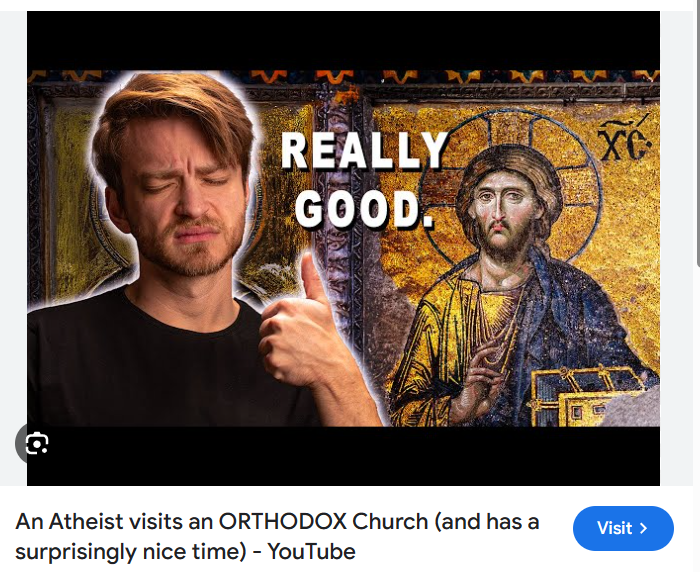
“An Atheist visits an ORTHODOX Church (and has a surprisingly nice time)” [25:20]
Jared Smith, creator of Heliocentric, visited an Antiochian Orthodox parish and rated it as “exceptional,” a “Knock ‘em dead! Home run out of the park!” experience. Unlike Tom Wadsworth’s careful analysis, Jared Smith’s report consists more of comparisons between what he saw at one Orthodox parish against other churches he had visited. He notes that a lot of thought and care had gone into the interior of All Saints Antiochian Orthodox Church and that the church was built for reverence. He contrasts this against the ugliness of the four bare walls of “the run-of-the-mill box church” or “a CVS church” (2:45-3:05).
Jared described how the greeter welcomed him warmly but did not pounce on him as in other churches. Then, as the greeter was explaining the church service, the priest entered the foyer, censing the room. The greeter paused, turned to the priest, and bowed in respect (5:36). For Jared Smith, that was impressive because it showed that in the Orthodox Liturgy, God is the center of the show, not you. I found his criticism of Protestantism’s audience-centered approach to worship quite insightful. It suggests that among the Gen-Z cohort there is a hunger for reverence that is not being met by Protestantism’s contemporary worship service. Jared Smith was surprised that he was invited to meet with the priest one-on-one (7:52). His experience has been that pastors only meet with loyal church members, not with outsiders. Sadly, it seems that personal contact with the pastor has become a rare exception, especially with huge mega churches (18:20, 20:27). I was surprised by Smith’s observation of icons in the Orthodox church. The icons of the saints reminded him that we are not alone but surrounded by a great cloud of witnesses (11:05). This contrasts sharply with the Baptists’ emphasis on Jesus and you—and you alone.
Part of Jared’s church review was the coffee hour (16:14 ff.). He was surprised that the priest stayed around after the Liturgy, taught adult religious education class, talked with people after the class, then to Jared’s surprise, invited him to his house for coffee. For Jared, the one-on-one personal contact was a far more effective way of doing outreach than the didactic lecture approach favored by Protestant Evangelicals. He also noted that the priest did not attempt to argue him out of his atheism, but accepted him.
What I find striking is that Jared Smith is the demographic polar opposite of Tom Wadsworth. Jared is in his late 20s, a former Evangelical, a graduate of Wheaton College, etc. His glowing description of Orthodoxy represents a bright silver lining in an otherwise gloomy situation described by Tom Wadsworth.
Jared Smith’s positive assessment of Orthodoxy seems to be part of a broader trend. The New York Post in December 2024 published an article: “Young men leaving traditional churches for ‘masculine Orthodox Christianity in droves.” This article has caught the attention of many and has generated considerable discussions among Protestants. If Orthodoxy can appeal to Gen-Zs like Jared Smith, then it is possible that the problem of church decline can be arrested and possibly reversed.

What Does the Future Hold?
The overall religious picture for the United States looks grim. It is like a long, extended drought drying up the landscape with plants and trees everywhere slowly dying off. This religious drought has been going on for several decades now. Surprisingly, there are a few spots of greenery popping up here and there. One of these spiritual oases is Eastern Orthodoxy. The recent influx of young men flocking to Orthodoxy can be seen as something like a rain shower that potentially signals a change in season.
We could be witnessing Orthodoxy’s transition from being seen as an exotic transplant to a well-regarded alternative to Protestantism and Roman Catholicism. For that to happen, American Orthodoxy will need to experience solid church growth. In addition to welcoming inquirers, we will need to give attention to the nurture of cradle Orthodox. Orthodoxy will thrive if the children of recent converts along with the grandchildren of immigrants are nurtured into a living faith in Christ. Both the recently-baptized convert and the recently-baptized infant whose ancestors embraced Orthodoxy centuries ago, are the future of Orthodoxy. For Orthodoxy to reverse the problem of church decline, we will need, not just thriving current parishes, but also new mission parishes planted in the same urban areas as well as in areas that have zero Orthodox parishes. For that to happen, we will need a wave of men to be ordained to the priesthood and the diaconate. And, we will need bishops that support the evangelization of America. We need a vibrant American Orthodoxy that presents the Ancient Faith to a post-Christian America.
Entering into the Harvest
And, let us not forget to pray. Jesus exhorted his followers:
The harvest is truly plentiful, but the laborers are few. Therefore pray the Lord of the harvest to send out laborers into His harvest. (Matthew 9:38, OSB)
The time of harvest has come. If you see new people at your local parish, that means that there is work to do. Let us welcome the visitors who seem lost in the Liturgy by giving them a helping hand. Let us invite them to join us for coffee after the Liturgy. If you see someone standing alone during coffee hour, introduce yourself to them. Getting the cold shoulder during the coffee hour can leave a bad impression after experiencing the Liturgy. Many first-time visitors are fearful of rejection, so be ready to put them at ease. Be ready to listen to them and to answer their questions, and be ready to share your faith story with the inquirer. Tell them how the Lord has been good to you. Let us keep in mind the words of Jesus:
Go home to your friends, and tell them what great things the Lord has done for you, and how He has had compassion on you. (Mark 5:19, OSB)
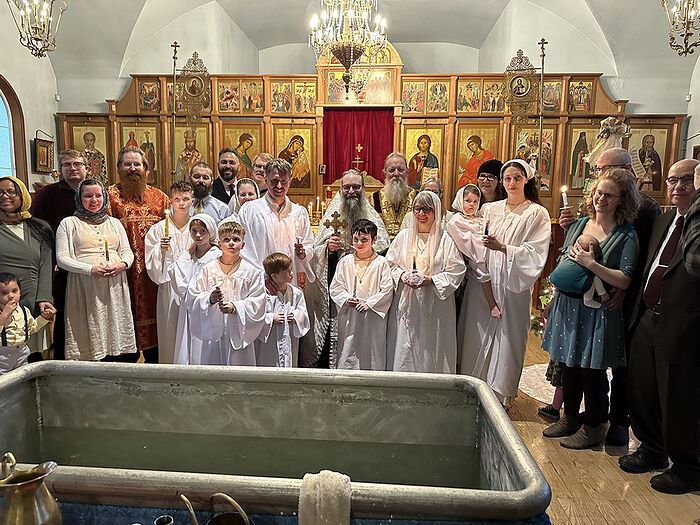
Newly illumined Orthodox Christians – Is this the future? Source
For Discussion
For readers who visit Handwritings, I would like to pose three questions:
Does your personal experience confirm or disconfirm Tom Wadsworth’s analysis of church decline?
Does your personal experience of Orthodox worship confirm or disconfirm Jared Smith’s positive assessment of Orthodoxy?
Do you think that Orthodoxy can help reverse church decline in America? How do you see that happening?
 Handwritings on the Wall
Years ago when I attended seminary, and studied western Church history, I noted that when the Church got fat and complacent attendance fell. Then after a while it began to grow again.
LikeLike