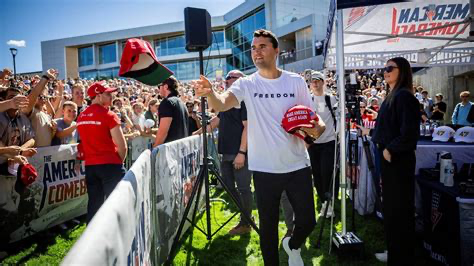
I write this from my cottage deep in the woods of the Japan Alps. A generation ago, before the advent of modern telecommunications deprived us of real and true isolation and the respite it brings, I would not have been as engaged with current affairs as I am now. I might watch the NHK (Nippon Hohsoh Kyoku) evening news and perhaps pick up a newspaper to stay in touch with the netherworld, but the reflection that came so effortlessly in those times suffers interference from the rat-a-tat-tat of posts on X and Substack and Facebook. Karl Barth, the renowned evangelical theologian, said “Take your Bible and take your newspaper and read both, but interpret your newspaper from your Bible.” I can’t ignore what is going on in the world.
A good Christian is a good citizen, and a Christian in a democratic republic under siege, the way our American republic is, had better pay attention. His prayers, his advocacy, and his vote may seem to be insignificant, but not participating is a posture even more insignificant.
Today back stateside it is the first anniversary of the assassination of Charlie Kirk. The juvenile delinquents on Tik Tok call it the “Kirkiversary” or “Kirkmas” as though it were a holiday to be celebrated. Charlie engaged in the sort of “conversation” that leftists purport to promote, but Charlie’s reward for going one-on-one with college kids and dialoguing with them got him a shot in the neck that stopped him dead in his tracks.
It’s already September the 11th here in Japan. Twenty-five years ago this morning, a colleague from church called me and told me to turn on my television. The scene on every channel was of the burning effects of the collision of the first jetliner that plowed into the World Trade Center in Manhattan. Then we watched live as the second plane smashed into the second tower.
That was a Tuesday. I remember going with ny wife to a certain Episcopal parish for the Eucharist on the following Sunday and hearing the former Catholic priest, now Episcopal priest, say something extraordinary in his homily. There is no personal evil, he said, or words to that effect. I am sure that he meant to say that there is no Devil, and I concluded that he probably meant that Mohammed Atta and his band of 19 terrorists were not influenced by demonic voices, that Satan was not responsible for ginning up the murderous hatred in their hearts toward our united States and her people.
Despite the demythologizing bent of Episcopal clergymen and -women, one can say with confidence that Islam is demonic. There is no need to separate run-of-the-mill Muslims from “Islamists” or “radical Muslims” when we speak of the theology of that belligerent ideology. Jesus had said that the Devil is come to steal, to kill, and to destroy. Islam is a cult, a death cult, whose ridiculous claims stem from the contradictory delusions of a seventh-century bedouin who raped, pillaged, and slaughtered his way through Arabia. Just like his father, the Devil. Their “Allah” is decidedly not the same spirit as the Allah whom Coptic Christians worship. Their Allah is Satan himself.
It was Satan who compelled Osama bin Laden and the 9/11 hijackers to commit mass murder and destruction twenty-five years ago today, just as it was Satan who inspired a young man named Robinson to take down Charlie Kirk with one shot twenty-four years later. Muslims who recall with fondness the atrocities of 9/11 and twisted kids who dance at the first anniversary of Charlie’s murder are enemies of our society by their own choice because they listened to that same dark voice from the enemy of mankind from the foundation of the world. They used their God-given human agency to go over to the dark side.
Neither Islam nor Leftism is a force for good in the world. May they both be utterly defeated and eliminated, and may God’s will be done on Earth as it is in heaven. Satan is up to no good, but Jesus Christ is come to grant life, and that more abundantly. All praise be to Him now and forever unto ages of ages.
It was a chilly day toward the end of May in Japan’s Alps. Three days it had taken my wife and me to get back here from stateside, but we were still a long taxi ride away from our cottage.
Waiting for the car in the warm hotel lobby, I spied a sparrow up on the power lines. It sat there all alone, a dark spot of feathers, balled up against the chill, motionless, staring off toward Mt. Yatsugatakè shrouded in clouds.
What a noble bird, taking no regard for its lack of a companion, shivering on the wire. The most insignificant of birds, sparrows are, but even a sparrow’s demise never goes unnoticed in heaven.
That unlikely sparrow braving the cold somehow helped me make a connection with heaven’s grace and rendered me misty-eyed. It must have been the sparrow’s courage to fly out on its own, brave the cold alone with nary a word of complaint that urged me to press on.
There it sat perched in full control of itself, staring off toward Yatsugatakè, waiting for sight of the majestic peaks to break through the rain clouds.
The appointment of Dame Sarah Mullaly to the historic See of Canterbury in October 2025 has sent shock waves throughout the Anglican Communion. The chair of the Global Anglican Future Conference (GAFCON), Archbishop Laurent Mbanda of Rwanda, in an official communique noted that the decision “abandons global Anglicans.” There is a possibility that when GAFCON meets in Nigeria in March 2026, it will formally break from the Anglican Communion.
Without doubt, the nomination of a female priest to the highest office of the Anglican Communion is highly controversial. However, her appointment is not all that surprising in light of her high standing as Bishop of London. (The Bishop of London is the third-ranking member in the Anglican Communion after the Archbishop of Canterbury then the Archbishop of York.) It can be expected that the decision will have consequences extending beyond the Anglican Communion to other Christian traditions. How this might affect Orthodoxy is the focus of this blog posting.
Guarding Against False Ecumenism
Historically, the Patriarch of Constantinople has been referred to as the “Ecumenical Patriarch.” The term “ecumenical” means “universal” or “worldwide.” This usage has roots in the Pentarchy, that is, the five patriarchal sees—Rome, Constantinople, Alexandria, Antioch, and Jerusalem—that oversaw the Christian Church in the ancient Roman Empire. After the Great Schism of 1054, the Patriarch of Constantinople came to be seen as the spiritual leader and unifying figure for all Eastern Orthodox Christians. Unlike the Pope of Rome, the Patriarch of Constantinople does not claim universal supremacy but is “first among equals.” Any attempt to impute supremacy to the Patriarchate of Constantinople like the Papacy deviates from historic Orthodoxy and implies a potentially dangerous innovation. Historically, Orthodoxy has recognized the Bishop of Rome as first among equals and considers papal supremacy to be an unacceptable innovation.
Likewise, any attempt to redefine the Ecumenical Patriarchate along the lines of the modern ecumenism has dangerous implications for Orthodoxy. In the twentieth century, a Protestant movement emerged known as the ecumenical movement. Its stated goal was not just the uniting of various Protestant denominations, but also Roman Catholicism and Eastern Orthodoxy. Roman Catholicism in 1964 embraced this new meaning of “ecumenical” in the decree “Unitatisredintegratio.” In that same year, Pope Paul VI and Patriarch Athenagoras met at the Mount of Olives in Jerusalem for prayer and exchanged the kiss of peace ostensibly in an attempt to end the Schism of 1054.
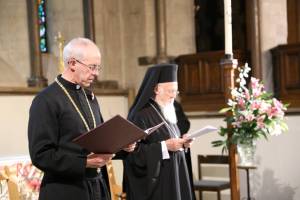
Welby and Bartholomew Praying – 2015
The current Patriarch of Constantinople, Bartholomew, has continued to follow the new meaning of “ecumenical” in his meetings with the Pope of Rome and also with the Archbishop of Canterbury. Bartholomew first met Justin Welby, Mullaly’s predecessor, in 2014. After his enthronement as the Archbishop of Canterbury, Welby visited Patriarch Bartholomew in Constantinople. Then in 2015, Welby reciprocated by hosting Bartholomew at Lambeth Palace. In 2015, Welby and Bartholomew held a joint prayer vigil for refugees. These meetings are far from casual, informal encounters. They are carefully choreographed events full of symbolic gestures much like international diplomatic events at the United Nations’ General Assembly. The glamor of these high-profile ecclesiastical affairs can tempt church leaders to make unwarranted concessions all in the name of Christian unity—hence, the need to guard against false ecumenism.
The Future of Anglican-Orthodox Relations
Saint Justin Popovich
Orthodoxy is far from united on ecumenism. Where some are eager to engage the non-Orthodox, others take a more wary posture. This reluctance stems from their desire to safeguard the Orthodox Faith from innovation and heresy. (For an Orthodox approach to ecumenism that avoids the errors of Western ecumenism see Phillip Calington’s discussion of Saint Justin Popovich’s approach to ecumenism.)
Unlike Western Christianity which has distilled their theology in carefully written documents and precisely worded confessions, Orthodoxy preserves its theology in its Liturgy, the episcopacy, the Ecumenical Councils, and the patristic consensus. One unwritten Tradition has been the all-male episcopacy. Unlike Western Christianity, the notion of women’s ordination has been a non-issue: We’re Orthodox; We don’t change. Where Western Christians often take reason and logic as the starting point for theologizing, in Orthodoxy we understand our faith and practice to be a sacred deposit received from the Apostles and preserved unchanged until the Second Coming. Thus, the Orthodox Church does not feel the need to adjust her faith and practice to contemporary culture. This also means that Orthodox Christians are not obliged to provide a theological rationale for a practice grounded in Apostolic Tradition; however, they are obliged to show that the practice or teaching can be traced back to the early Church. This gives Orthodoxy a stability that is sadly lacking in the West. When one examines the faith and practice of Anglicanism from the 1950s to 2025, one cannot help but be struck by the massive changes in Anglicanism. While it is debatable whether women’s ordination was the start of Anglicanism’s decline into liberalism, it is clear that women’s ordination is not unrelated to the overall liberalization of Anglicanism.
Thus, Sarah Mullaly’s elevation to the See of Canterbury will be highly consequential for Anglican-Orthodox relations. Any indication by Bartholomew of his acceptance of the validity of Mullay’s elevation would imply an acceptance of women’s ordination. Bartholomew’s acceptance of Mullaly’s elevation to the See of Canterbury could happen by his: (1) attending her enthronement service, (2) extending an official invitation to come to Constantinople like Welby’s visit in 2014, or (3) be an official guest to the Lambeth House like the hospitality Welby extended in 2015. Another possibility is an official announcement or personal communication that signals acceptance of Mullaly’s elevation. Of concern to the Orthodox faithful is whether Patriarch Bartholomew will go a step too far and embrace women’s ordination, whether implicitly or explicitly. Such an ecumenical gesture could inadvertently damage Constantinople’s claim to valid apostolic succession.
Orthodoxy’s opposition to women’s ordination is far from a clear-cut, black-and-white issue. Historically, there has been a female diaconate in Orthodoxy; however, the ordination of women did not extend to the presbyterate or episcopacy—both these offices are essential to the Eucharistic sacrifice. Orthodoxy’s opposition is grounded in Orthodox metaphysics, not in mere cultural conservatism. Alexander Schmemann points to the dogmatic underpinnings of the Orthodox opposition to women’s ordination.
I cannot discuss the problem itself because to do so would necessitate the elucidation of our approach — not to women and to priesthood only — but, above all to God in his Triune Life, to Creation, Fall and Redemption, to the Church and the mystery of her life, to the deification of man and the consummation of all things in Christ. (Schmemann in Harvey 2008)
In other words, women’s ordination would go far beyond a modification of ecclesial structures and lead to a wrecking of the dogmatic underpinnings of Orthodox ecclesiology.
Short of all this it would remain incomprehensible, I am sure, why the ordination of women to priesthood is tantamount for us to a radical and irreparable mutilation of the entire faith, the rejection of the whole Scripture, and, needless to say, the end of “dialogues.” (Schmemann in Harvey 2008)
Where in the West ordination is understood in functional terms and gender difference is viewed as mere surface externality (women are capable of ritual actions just as well as men), in Orthodoxy gender differences carry with it profound implications for anthropology, ecclesiology, soteriology, and cosmology. Differences in gender entail more than differences in external form of the human body. Being rooted in the imago dei, differences in gender point to the profound difference in the existential orientation of men and women towards the world, towards each other, and towards God. Where Western modernity has become untethered from order of creation described in Genesis, Orthodoxy with its adherence to the sacramental worldview and to the Incarnation of the Eternal Logos has continued to honor the male-female distinction established by the divine Creator.
In these unsettled times, what is needed are Orthodox Christians with a solid, unshakable faith who speak boldly with humility and charity, and who avoid unnecessary confrontations. Orthodox Christians need to have in mind the wise admonition in the Epistle of James:
So then, my beloved brethren, let every man be swift to hear, slow to speak, slow to wrath: for the wrath of man does not produce the righteousness of God. (James 1:19-20; OSB)
Orthodox Christians are called to avoid hastiness, whether in thought or in speech. Mullaly’s elevation to the highest office in the Anglican Communion involves several steps. She was nominated to the office of Archbishop of Canterbury in October 2025. A confirmation of election will be held in January 2026 (Maqbool). The date of her enthronement has yet to be announced. Those who worry about overzealous Orthodox ecumenical enthusiasm should approach the matter soberly and not rush to pass judgment. At the same time, they should be alert for any ecumenical engagements that put Holy Orthodoxy at risk. The Orthodox laity have the solemn obligation, as do the clergy and hierarchs, to safeguard against heresy and innovation.
Should Sarah Mullaly’s elevation to the See of Canterbury become official, many Orthodox Christians will consider this a step too far. In the past, many Orthodox Christians have viewed Canterbury’s claim to apostolic succession with considerable skepticism. The issue for them was not the validity of Anglican orders, but from their failure to keep the Faith. However, the elevation of a woman to this historic office leaves no room for doubt—Canterbury can no longer claim apostolic succession for it has parted ways with historic Christianity. Anglican-Orthodox dialogue has reached an impasse—a situation in which no progress is possible. Ecumenical engagement is premised upon the assumption that the participating parties can find common ground in faith and practice. (To use a medical analogy, there comes a time when any further attempt to resuscitate the patient is futile and the attending physician is obliged to pronounce the patient dead and note the time of death.)
Evangelicals Received Into Orthodoxy – Halifax, England 2025 (Source)
If the basis for commonality is shattered, then a different approach to Christian unity must be taken. Instead of mutual recognition, the alternative is reception. In the reception model of Christian unity, non-Orthodox faith communities seek to be received into Holy Orthodoxy after they have carefully studied and embraced Apostolic Tradition.
We see this taking place in the recent conversion of an entire Evangelical parish in England to Orthodoxy in 2025. (Source) There are reports of Anglican parishes converting to Orthodoxy, although specific details are hard to locate. There have been instances of Anglican parishes converting to Roman Catholicism. In 2011, some 600 laity and 20 clergy became Roman Catholic through the ordinariate established by Pope Benedict XVI. (BBC 2011)
Helping Hands
The Faith for all Ages
Anglicanism’s crisis extends far beyond women’s ordination. It includes the abandonment of historic Christian doctrines. David Gilchrist recounts how he converted from Evangelicalism to Anglicanism in the belief that that in the Church of England he had found the historic apostolic Faith. However, his confidence was shattered by the elevation to the episcopacy a priest who denied the historic, bodily resurrection of Christ. This crisis eventually led him to convert to Orthodoxy.
Orthodox readers should avoid triumphalist gloating and instead regard Anglicans troubled over Mullaly’s elevation with compassion. Anglicanism has a rich heritage and many devout Anglicans will be loath to relinquish this venerable patrimony. Nonetheless, some have taken this radical step. If they desire to convert to Orthodoxy, it will be a costly decision. However, if Orthodoxy and the Tradition it presents is the Pearl of Great Price (Matthew 13:45-46), then becoming Orthodox will be deeply rewarding. To become Orthodox does not entail the rejection of Anglicanism, but rather its fulfillment. It is important to remember that England was Orthodox before it was Roman Catholic or Anglican. Prior to the Great Schism of 1054, all Christians were part of the one holy catholic and apostolic Church confessed in the Nicene Creed.
Icon – First Ecumenical Council (325)
Becoming Orthodox does not mean becoming Greek. It means a return to the Ancient Faith that extends across the entire ecumene embracing both the West and the East. Irenaeus of Lyons, the second century Church Father, wrote:
As I have already observed, the Church, having received this preaching and this faith, although scattered throughout the whole world, yet, as if occupying but one house, carefully preserves it. She also believes these points [of doctrine] just as if she had but one soul, and one and the same heart, and she proclaims them, and teaches them, and hands them down, with perfect harmony, as if she possessed only one mouth. (Against Heresies 1.10.2; New Advent)
Troubled Anglicans need not despair. The universal Church described by Irenaeus of Lyons can still be found today. It has continued to present day in the Orthodox Church.
My advice to troubled Anglicans is that they attend a Sunday service at a local Orthodox parish and experience the ancient worship. My other piece of advice is that they compare present-day Orthodoxy with the ancient Church and see if the Ancient Faith has been preserved to the present day in Orthodoxy. Unlike so much of Western Christianity, they will find that Orthodoxy has been able to withstand the temptations and pressures to accommodate modern culture. In Holy Orthodoxy, they will find shelter from the raging storms of modernity. The Orthodox Church is the Ark of Salvation and her Captain, Jesus Christ, cries out:
Come to Me, all you who labor and are heavy laden, and I will give you rest. (Matthew 11:28; OSB)
Phillip Calington. 2016. “Speaking Painful Truth in Love: Orthodox Ecumenism and St. Justin Popovic.” Pravoslavie.ru 16 December 2016. https://www.pravoslavie.ru/99512.html
Orthodox Christianity. 2025. “Evangelical church in Halifax, England preparing to join Orthodox Church.” 17 February 2025. https://orthochristian.com/167338.html
I’m back in Japan for a few months. My wife and I are up in the Japan Alps, where fall has already arrived. The Christian population in Japan may squeeze in at under 1% of the general population, but there are small churches all over the country. Orthodox parishes are few and far between, however, and the closest one is half a day away from us. I have to admit that I have been attending the worship services of our Christian brethren (cousins?) while we’re away from home. My wife is Catholic, so she and I have gravitated to parishes in that community while we are here. Like Starbucks or McDonald’s, there is always a Catholic parish not too far away. There are three parishes in towns down the mountain and a monastery to boot. I just pray to myself while at mass, and I never receive communion.
This past Sunday, just days after the shocking murder of Charlie Kirk back home in the States, my wife and I went to an evangelical Protestant church. I expected to hear the local preacher mention the tragic event and render some words of wisdom. After all, Charlie was a prominent evangelical Christian and his assassination had gotten a mention on NHK, the national public television network. That’s a big deal.
The whole world is watching and responding to Charlie’s death. Japan has a non-religious society, but people in more Christian nations around the world are saying that they’ve been to church for the first time in their lives, or that they’ve returned to church for the first time in years in the last few days.
Regardless of that, there was not one word from the pulpit about the event at the service we attended . No one mentioned it at tea following the service, either. I got the sense that the pastor and the small congregation live in a pious bubble. I was disappointed.
Sunday rolled around a day later in the U.S., so I checked the livestream recording of the Divine Liturgy from my own Orthodox parish. Nope. Nothing about Charlie, his murder, or the tremendous effect that it has had inside and outside Christian churches. I was disappointed again, but hope that perhaps next week the clergy will say something about it. I have noticed that Orthodox churches tend to navel-gazing as well, so I won’t expect any mention, yet I’ll be happy to be surprised.
One exception has been Fr. Josiah Trenham, whose gracious tribute to Charlie is on YouTube, and which I have shared abroad via email. Fr. Josiah will be a guest with Tucker Carlson soon, so let’s stay tuned. Here’s the tribute:
Charlie Kirk was larger than life and his willingness to proclaim the good news to young people on college campuses and debate the moral issues of our time was effective. I suspect the Holy Spirit is moving mightily now and a great harvest of souls is beginning now that Charlie’s earthly life has been cut short.
Tell me: Did your preacher speak about Charlie last Sunday? If so, please say something in the comments below.
The Apostle Saint Paul tells us emphatically that without the resurrection our faith is worthless, arguing a priori that if the concept of the dead rising from the dead is mere wishful thinking, then the event could not have occurred:
I Cor. 15:13 But if there be no resurrection of the dead, then is Christ not risen:14 And if Christ be not risen, then is our preaching vain, and your faith is also vain.
Not to worry. Jesus Christ did indeed rise from the dead:
20 But now is Christ risen from the dead, and become the firstfruits of them that slept.21 For since by man came death, by man came also the resurrection of the dead.22 For as in Adam all die, even so in Christ shall all be made alive.
St. Paul lists the witnesses to Christ’s resurrection:
5 … he was seen of Cephas, then of the twelve:6 After that, he was seen of above five hundred brethren at once; of whom the greater part remain unto this present, but some are fallen asleep.7 After that, he was seen of James; then of all the apostles.8 And last of all he was seen of me also, as of one born out of due time.






 Should Sarah Mullaly’s elevation to the See of Canterbury become official, many Orthodox Christians will consider this a step too far. In the past, many Orthodox Christians have viewed Canterbury’s claim to apostolic succession with considerable skepticism. The issue for them was not the validity of Anglican orders, but from their failure to keep the Faith. However, the elevation of a woman to this historic office leaves no room for doubt—Canterbury can no longer claim apostolic succession for it has parted ways with historic Christianity. Anglican-Orthodox dialogue has reached an impasse—a situation in which no progress is possible. Ecumenical engagement is premised upon the assumption that the participating parties can find common ground in faith and practice. (To use a medical analogy, there comes a time when any further attempt to resuscitate the patient is futile and the attending physician is obliged to pronounce the patient dead and note the time of death.)