
Avoiding a Premature Union
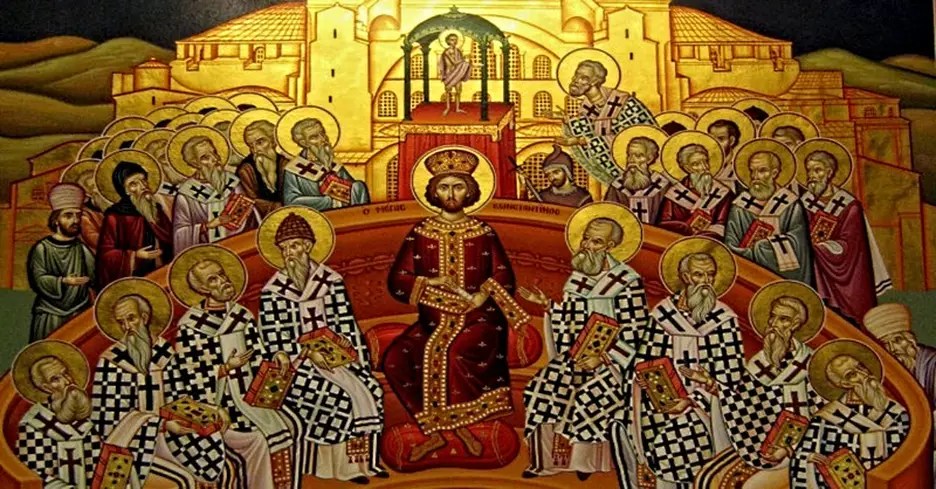
The new year 2025 promises to be an interesting one for Orthodoxy. It marks the 1,700th anniversary of the First Ecumenical Council (Nicea I). By coincidence, Western and Eastern Easter falls on the same Sunday in 2025, April 20. Pope Francis sees the coinciding of the two as an auspicious occasion for bringing Roman Catholicism and Orthodoxy together. In his address to the delegation of the group “Pasqua Together 2025,” the Pope urged that an agreement be reached on a common Easter for all Christians.
Orthodox Christians pray for the “unity of all” in every Sunday Liturgy, however, we are also mindful of the need to avoid rushing into premature unity. As Orthodox Christians, we seek always to be faithful to Holy Tradition. Among the sources of Holy Tradition are the Seven Ecumenical Councils. The first Ecumenical Council, Nicea I, in addition to promulgating the Nicene Creed, also issued a canon regarding the date when Pascha (Easter) was to be celebrated. For Orthodox Christians, the Seven Ecumenical Councils are not merely ancient fossils to be exhumed from the history books, but a living reality for us. Orthodoxy regards the Seven Ecumenical Councils to be inspired of Holy Spirit, infallible, and therefore divinely authoritative. The other Christian traditions, Roman Catholicism and Protestantism, may have their own ways of doing theology, but we Orthodox seek to be faithful to the Ancient Faith taught by the Apostles and passed on through the bishops, the successors to the Apostles.
While Orthodoxy has representation at the World Council of Churches, calendar reform is primarily an in-house matter. Some Orthodox hierarchs have suggested the need for calendar reform, however, such a move–especially that involving Pascha (Easter)–would require agreement among all Orthodox jurisdictions. This would entail the convening of a pan-Orthodox synod. Especially important would be the need for agreement among the various jurisdictions, especially the Patriarchate of Constantinople and the Patriarchate of Moscow. Given the current strained relations between the two jurisdictions, calendar reform seems a remote possibility.
When it comes to healing schism, it is helpful to look to a time when there was unity then to locate the time or occasion when the two traditions diverged. (See Severance and Graves.) Both Roman Catholicism and Orthodoxy are in agreement as regards the authority and inspiration of the First Ecumenical Council. The divergence in Easter dates occurred when Roman Catholicism in the sixteenth century abandoned the Julian calendar and adopted the Gregorian calendar. In 1582, Pope Gregory XII issued the papal bull Inter gravissimas, which ordered the change in church calendar. (There is an interesting note in the NPNF (Nicene and Post-Nicene Fathers) series on the Ecumenical Councils (vol. 14 p. 108) that in 1825 the entirety of Roman Catholicism fell under the anathema by celebrating Easter on the same date as the Jewish Passover!) Orthodoxy has continued to the present day to rely on the Julian calendar, which dates to 46 BCE.
Based upon the historical facts, it seems that the quickest way to put an end the problem of divergent Easter dates is for Pope Francis to repeal Inter gravissimas (1582) and issue a decree that all churches under his jurisdiction revert to the Julian calendar in the calculation of Easter per the canons of the Nicea I (325). By doing so, Pope Francis would be facilitating Roman Catholicism’s return to its roots in the Seven Ecumenical Councils and laying the groundwork for the reunification of Roman Catholicism with Eastern Orthodoxy.
There are other issues separating Roman Catholics from Eastern Orthodox, among them the filioque phrase. We urge Pope Francis, if he truly desires to accomplish church unity, to renounce and remove all innovations that separate Roman Catholicism from Eastern Orthodoxy.
References
Pope Francis. 2024. “ADDRESS OF THE HOLY FATHER TO THE DELEGATION OF THE GROUP “PASQUA TOGETHER 2025.” Holy See Press Office, 19 September 2024.
Dan Graves. n.d. “#109 – Council of Nicea.” Christian History Institute.
Archbishop Job of Telmessos. 2021. “We need to establish common date of Easter in order to remain faithful to decisions of Council Nicaea.” Orthodox Times 31 March 2021.
Diane Severance and Dan Graves. 2023. “The Council of Nicea: Ruling on Easter Day in 325 A.D.” Christianity.com
Jacob Stein. EWTN Vatican. 2024. “Pope Francis Calls for Unified Easter Celebrations.” September 27.
Devin Watkins. 2024. “Pope Francis: Easter belongs to Christ, not our calendars.” Vatican News, 19 September 2024.
World Council of Churches. 2007. “Frequently asked questions about the date of Easter.“
 Handwritings on the Wall
I have a question for Athenagoras, if he will allow me to play devil’s advocate for a minute. We can’t help but acknowledge that the rest of Christendom outside of the Orthodox Church celebrates Easter or Pascha according to celestial calculation based on the Gregorian calendar. If astronomers say that the Gregorian calendar is an improvement on the earlier Julian calendar, then wouldn’t the Orthodox Church benefit from switching to the Gregorian calendar, even if only for the sake of celestial accuracy, and without regard to the movement toward the reunification of the Roman Catholic with the Orthodox Church?
LikeLike
Thank you Lawrence for your question. Your reasoning regarding celestial accuracy appears to be sound. I suggest you bring this to the attention of your priest and your bishop, asking that they consider undertaking calendar reform. However, it might be a while for the various jurisdictions to agree on calendar reform.
The main point of my blog article is that if a common Easter date is such a big deal for Roman Catholics, then the most expeditious way forward is for the Pope to revoke the papal decree of 1582. From what I can see, it is the Roman Catholics who desire a common Easter date, not the Orthodox. I suspect that the majority of Orthodox Christians are content to let things remain as they are. I am not aware of any significant movement within Orthodoxy calling for calendar reform and the need for celestial accuracy. If that is the case, then the most practical step would be for calendar realignment to take place beginning with the Bishop of Rome.
LikeLike
Athenagoras said, “I suspect that the majority of Orthodox Christians are content to let things remain as they are.” I suppose that’s true as far as it relates to the date for Easter/Pascha. On the other hand, ever since I took an interest in the Orthodox Church years ago, I have been confused and frustrated that many parishes in the OCA and all of them in the Greek Orthodox Archdiocese celebrate the Nativity of our Lord according to the Gregorian calendar while many other parishes in the OCA and the dioceses and parishes of the Russian strain maintain the Julian calendar.
This stubborn discrepancy is a disservice to everyone, especially to new converts. It keeps us divided over a problem that should be easy to fix. While I was participating in the Christmas liturgy at my Russian parish today, I couldn’t help but think how queer it is that the Greeks downtown have already moved on from Christmas and Theophany and here we are 13 days behind them never to catch up. Perhaps the bishops of the various Orthodox jurisdictions need to get together and compare notes with a view to settling on one calendar. Don’t you agree?
LikeLike
Lawrence, I am not so much bothered by the different calendars between the Greek parish in downtown Honolulu and the Russian parish on the windward side of Oahu as I am bothered by the scandal of multiple bishops for one island. Proper Orthodox ecclesiology upholds the principle of one bishop for one city. The multiple jurisdiction problem in Hawaii is exacerabed by the fact that the OCA has two mission parishes on the Big Island, one for the Kailua-Kona side and one for the Hilo side. Why can’t there be one bishop for Hawaii?
But to answer your question about our hierarchs comparing notes on there being one calendar, I think it would be a good idea if there were to be one American calendar for the Orthodox parishes in the United States of America, all the while holding in honor the calendar practice of the historic motherlands. This would be a small step towards an autocephalous American Orthodox Church.
LikeLike