This Budde’s for You, Mr. President!

It was the morning of the day that Donald Trump would be inaugurated president for the second and last time. The customary prayer service for the president’s tenure in the highest office in the land was held in the majestic National Cathedral. I visited the grand church many years ago and was duly impressed by the shear scale of the structure on a rise in the otherwise flat District of Columbia. It didn’t take much to impress me because I’ve always been enamored of Gothic church architecture, but that edifice is truly massive. There was something queer about it, though. As I stood in the center aisle near the west door in the back of the church, it was clear that the chancel way up forward was not on center. It was skewed markedly to the left. How symbolic of the politics of the Episcopal Church! Was this flaw a demonstration of the Almighty’s subtle sense of humor?

Back to Inauguration Day, 2025. Donald Trump, the non-political real estate magnate and entrepreneur turned politician was soon to be sworn in. He had not yet taken his first action as president, but he sat there chomping at the bit like a race horse in the gate. Protocol demanded that he be docile just for a short duration while he was seated at the feet of Mariann Budde, the bishopess of the small but influential Episcopal Diocese of Washington. Budde is an unassuming woman, small of stature, quiet of voice, lacking the type of personal charisma that one would expect from a hierarch in her vaunted office in our capital city. She was dressed the part in her long rochette and chemire with her master’s academic hood draping down the back, and black tippet down the front. But underneath the finery Budde’s demeanor was thoroughly unimpressive. She would look less out of place officiating at a little noonday service in a side chapel than she did that morning in the nave of the cathedral. I had noticed the lack of appeal in the woman when she officiated at Jimmy Carter’s funeral only days before, so it was clear that she wasn’t just having a bad day the morning of Mr. Trump’s inauguration.
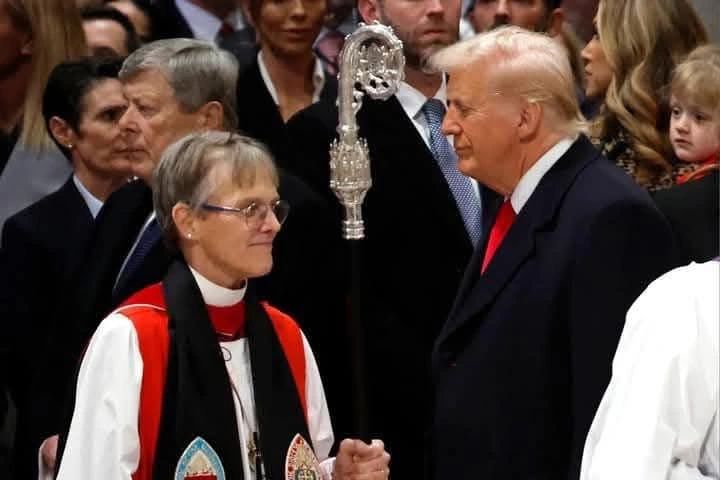
Like ships passing in the night?

The unassuming bishopess reminds me of Winston Churchill’s quip about the prime minister who followed him in office after World War II and whom he in turn succeeded. “An empty taxi pulled up to Whitehall and Mr. Attlee got out.” Dare I say that another nondescript prime minister, the grey but pernicious Keir Starmer has about the same personal appeal as old one-termer Clement Attlee, the father of the British welfare state. Marriann Budde with shortly-cropped hair and lack of makeup looks and acts like these British beta-men. Uninspiring is the word one might use just to be polite.

At the end of her unimpressive homily, Budde decided she had a singular chance to take a dig at the president soon-to-be. In a soft motherly tone, she pleaded with Pres. Trump to have mercy on the transgendered youth and the illegal migrants in the country. Apparently, some were afraid even for their lives. Perhaps those fears are justified, not because of what Pres. Trump might do, but rather because of the permanent damage that bodily mutilation might do. Pleas for so-called “gender-affirming care” are utterly disingenuous. I despise the usage of that misleading euphemism for the chemical interruption of puberty and the butchery of castrations and double mastectomies. Budde spoke in soft, irenic tones implying support for medical interventions that would have delighted the monster Dr. Mengelè of Nazi notoriety. Budde has children of her own; would she have allowed them in their pubescent confusion to complain that they had been born in the wrong body? The devil appears as an angel of light, and sometimes in episcopal finery.
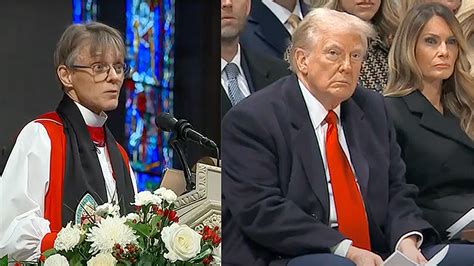
This Budde’s for you, Mr. President!

From her perch in the cathedral’s grand pulpit, Budde urged Mr. Trump to have mercy also on the illegal immigrants that Joe Biden deliberately encouraged to flood into our country. She wasn’t aware how naïve she sounded when she spoke in support of the invasion of millions of unvetted foreigners who have placed a tremendous burden on our welfare safety net. Surely she wasn’t so stupid as to deny the fact that many illegal foreign criminals have raped, maimed, and killed American citizens and stolen their property. Where, O where was the bishopess’ compassion for her fellow Americans and their need to be safe on America’s streets? Likewise for the sakes of many illegal aliens in our country who are trapped here as indentured servants by criminals as child laborers or prostitutes. Deportation may just be the way for some who are at the mercy of drug cartels and gangs of thugs to break free from their own personal bondage.

Imagine the ire that Mr. Trump must have suppressed while he was forced to listen to Democrat talking points coming from the pulpit where Gospel words of encouragement would have been welcome to the ears of the incoming president.

One might get the impression that EMM prefers sexually deviant migrants to run-of-the-mill migrants.

Let us also be cognizant of this fact: Budde’s moral posturing conveniently omits the fact that the Episcopal Migration Ministry (EMM), the federal contracting arm of her church, has been profiting immensely from taxpayer-funded government programs aimed at resettling migrants. In 2023 alone, EMM raked in $53 million to resettle 3,600 individuals, according to the New York Post. (Jim Hoff, Gateway Pundit, 2/5/25) That’s a generous $14,722 per migrant. Did all of that money go to the migrants? One might ask what the Episcopal Church is doing abetting illegal migration anyway.

“I want to build up the liberal church again so we can be a legitimate conversation partner in the public arena,” Bp. Budde told The Washington Post five years ago. (AP, JUNE 1, 2020) The Episcopal Church has always been pretty good at keeping records. Statistics show that the Diocese of Washington — that is the Episcopal Church in our nation’s capital and part of Maryland — suffered a drop in average Sunday attendance at services during the decade between 2014 and 2023. Washington is a small diocese in both land area and membership. Of the 30,000 members, only 13,330 showed up on any given Sunday in 2014, but as one might suspect, that number dropped over the years to 8,483 in 2023, even accounting for an uptick in interest after Covid. Although one must admit that all of the old mainline Protestant denominations have suffered similar losses in attendance over the years, the trend is not exactly a ringing endorsement for Bp. Budde’s episcopate, which commenced when these numbers began to be tabulated. She was consecrated bishop and installed as the diocesan ordinary on November 12, 2011.
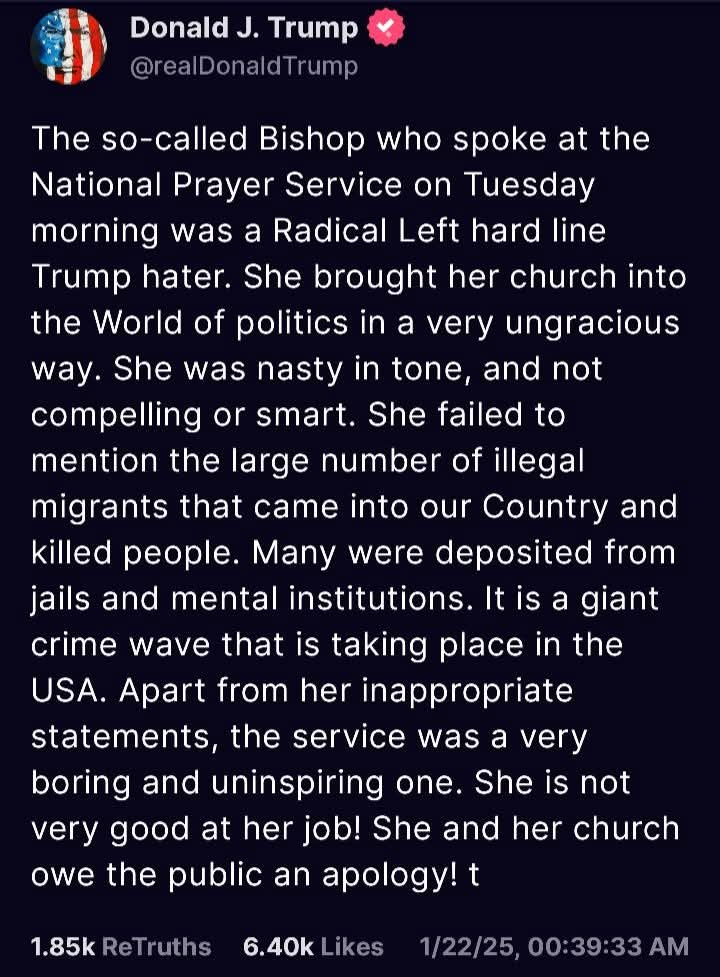
Mr. Trump’s assessment of Ms. Budde is more profound than he may have intended it to be, for truth be told, Budde is no bishop. She is no bishop because she is no priest. She is no priest because she is a woman. The Church — the one, holy catholic and Orthodox Church — has never ordained women to the priesthood, much less the episcopacy. The Episcopal Church adhered to this ancient tradition until 1976, the year that I graduated from college. That is the year when the national Church voted to normalize the so-called ordinations of the Philadelphia Eleven, women who had received the laying on of hands in 1974 by retired robber bishops who acted in ultra vires fashion, scandalizing the entire Episcopal Church. Now saddled with that fait accompli, the liberals in Massachusetts elected Barbara Harris, a radical black priestess and consecrated her suffragan bishop for that diocese in 1988. Barbara Harris, the first woman to be consecrated bishop in the Anglican Communion, was conveniently black, so any critical reaction to her ordination was considered racist, not merely sexist. Women had now swung their hips and barged into all of the major orders of the Church.

Barbara Harris, the first woman to be consecrated bishop in the Anglican Communion, was conveniently black.

With Barbara Harris’ illicit elevation to the episcopacy, any doubt that the Episcopal Church was a swinging branch of the greater Church Catholic was removed once and for all. The Episcopal Church, the American branch of the worldwide Anglican Communion, still prides itself on its claim as the third branch of the Church Catholic along with the Orthodox and the Roman Catholics. They are decidedly not so. They never were, except in their own mistaken theology: the Branch Theory.

To confirm their contention to be “The Church of What’s Happening Now”, the national Church approved the 2003 election of Vicky Gene Robinson to become bishop coadjutor with right of succession to the seat of the Diocese of New Hampshire. Robinson was a gay man, despite the feminine name, who was once married to a woman with whom he sired two daughters, but then divorced the mother. He came out of the closet and acquired a male partner whom he later “married”… and subsequently divorced. Robinson is not exactly a bishop above reproach.
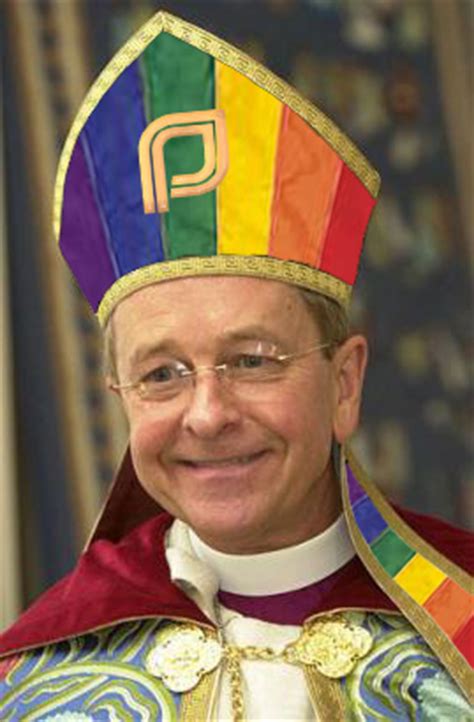
Bp. Vicky Gene Robinson. His parents wanted a girl, it’s said.
Notice that the capital P on Robinson’s rainbow mitre is in the same font as the P’s in Planned Parenthood. Abortion is another issue enthusiastically advocated by the Episcopal Church.

What do I mean by the Branch Theory? The Anglican Communion as a whole claims that their bishops have always been ordained by senior bishops in an unbroken line of apostolic succession. They can even unroll ecclesiastical genealogies to prove their places on the family tree. The problem is that mere succession to the apostles is not enough to maintain one’s rightful place of honor within the universal Church. Adherence to the Apostolic Tradition is just as necessary as membership in the Apostolic Succession. The influence of the Calvinist and Lutheran movements of the sixteenth century led the mother Church in England to jettison aspects of Tradition which the Catholic Church had maintained even after the eleventh century rupture with the Orthodox East. For example, five of the seven sacraments were downgraded to sacramentals. The mystical epiclesis of the Eucharist was removed. And King Henry VIII plundered the monasteries to fill the royal coffers after he declared himself Supreme Head of the Church of England in 1531, depriving the pope of Rome of his place atop the hierarchy. We Orthodox don’t even accept the Roman Church’s contention that they are the One True Church of Jesus Christ; the notion that the Anglican Communion ever was a branch of the same tree has been utterly rejected by our hierarchs several times in history. The shenanigans performed by the Anglican Churches makes any claim to catholicity utterly laughable now that the Episcopal Church in particular has made a mockery of their Holy Orders.

I must admit with a tinge of sadness that I was born and raised in the Episcopal Church and later was trained and ordained a priest in its sister jurisdiction, the Nippon Seikokai. When the Seikokai decided in convention in 1990 to study the prospect of ordaining women to the priesthood, I knew the handwriting was on the wall. The first woman to be made deacon was Margaret Shibukawa, a senior colleague of mine in the Chubu Diocese centered in Nagoya. She ultimately was the first woman to be priested in Japan. At a clericus in the mountains of Nagano, Shibukawa complained in front of all the clergy of the diocese that I was targeting her for criticism. I stated plainly that my reasons for opposing her potential ordination were not personal, but rather theological. Women had never been ordained to the priesthood because they were not qualified to officiate at the unbloody sacrifice which is the Eucharist. Not only that, but the Scriptures, specifically St. Paul, did not permit women to teach men (I Timothy 2:12). He even prevented women from speaking in the Church! (I Corinthians 14:34) As valid as my argument was, it was ignored by Ms. Shibukawa and our bishop Samuel Hoyo. For that reason and others, I left the Nippon Seikokai and returned stateside with my family in 1994; Ms. Shibukawa was ordained the first woman priest in 1998.

from the website of the Nippon Seikokai provincial office in Tokyo.

Here is what I would say to the bishop of Washington given the chance: Ms. Budde, if I may say so, your vindictive little stunt before the president was uncalled for. You may have scored points among your fellow liberal Episcopalians and Democrats, but a large portion of the country found it to be in poor taste. I agree with the president; you owe him and the country an apology.


AVOIDING COSMETIC UNITY

Not Rushing to Premature Ecumenism

Patriarch Bartholomew 2024 (Source)

It is a widely known fact that Roman Catholicism and Orthodoxy celebrate Easter on different days. Some years they celebrate Easter one week apart. Some years, for example in 2024, their Easter celebration is more than a month apart. In 2024, Roman Catholics celebrated Easter on March 31, while the Orthodox will be celebrating Easter (aka Pascha) at Midnight May 4.

The disparity between Western Easter and Orthodox Easter has led some to deplore the differences and call for both traditions to agree on a common date. Recently, on 31 March 2024, Patriarch Bartholomew in his homily expressed his desire that beginning in 2025 both Roman Catholics and Orthodox would celebrate Easter on the same day.

But also from this position we extend a heartfelt greeting of love to all Christians around the world who celebrate Holy Easter today. We beseech the Lord of Glory that the forthcoming Easter celebration next year will not merely be a fortuitous occurrence, but rather the beginning of a unified date for its observance by both Eastern and Western Christianity.

This aspiration is particularly significant in light of the upcoming 1700th anniversary in 2025, marking the convening of the First Ecumenical Synod in Nicaea. Among its pivotal discussions was the matter of establishing a common timeframe for the Easter festivities. We are optimistic, as there is goodwill and willingness on both sides. Because, indeed, it is a scandal to celebrate separately the unique event of the one Resurrection of the One Lord! [Source, Emphasis added.]

Apparently, Patriarch Bartholomew is hoping that by 2025 both Roman Catholicism and Orthodoxy will have agreed on a common date for Easter and that after 2025 there will no longer be different dates for celebrating it. In addition, he reminds his listeners that 2025 will mark the 1700th anniversary of the First Ecumenical Council (325). Nicea I was a landmark event in which bishops came from all over the Roman Empire to proclaim their common faith in Jesus Christ, the incarnate Son of God who came to save humankind.

Rejecting Cosmetic Unity

All Orthodox Christians ought to seek the ending of the schism between Roman Catholicism and Orthodoxy. However, we are to guard against changing Holy Tradition for the sake of cosmetic unity.  To agree on a common date for Easter while overlooking significant issues arising from the Great Schism of 1054 would be rushing to premature ecumenism. It would be like a contractor painting over the cracks in the wall of a house after a devastating earthquake. To paint over the cracks and certify a severely damaged building as inhabitable is not only highly irresponsible, it is fraudulent behavior that verges on criminality.

The Great Schism of 1054 and its Aftermath

For the first millennium, Christian unity was manifested in such markers as the Eucharist, the canonical Scriptures, the Church Fathers, the Ecumenical Councils, the Nicene Creed, the episcopacy, and the Pentarchy. The Pentarchy was comprised of the five patriarchates of Rome, Constantinople, Alexandria, Antioch, and Jerusalem. Unlike Protestantism which believes that the unity of the Universal Church is an invisible, spiritual unity, Christians in the first millennium believed in a visible, tangible Universal Church.

Christian unity suffered a major setback when Pope Benedict VIII unilaterally inserted the Filioque phrase “and the Son” into the Niceno-Constantinopolitan Creed (381) in 1014. By 1054, the papal legate, Cardinal Humbert, excommunicated the patriarch of Constantinople, Michael Cerularius. This resulted in the mutual excommunications by both sides. While some have exaggerated the fracas of 1054, it serves as a reference point for when Rome and the Eastern churches went their separate ways. It is worth noting that it was not just Constantinople that rejected the Filioque, the other patriarchates: Alexandria, Antioch, and Jerusalem likewise objected to the Filioque.

The insertion of the Filioque was a highly significant move by the pope. First, it implied that the pope had an authority equivalent to the Ecumenical Councils (Nicea I {325} and Constantinople 1 {381}) to define the universal creed. This is contrary to Orthodox ecclesiology, which holds that the highest ecclesial authority resides in the ecumenical councils. When a council is convened, the bishops, as successors to the Apostles, gather together as representatives of the Church Catholic. Second, the insertion of the Filioque implied the pope’s universal supremacy over all Christians in matters of faith and practice. Papal supremacy is implicit in the Filioque. It would take several centuries until papal infallibility was explicitly promulgated by the First Vatican Council (1869-1870). Third, the Filioque has significant implications for the doctrine of the Trinity that many Orthodox would consider dubious or even heretical. For the Orthodox, it is significant that the Filioque does not have the general support of the Church Fathers.

Steps Towards Authentic Unity

Patriarch Bartholomew rightfully deplores the calendar differences between Roman Catholicism and Orthodoxy. However, it is significant that he has not said much about the need to resolve the issues stemming from the Schism of 1054. Until these issues are resolved, talk of a common Easter date is premature. Agreeing upon a common date for Easter without attending to the deeper matters of faith and practice would be more of a public relations (PR) stunt than a genuine healing of schism.

Below are some suggestions for steps that can be taken to reach genuine reunification between Roman Catholicism and Orthodoxy. Basically, it calls for both sides to return to their shared roots in Apostolic Tradition, e.g., the Seven Ecumenical Councils, the Church Fathers, and the historic liturgies.

1. Drop the Filioque

The first step towards reunification would be for Roman Catholicism to return to the original Niceno-Constantinopolitan Creed (381) as the normative creed for its Sunday Mass in all parishes worldwide. The suspension of the Filioque in the Sunday Mass worldwide would show that Pope Francis is serious about reunification with Orthodoxy. It has been the practice that when Roman Catholics and Orthodox come together to recite the Nicene Creed with the Filioque omitted for that occasion. Notwithstanding, such actions are more PR gestures than serious attempts to heal the schism between the two traditions. Genuine reunification entails the eschewing of innovation and the restoration of historic liturgical practices.

The second step would be for Pope Francis to announce that the unilateral insertion of the Filioque was a mistake and that saying the Filioque is to be suspended until a universal church council (including the historic Pentarchy and other autocephalous jurisdictions) rule on the Filioque. It is imperative that the Church Catholic come to an agreement on the Filioque, whether to adopt it or exclude it.

Many staunch Roman Catholics, in their interaction with Orthodox Christians, have said much in defense of the double-procession of the Holy Spirit, all the while misunderstanding the differences between the two traditions. Where many Roman Catholics approach the Filioque in terms of systematic theology, for the Orthodox, the Filioque controversy is fundamentally about liturgical theology: that is, our worship of the Triune God in the Liturgy. The insertion of the Filioque has serious implications for the way in which we understand the Trinity. So, while Roman Catholics and Orthodox Christians are reciting nearly identical versions of the Nicene Creed, they are articulating rather different understandings of the Trinity. This difference in wording is a far more serious matter than the discrepant Easter dates that troubles Patriarch Bartholomew.

2. Repudiate Papal Supremacy

For Roman Catholics to reunite with the Orthodox, the Bishop of Rome and the Vatican would need to formally repudiate papal supremacy and formally endorse the conciliar understanding of the Church Catholic. Historically, Orthodoxy has accepted papal primacy but rejected papal supremacy. To put it another way, Orthodoxy accepts the bishop of Rome as first among other bishops, but not as superior in rank or authority to the other bishops. Once the bishop of Rome has formally repudiated papal supremacy, the details of church administration and canon law can be worked out by both sides.

3. Formally Assess the Novus Ordo Mass

Almost a thousand years have passed since the Great Schism, since then Roman Catholicism has undergone many changes in its theology and worship. When an Eastern Orthodox Christian visits a Coptic Orthodox Liturgy, he will see and hear much that is familiar to his home parish. However, when he visits a Catholic Mass, especially a Novus Ordo Mass, he will be surprised and even shocked by how different the Novus Ordo Mass is from the Orthodox liturgy.

The Novus Ordo Mass (aka the Vatican II Mass, aka the Mass of Paul VI), which originated in the 1960s and the 1970s, is a striking departure from the historic liturgies. Many Catholics have complained about the lack of reverence and shocking innovations in the Novus Ordo Mass. Of concern to the Orthodox is the recent suppression of the traditional Latin Mass by Pope Francis. To Orthodox Christians, it appears that Roman Catholicism has abandoned its historic liturgical heritage for one based on modern innovation. Examples of liturgical innovation include: the inclusion of secular songs such as “You Got a Friend” or “Stairway to Heaven,” the introduction of lay Eucharistic ministers to distribute the consecrated Host, and the priest ceasing to pray ad orientem (facing East).

The ultimate goal of Catholic-Orthodox reunification is the Eucharist, but is that possible if the Novus Ordo Mass is incompatible with the ancient liturgies of Saint John Chrysostom and Saint Basil the Great? It is suggested that if the bishop of Rome were to implement the first two steps recommended above (i.e., suspend the use of the Filioque in Sunday worship and formally renounce papal supremacy), that the Orthodox hierarchs convene a pan-Orthodox synod that will examine the validity of the Novus Ordo Mass. The Novus Ordo Mass is not necessarily heretical, but it is a striking innovation that appears to diverge from historic Christian worship. This is an issue that cannot be ignored. A simpler approach would be for the Roman Catholic church to lay aside the Novus Ordo Mass and return to the historic Latin Mass, duly translated into the vernacular, as the normative form of Sunday worship worldwide.

These three suggestions are just initial steps that would demonstrate that Pope Francis and his fellow bishops do sincerely desire reunification with Orthodoxy. Until Pope Francis and the Vatican suspend the use of the Filioque from the Sunday Mass worldwide, all talk about reunification between the two traditions is premature. One has to wonder why Patriarch Bartholomew has not given greater attention to the Filioque in his pursuit of closer ties with Rome. It is incumbent upon the Orthodox laity to humbly request that our priests and bishops not succumb to premature ecumenism and that the local Orthodox clergy relay their concerns to their respective primates. A fundamental component of Orthodox ecclesiology is that the whole people of God, from the bishop down to the priest and deacons, and to the laity, are responsible for safeguarding Holy Tradition. It is the job of ordained clergy, bishops and priests, to safeguard Holy Tradition. The laity should speak out only if it appears that attempts are being made to tamper with Holy Tradition.

Avoiding False Unity

Patriarch Bartholomew has been a very vocal advocate for reunification with Rome. In late 2019, he informed the monks of Mount Athos that there are no dogmatic differences between Orthodoxy and Roman Catholicism, and that reunion is inevitable (See the website OrthodoxChristianity). However, his optimism may be premature. There is very little evidence that Pope Francis is seeking to undo the tragic legacy of the 1054 Schism. It is concerning that Patriarch Bartholomew has not taken a stronger stand on the Filioque and papal supremacy. Until then, the best stance for the Orthodox to take with respect to reunion with Roman Catholicism is to reiterate: We are Orthodox, and we hold to Holy Tradition without change.

The temptation for many enthusiastic ecumenists is to sweep under the rug the hugely significant issues that stand between Roman Catholics and Orthodox. However, doing that would entail the abandonment of Holy Tradition. If Roman Catholicism wishes to return to its patristic roots, we Orthodox should by all means help them return to Pre-Schism Christianity; but we cannot and must not pawn off the family heirloom for counterfeit unity.

It may be that this author protests too much. However, Patriarch Bartholomew’s recent  words are cause for concern. As we look to 2025, we should be alert for PR campaigns pressuring the Orthodox faithful into false unity with Roman Catholics. It is important that the Orthodox laity become familiar with the core beliefs and practices of Orthodoxy. A solid understanding of Holy Tradition is key to obeying the Apostle Paul’s admonition in 2 Thessalonians:

Therefore, brethren, stand fast and hold the traditions which you were taught, whether by word or epistle. (2 Thes. 2:15; emphasis added)

To be able to stand fast means to not easily be pushed around and to hold fast to something means that it cannot be easily yanked out of one’s grip. In this context, we need Orthodox Christians who are familiar with the Holy Tradition. If we are unfamiliar with the teachings and practices of Orthodoxy, we will be susceptible to being bamboozled by the polished rhetoric of ecumenical enthusiasts, whether Orthodox or Roman Catholic. We need a united front against the false ecumenists.

In opposing false ecumenism, we also need to guard against the spirit of spiritual pride and judgmentalism. We should seek to develop the Orthodox phronema (way of thinking) of humility and charity. And, we should seek the prayers of the great saints such as Irenaeus of Lyons, Vincent of Lérins, Mark of Ephesus, and Justin Popovich. Let us emulate the spirit of humble service exemplified by these saints.

I would like to close by quoting another Orthodox patriarch, Philaret of Moscow. In 1965, when the patriarch of Constantinople, Athenagoras, met with Pope Paul VI to lift the mutual excommunications of 1054, Philaret wrote to express his concerns.

No union of the Roman Church with us is possible until it renounces its new doctrines, and no communion in prayer can be restored with it without a decision of all churches, which, however, can hardly be possible before the liberation of the Church of Russia which at present has to live in catacombs. [Source.]

With the ending of the Cold War, the Russian Church has emerged from its catacombs. This has allowed the patriarchate of Moscow to play a more prominent role in the Orthodox world. Orthodoxy’s conciliar nature means that we are not totally dependent on Constantinople. If we suspect that one patriarchate is in danger of straying from Holy Tradition, we can turn to other patriarchates for guidance. While Catholic-Orthodox reunification is highly desirable, it is imperative that Constantinople not seek reunification with Rome without the consent and approval of Moscow and the other patriarchs and primates. True Church unity requires fidelity to Holy Tradition. The Apostle Paul wrote to Bishop Timothy:

Hold fast the pattern of sound words which you have heard from me, in faith and love which are in Christ Jesus. That good thing which was committed to you, keep by the Holy Spirit who dwells in us. (2 Tim. 1:13-14)

Let us heed the words of the Apostle Paul and emulate the example of Bishop Timothy.

Athenagoras

References

Britannica. “East-West Schism.

Father Lawrence Farley. “The Filioque Clause.” OCA.org 11 July 2012.

Konstantinos Menyktas, transl. “Ecumenical Patriarch: It’s a scandal to celebrate separately the one Resurrection of the One Lord.Orthodox Times, 1 April 2024.

Orthodox Christianity. “Patriarch Bartholomew Tells Athonites Reunion With Catholics Is Inevitable, Reports UOJ.” OrthodoxChristianity.com, 27 November 2019.

OrthodoxWiki. “Holy Tradition.”

Patriarch Philaret. “A Protest to Patriarch Athenagoras—On the Lifting of the Anathemas of 1054.” Orthodox Christian Information Center, December 2/15 1965.

Sylvia Poggioli. “The 1,000-Year-Old Schism That Pope Francis Seeks To Heal.” 21 May 2014. NPR. 

Wikipedia. “Filioque.”

Wikipedia. “First Vatican Council.”

Wikipedia. “History of the filioque controversy.”

Theomimesis. YouTube video: “Catholic and Orthodox Liturgy Compared.” [5:18]

Papal Supremacy and the Suppression of the Latin Mass

Latin Mass Source

On 16 July 2021, Pope Francis issued the motu proprio (apostolic letter) Traditionis Custodes, which imposed severe restrictions on the celebration of the Latin Mass. This policy has upset many conservative or traditional Roman Catholics. They are aggrieved because they very much prefer the Latin Mass to the Novus Ordo Mass aka the Vatican II Mass. Many took to social media protesting the Pope’s decision. But traditional Catholics may be unaware that the recent revival of the Latin Mass was in large part due to another motu proprio Summorum Pontificum issued by Pope Benedict XVI in 2007. In other words, what the pope gives, the pope can take back.

This points to a more fundamental theological problem underlying the brouhaha over the Latin Mass—the Pope’s power to regulate the liturgical life of the Church Catholic. The central issue here is papal supremacy. Papal supremacy means the pope has ultimate authority, not just over all Christians—even non-Catholics—worldwide, but also over the manner in which they are to worship.

This throws light onto one of the fundamental differences between Roman Catholicism and Eastern Orthodoxy. Orthodoxy rejects papal supremacy. In Orthodoxy, the authority of bishops and patriarchs, even the Bishop of Rome, is contingent upon fidelity to Apostolic Tradition. The bishop receives Holy Tradition from his predecessor and is expected to transmit Holy Tradition unchanged to his successor. In the Orthodox paradigm, the bishop is under Apostolic Tradition. In Roman Catholicism, however, the pope is over Apostolic Tradition. Thus, it is asserted that the Pope can unilaterally alter the form of worship for millions of Catholics worldwide.

The scope of the pope’s authority over Roman Catholicism is breathtaking. Following Vatican II, Pope Paul VI unilaterally replaced the Latin Mass with the Novus Ordo Mass aka the Vatican II Mass. Despite scattered protests and acts of resistance, the Novus Ordo Mass has become the de facto form for Sunday worship for millions of Catholics worldwide. Traditional Catholics are scandalized by the new expressions of worship—for example, the so-called “chicken-dance Mass”—taking place under the auspices of the Novus Ordo Mass and they yearn for the solemn reverence of the pre-Vatican II Mass. In contrast to these changes, Orthodoxy worldwide for over a millennium—actually for 1500 years—continues to use the Liturgy of Saint John Chrysostom, which dates to the 400s. This has given rise to the criticism from Roman Catholics that Orthodoxy is stagnant and ossified. To which the Orthodox reply is: Thank you for the unintended compliment!

Is Roman Catholicism Still Catholic?

Traditionis Custodes has troubling implications for Orthodox-Catholic reunion. By suppressing the Latin Mass, Pope Francis has further weakened Roman Catholicism’s historic ties with the Latin Christianity of the first millennium. Through the Latin Mass, Roman Catholicism was able to claim a liturgical link to historic Catholicism of the Middle Ages, as well as Latin Christianity of the first millennium. The Latin Mass linked Roman Catholics to renowned theologians such as Thomas Aquinas and Augustine of Hippo. However, with Traditionis Custodes their link with the past has been all but severed. Reunion has become all but impossible given Orthodoxy’s adherence to Apostolic Tradition and Rome’s continued drift from its historic roots.

According to the ancient theological principle lex orandi, lex credendi (the rule of prayer is the rule of faith) the way one worships God is interrelated with the way one understands God. With the adoption of the Novus Ordo Mass, Roman Catholicism has moved further away the historic Christian Faith towards a new kind of theology. This theological drift has taken on alarming proportion by the recent controversial declaration issued by the Vatican’s Dicastery for the Doctrine of the Faith in 2023: Fiducia Supplicans, which allows Roman Catholic clergy to give a blessing to couples not considered married according to church teaching, including same-sex couples. With the apparent jettisoning of traditional liturgical forms of worship in Traditionis Custodes and the implied revision of sexual ethics in Fiducia Supplicans, one has to wonder whether the Roman Catholic church still Catholic?

For traditional Roman Catholics the recent controversies raise troubling questions about the validity of the papacy. Can papal infallibility be regarded as valid in light of the recent controversial decisions that have diverged from historic Roman Catholicism? For many devout Catholics, to question the validity of the papacy would constitute another trauma added onto the other crises of faith taking place, but these questions must be faced head on. Roman Catholics who find themselves in this horrific situation need our sympathy and prayers, not triumphalist pressure to convert to Orthodoxy.

The Filioque Again

A lot of ink has been spilled on the Internet (metaphorically speaking) in defense of the Filioque phrase. “Filioque” is the Latin rendering of “and the Son.” (See Wikipedia article: “Filioque.”) Eastern Orthodoxy rejects the insertion of the phrase “and the Son” into the section of the Nicene Creed pertaining to the Holy Spirit. In my opinion as an Orthodox Christian, Roman Catholics and their Protestant counterparts who defend the Filioque by arguing that the inserted phrase makes theological sense have missed the point. The key issue underlying the controversy over the Filioque is: Does the Pope have the authority to unilaterally alter the Niceno-Constantinopolitan Creed of 381? The Orthodox position is that only the Church Catholic through an Ecumenical Council has the authority to revise the Nicene Creed. This is what happened in 381, at the Second Ecumenical Council.

The issue here is papal supremacy. Is the pope superior to Apostolic Tradition? Because Orthodoxy holds that the pope was wrong to unilaterally insert the Filioque into the Nicene Creed, the Orthodox position is that Rome must drop the Filioque and restore the original Niceno-Constantinopolitan Creed of 381 to all its Sunday worship. Until this is done, there can be no reunion between Roman Catholicism and Eastern Orthodoxy. (It should be noted that for all the attention given to the scandal of the 1054 incident, the papal alteration of the Creed took place in 1014.)

Safe Harbor from the Storm

A Word for Distressed Roman Catholics

The recent actions by Pope Francis have caused great distress for many former Protestants who sought refuge from the confusion and tumult in Evangelicalism and mainline Protestantism. My advice to distressed Roman Catholics, both cradle and convert, is for them to take a vacation by attending a nearby Orthodox Liturgy for the next several months. Lie low, spend time in prayer and quiet reflection. Enjoy the reverent atmosphere and the ancient hymns and prayers of the early Church. And enjoy the coffee hour after the Liturgy. Tell the Orthodox Christians that you need time for healing and that you are not ready to convert. Thoughtful mature Orthodox Christians will honor your desire to be left alone.

Grieving for a Lost Past

For better or for worse, Latin Christianity and its signature rite, the Latin Mass, is gone for good. Conservative and traditionalist Roman Catholics will need time to mourn their loss. Many will need time to process their feelings of anger, loss, sadness, and emptiness, while also giving thought about their future. It is important that they understand that Eastern Orthodoxy cannot be a replacement for the Latin Mass they have lost.

It is important for Orthodox Christians to realize that they too have suffered a great loss with the recent suppression of the Latin Mass. The Latin Mass and the Latin Fathers, e.g., Ambrose of Milan, Augustine of Hippo, Leo the Great, and Gregory the Great, are part of the Orthodox heritage. As Roman Catholicism drifts further and further from its historic roots, it now falls on the Orthodox to rescue and preserve these spiritual and theological treasures for future generations.

Western Rite Orthodox Mass at St. Patrick Orthodox Church, Bealeton, Virginia – Antiochian Orthodox Christian Archdiocese

Convert to Orthodoxy?

The Latin West and Orthodoxy, having been separated for a millennium, have diverged with respect to theological frameworks, devotional practices, and local customs. For distressed Roman Catholics who have lost their home, Orthodoxy can be their new home but moving into the new home will require adjustment. They cannot expect to carry their traditional Roman Catholicism into the Orthodox Church. One possibility for some is Western Rite Orthodoxy. The Western Rite is patterned after the Latin Mass but it is done in the local vernacular. So far as this author knows, there is no Latin Rite in Eastern Orthodoxy.

If traditionalist Roman Catholics desire to convert to Orthodoxy, we welcome you but you must want to become Orthodox. There is much in the Roman Catholic tradition that can be brought over into Orthodoxy, but there are elements of Roman Catholicism that are incompatible with Orthodoxy and so must be left at the door. To attempt to hold onto these problematic beliefs and practices as one seeks to become Orthodox is like a smuggler seeking to covertly transport contraband over the border. If you desire to become Orthodox, we will help you. However, if you wish to reshape Orthodoxy into something reminiscent of the Latin Rite you are longing for, we ask you to go elsewhere. We’re Orthodox, and we are not going to change.

Priest distributing the antidoron.

You are welcome to attend the Sunday Liturgy as an ecclesial refugee who needs a comforting corner for respite. We ask that you refrain from going up for Holy Communion as the Orthodox leadership have not yet changed the Church’s position on Roman Catholics receiving Holy Communion. Please don’t take this as a sign of rejection or judgment. To receive Holy Communion means that one shares the same Faith as the Orthodox Church and are under the pastoral care of an Orthodox bishop. However, after the Liturgy has been concluded you are welcome to come up and receive the antidoron (blessed bread) from the priest. The antidoron is given to the Orthodox and non-Orthodox as a sign of hospitality.

May God have mercy on us all in these troubled times.

Athenagoras

REFERENCES

Documents

Fiducia Supplicans. Vatican.va

Traditionis Custodes. Vatican.va

Summorum Pontificum. Vatican.va

Articles

Susan Benofy. “The Day the Mass Changed, How it Happened and Why — Part I.” In CatholicCulture.org

Fr. Stephen Freeman. “Belief and Practice.” Glory To God For All Things.com

Filioque” in Wikipedia.

Nicene Creed” in Britannica.com

YouTube Videos

YouTube video: “Shocking: Scandalous Chicken Dance Mass in Germany – Dr. Taylor Marshall” [48:23] 

YouTube video: “Western Rite Orthodox Mass” [1:05:21]

YouTube video: “Western Rite Orthodoxy Explained” [21:02]

Orthodoxy – Right worship for the ages of ages. Come and join us!