I’m back in Japan for a few months. My wife and I are up in the Japan Alps, where fall has already arrived. The Christian population in Japan may squeeze in at under 1% of the general population, but there are small churches all over the country. Orthodox parishes are few and far between, however, and the closest one is half a day away from us. I have to admit that I have been attending the worship services of our Christian brethren (cousins?) while we’re away from home. My wife is Catholic, so she and I have gravitated to parishes in that community while we are here. Like Starbucks or McDonald’s, there is always a Catholic parish not too far away. There are three parishes in towns down the mountain and a monastery to boot. I just pray to myself while at mass, and I never receive communion.
This past Sunday, just days after the shocking murder of Charlie Kirk back home in the States, my wife and I went to an evangelical Protestant church. I expected to hear the local preacher mention the tragic event and render some words of wisdom. After all, Charlie was a prominent evangelical Christian and his assassination had gotten a mention on NHK, the national public television network. That’s a big deal.
The whole world is watching and responding to Charlie’s death. Japan has a non-religious society, but people in more Christian nations around the world are saying that they’ve been to church for the first time in their lives, or that they’ve returned to church for the first time in years in the last few days.
Regardless of that, there was not one word from the pulpit about the event at the service we attended . No one mentioned it at tea following the service, either. I got the sense that the pastor and the small congregation live in a pious bubble. I was disappointed.
Sunday rolled around a day later in the U.S., so I checked the livestream recording of the Divine Liturgy from my own Orthodox parish. Nope. Nothing about Charlie, his murder, or the tremendous effect that it has had inside and outside Christian churches. I was disappointed again, but hope that perhaps next week the clergy will say something about it. I have noticed that Orthodox churches tend to navel-gazing as well, so I won’t expect any mention, yet I’ll be happy to be surprised.
One exception has been Fr. Josiah Trenham, whose gracious tribute to Charlie is on YouTube, and which I have shared abroad via email. Fr. Josiah will be a guest with Tucker Carlson soon, so let’s stay tuned. Here’s the tribute:
Charlie Kirk was larger than life and his willingness to proclaim the good news to young people on college campuses and debate the moral issues of our time was effective. I suspect the Holy Spirit is moving mightily now and a great harvest of souls is beginning now that Charlie’s earthly life has been cut short.
Tell me: Did your preacher speak about Charlie last Sunday? If so, please say something in the comments below.
It was the morning of the day that Donald Trump would be inaugurated president for the second and last time. The customary prayer service for the president’s tenure in the highest office in the land was held in the majestic National Cathedral. I visited the grand church many years ago and was duly impressed by the shear scale of the structure on a rise in the otherwise flat District of Columbia. It didn’t take much to impress me because I’ve always been enamored of Gothic church architecture, but that edifice is truly massive. There was something queer about it, though. As I stood in the center aisle near the west door in the back of the church, it was clear that the chancel way up forward was not on center. It was skewed markedly to the left. How symbolic of the politics of the Episcopal Church! Was this flaw a demonstration of the Almighty’s subtle sense of humor?
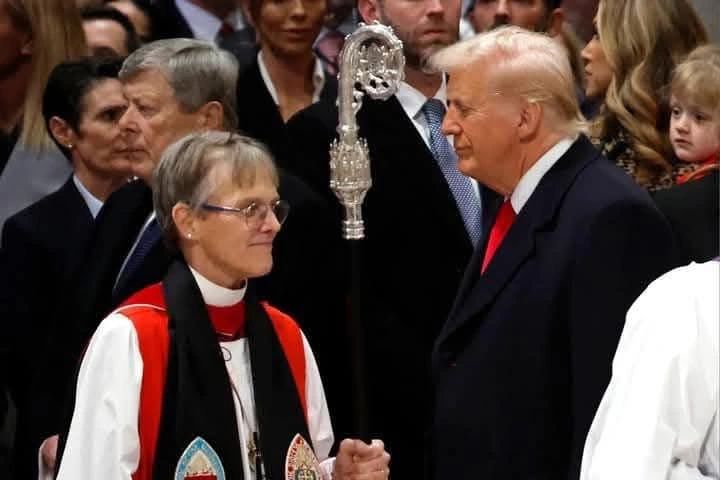
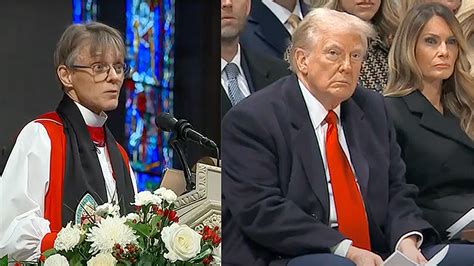
Back to Inauguration Day, 2025. Donald Trump, the non-political real estate magnate and entrepreneur turned politician was soon to be sworn in. He had not yet taken his first action as president, but he sat there chomping at the bit like a race horse in the gate. Protocol demanded that he be docile just for a short duration while he was seated at the feet of Mariann Budde, the bishopess of the small but influential Episcopal Diocese of Washington. Budde is an unassuming woman, small of stature, quiet of voice, lacking the type of personal charisma that one would expect from a hierarch in her vaunted office in our capital city. She was dressed the part in her long rochette and chemire with her master’s academic hood draping down the back, and black tippet down the front. But underneath the finery Budde’s demeanor was thoroughly unimpressive. She would look less out of place officiating at a little noonday service in a side chapel than she did that morning in the nave of the cathedral. I had noticed the lack of appeal in the woman when she officiated at Jimmy Carter’s funeral only days before, so it was clear that she wasn’t just having a bad day the morning of Mr. Trump’s inauguration.
Like ships passing in the night?
The unassuming bishopess reminds me of Winston Churchill’s quip about the prime minister who followed him in office after World War II and whom he in turn succeeded. “An empty taxi pulled up to Whitehall and Mr. Attlee got out.” Dare I say that another nondescript prime minister, the grey but pernicious Keir Starmer has about the same personal appeal as old one-termer Clement Attlee, the father of the British welfare state. Marriann Budde with shortly-cropped hair and lack of makeup looks and acts like these British beta-men. Uninspiring is the word one might use just to be polite.
At the end of her unimpressive homily, Budde decided she had a singular chance to take a dig at the president soon-to-be. In a soft motherly tone, she pleaded with Pres. Trump to have mercy on the transgendered youth and the illegal migrants in the country. Apparently, some were afraid even for their lives. Perhaps those fears are justified, not because of what Pres. Trump might do, but rather because of the permanent damage that bodily mutilation might do. Pleas for so-called “gender-affirming care” are utterly disingenuous. I despise the usage of that misleading euphemism for the chemical interruption of puberty and the butchery of castrations and double mastectomies. Budde spoke in soft, irenic tones implying support for medical interventions that would have delighted the monster Dr. Mengelè of Nazi notoriety. Budde has children of her own; would she have allowed them in their pubescent confusion to complain that they had been born in the wrong body? The devil appears as an angel of light, and sometimes in episcopal finery.
This Budde’s for you, Mr. President!
From her perch in the cathedral’s grand pulpit, Budde urged Mr. Trump to have mercy also on the illegal immigrants that Joe Biden deliberately encouraged to flood into our country. She wasn’t aware how naïve she sounded when she spoke in support of the invasion of millions of unvetted foreigners who have placed a tremendous burden on our welfare safety net. Surely she wasn’t so stupid as to deny the fact that many illegal foreign criminals have raped, maimed, and killed American citizens and stolen their property. Where, O where was the bishopess’ compassion for her fellow Americans and their need to be safe on America’s streets? Likewise for the sakes of many illegal aliens in our country who are trapped here as indentured servants by criminals as child laborers or prostitutes. Deportation may just be the way for some who are at the mercy of drug cartels and gangs of thugs to break free from their own personal bondage.
Imagine the ire that Mr. Trump must have suppressed while he was forced to listen to Democrat talking points coming from the pulpit where Gospel words of encouragement would have been welcome to the ears of the incoming president.
One might get the impression that EMM prefers sexually deviant migrants to run-of-the-mill migrants.
Let us also be cognizant of this fact: Budde’s moral posturing conveniently omits the fact that the Episcopal Migration Ministry (EMM), the federal contracting arm of her church, has been profiting immensely from taxpayer-funded government programs aimed at resettling migrants. In 2023 alone, EMM raked in $53 million to resettle 3,600 individuals, according to the New York Post. (Jim Hoff, Gateway Pundit, 2/5/25) That’s a generous $14,722 per migrant. Did all of that money go to the migrants? One might ask what the Episcopal Church is doing abetting illegal migration anyway.
“I want to build up the liberal church again so we can be a legitimate conversation partner in the public arena,” Bp. Budde told The Washington Post five years ago. (AP, JUNE 1, 2020) The Episcopal Church has always been pretty good at keeping records. Statistics show that the Diocese of Washington — that is the Episcopal Church in our nation’s capital and part of Maryland — suffered a drop in average Sunday attendance at services during the decade between 2014 and 2023. Washington is a small diocese in both land area and membership. Of the 30,000 members, only 13,330 showed up on any given Sunday in 2014, but as one might suspect, that number dropped over the years to 8,483 in 2023, even accounting for an uptick in interest after Covid. Although one must admit that all of the old mainline Protestant denominations have suffered similar losses in attendance over the years, the trend is not exactly a ringing endorsement for Bp. Budde’s episcopate, which commenced when these numbers began to be tabulated. She was consecrated bishop and installed as the diocesan ordinary on November 12, 2011.
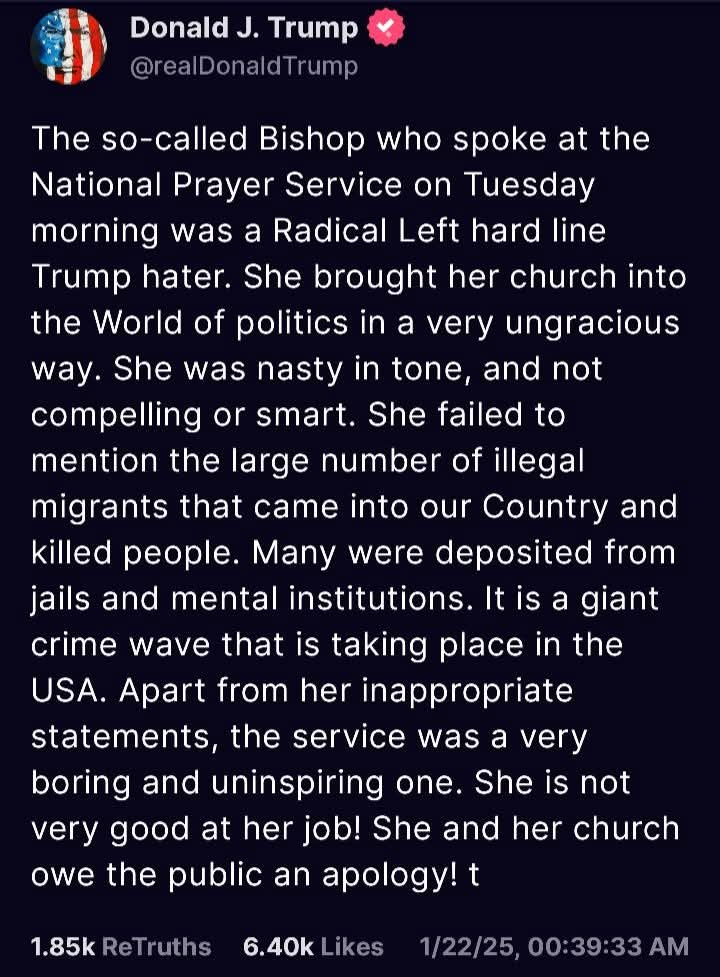
Mr. Trump’s assessment of Ms. Budde is more profound than he may have intended it to be, for truth be told, Budde is no bishop. She is no bishop because she is no priest. She is no priest because she is a woman. The Church — the one, holy catholic and Orthodox Church — has never ordained women to the priesthood, much less the episcopacy. The Episcopal Church adhered to this ancient tradition until 1976, the year that I graduated from college. That is the year when the national Church voted to normalize the so-called ordinations of the Philadelphia Eleven, women who had received the laying on of hands in 1974 by retired robber bishops who acted in ultra vires fashion, scandalizing the entire Episcopal Church. Now saddled with that fait accompli, the liberals in Massachusetts elected Barbara Harris, a radical black priestess and consecrated her suffragan bishop for that diocese in 1988. Barbara Harris, the first woman to be consecrated bishop in the Anglican Communion, was conveniently black, so any critical reaction to her ordination was considered racist, not merely sexist. Women had now swung their hips and barged into all of the major orders of the Church.
Barbara Harris, the first woman to be consecrated bishop in the Anglican Communion, was conveniently black.
With Barbara Harris’ illicit elevation to the episcopacy, any doubt that the Episcopal Church was a swinging branch of the greater Church Catholic was removed once and for all. The Episcopal Church, the American branch of the worldwide Anglican Communion, still prides itself on its claim as the third branch of the Church Catholic along with the Orthodox and the Roman Catholics. They are decidedly not so. They never were, except in their own mistaken theology: the Branch Theory.
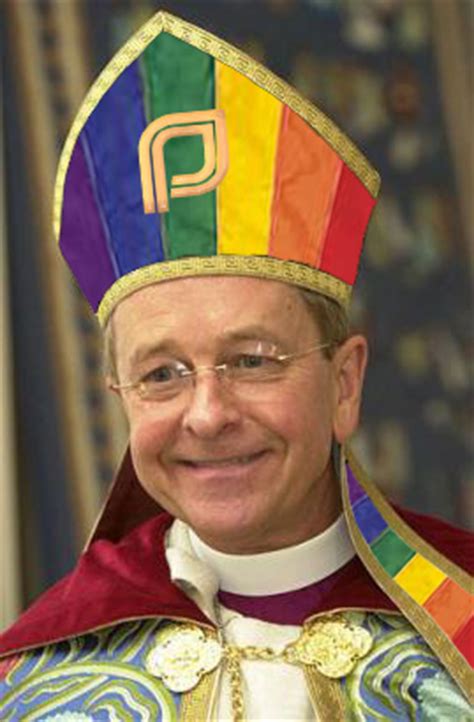
To confirm their contention to be “The Church of What’s Happening Now”, the national Church approved the 2003 election of Vicky Gene Robinson to become bishop coadjutor with right of succession to the seat of the Diocese of New Hampshire. Robinson was a gay man, despite the feminine name, who was once married to a woman with whom he sired two daughters, but then divorced the mother. He came out of the closet and acquired a male partner whom he later “married”… and subsequently divorced. Robinson is not exactly a bishop above reproach.
Bp. Vicky Gene Robinson. His parents wanted a girl, it’s said.Notice that the capital P on Robinson’s rainbow mitre is in the same font as the P’s in Planned Parenthood. Abortion is another issue enthusiastically advocated by the Episcopal Church.
What do I mean by the Branch Theory? The Anglican Communion as a whole claims that their bishops have always been ordained by senior bishops in an unbroken line of apostolic succession. They can even unroll ecclesiastical genealogies to prove their places on the family tree. The problem is that mere succession to the apostles is not enough to maintain one’s rightful place of honor within the universal Church. Adherence to the Apostolic Tradition is just as necessary as membership in the Apostolic Succession. The influence of the Calvinist and Lutheran movements of the sixteenth century led the mother Church in England to jettison aspects of Tradition which the Catholic Church had maintained even after the eleventh century rupture with the Orthodox East. For example, five of the seven sacraments were downgraded to sacramentals. The mystical epiclesis of the Eucharist was removed. And King Henry VIII plundered the monasteries to fill the royal coffers after he declared himself Supreme Head of the Church of England in 1531, depriving the pope of Rome of his place atop the hierarchy. We Orthodox don’t even accept the Roman Church’s contention that they are the One True Church of Jesus Christ; the notion that the Anglican Communion ever was a branch of the same tree has been utterly rejected by our hierarchs several times in history. The shenanigans performed by the Anglican Churches makes any claim to catholicity utterly laughable now that the Episcopal Church in particular has made a mockery of their Holy Orders.
I must admit with a tinge of sadness that I was born and raised in the Episcopal Church and later was trained and ordained a priest in its sister jurisdiction, the Nippon Seikokai. When the Seikokaidecided in convention in 1990 to study the prospect of ordaining women to the priesthood, I knew the handwriting was on the wall. The first woman to be made deacon was Margaret Shibukawa, a senior colleague of mine in the Chubu Diocese centered in Nagoya. She ultimately was the first woman to be priested in Japan. At a clericus in the mountains of Nagano, Shibukawa complained in front of all the clergy of the diocese that I was targeting her for criticism. I stated plainly that my reasons for opposing her potential ordination were not personal, but rather theological. Women had never been ordained to the priesthood because they were not qualified to officiate at the unbloody sacrifice which is the Eucharist. Not only that, but the Scriptures, specifically St. Paul, did not permit women to teach men (I Timothy 2:12). He even prevented women from speaking in the Church! (I Corinthians 14:34) As valid as my argument was, it was ignored by Ms. Shibukawa and our bishop Samuel Hoyo. For that reason and others, I left the Nippon Seikokai and returned stateside with my family in 1994; Ms. Shibukawa was ordained the first woman priest in 1998.
from the website of the Nippon Seikokai provincial office in Tokyo.
Here is what I would say to the bishop of Washington given the chance: Ms. Budde, if I may say so, your vindictive little stunt before the president was uncalled for. You may have scored points among your fellow liberal Episcopalians and Democrats, but a large portion of the country found it to be in poor taste. I agree with the president; you owe him and the country an apology.
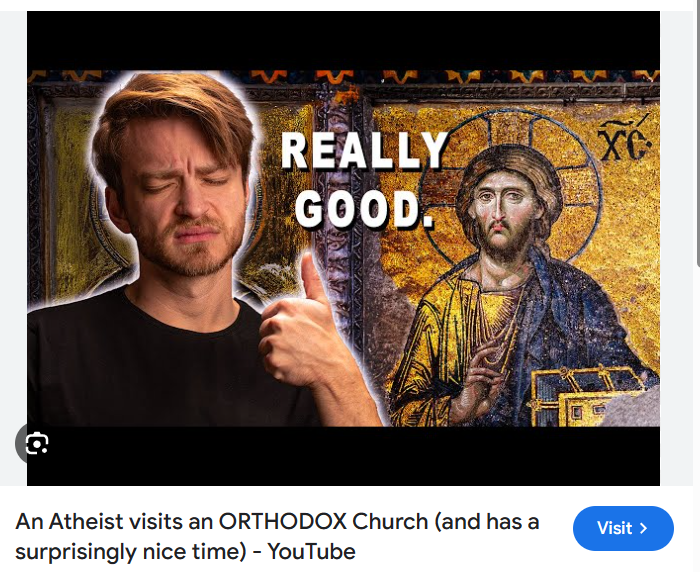
YouTube’s algorithm can produce interesting results. It recently recommended two sharply contrasting podcasts. One was a sober analysis of church decline in rural Illinois by a self-described “old geezer” Christian; the other was an “audit” by a young Gen-Z atheist who raved about his visit to an Orthodox Liturgy. That afternoon I found myself going back and forth between feeling pessimistic, and feeling hopeful as I watched the two videos.
The purpose of this article is to stimulate discussion about the current religious situation in the United States. Do we indeed have a church attendance crisis in America? Does Christianity have a future in America? Can Orthodoxy help reverse church decline in America?
Tom Wadsworth, a former pastor and independent scholar, presents the findings of his survey research which he conducted in his hometown of Dixon, Illinois, from 1983 to 2023. His research deserves our attention because of its solid data and meticulous methodology. One surprising finding is that Gallup polls significantly overestimate the percentage of Americans who attend church/religious services. Where Gallup polls report that 31% of Americans attend church services (based on self-description), Wadsworth estimates that the actual percentage may be around 13% (based on head counts) (see 18:15-24:54; see 24:12). Wadsworth notes that if church attendance is 13% for a conservative, rural area, like Dixon, Illinois, then the rate of church attendance is likely to be even lower in major urban areas like Chicago, Orlando, New York, etc. In other words, the problem of church decline may be even worse than we think it is.
Wadsworth introduces the concept of “critical mass”—the minimum size or amount of something required to start or maintain a venture. For churches to survive they need a certain number of congregants and income to survive. Which begs the question: What are the critical thresholds needed for a church to survive? Wadsworth hypothesizes that if a church has: (1) 40 in attendance on average and (2) 60% of its attendees are 65+ in age, then that church is likely to close its doors in ten to twenty years (28:16). This numbers-driven approach is pragmatic and helps generate a realistic assessment of a congregation’s vitality. These two findings—actual attendance rates and critical mass needed for church growth—are what makes Wadsworth’s presentation noteworthy. Here he breaks new ground. While Wadsworth’s discussion of ten factors contributing to church decline (31:17-42:06) is also worth considering, this is familiar ground that has been discussed by others. Among the reasons he gives for church decline are the recent public pastor scandals, the pandemic lockdown, the polarizing effects of the religious right, the 9/11 effect—the ejection of religious fanaticism, youths rejecting the Evangelicalism of their parents, the effects of social media on socialization, the declining birth rate, and the fact that secular culture is now in fashion, etc.
Overall, this author finds Wadsworth’s discussion of possible causes for church decline to be full of insights. However, I do have a few quibbles with him. The youth’s rejection of their parents’ Evangelicalism is not so much a causal factor as it is a description of an aspect of the overall decline. Based on anecdotes I have read on the Internet; I am inclined to agree with his identifying the Religious Right as a contributing factor. However, one must also take into account the drift of the historic mainline denominations towards secularism and liberalism. The drift away from historic orthodoxy in the mainline denominations has resulted in liberal theology devoid of belief in the supernatural, i.e., watered down Christianity. As a former atheist, I find mainline Protestantism lacking the robustness and vitality of historic supernatural Christianity. Another factor I believe that Wadsworth’s analysis overlooks is the impact of rising divorce rates. I suspect that children of divorce find it harder to feel at home in churches that hold the intact nuclear family to be the norm; divorcees, single parents, never-married singles, and those with confused sexual identities will feel unwanted and marginalized.
Jared Smith, creator of Heliocentric, visited an Antiochian Orthodox parish and rated it as “exceptional,” a “Knock ‘em dead! Home run out of the park!” experience. Unlike Tom Wadsworth’s careful analysis, Jared Smith’s report consists more of comparisons between what he saw at one Orthodox parish against other churches he had visited. He notes that a lot of thought and care had gone into the interior of All Saints Antiochian Orthodox Church and that the church was built for reverence. He contrasts this against the ugliness of the four bare walls of “the run-of-the-mill box church” or “a CVS church” (2:45-3:05).
Jared described how the greeter welcomed him warmly but did not pounce on him as in other churches. Then, as the greeter was explaining the church service, the priest entered the foyer, censing the room. The greeter paused, turned to the priest, and bowed in respect (5:36). For Jared Smith, that was impressive because it showed that in the Orthodox Liturgy, God is the center of the show, not you. I found his criticism of Protestantism’s audience-centered approach to worship quite insightful. It suggests that among the Gen-Z cohort there is a hunger for reverence that is not being met by Protestantism’s contemporary worship service. Jared Smith was surprised that he was invited to meet with the priest one-on-one (7:52). His experience has been that pastors only meet with loyal church members, not with outsiders. Sadly, it seems that personal contact with the pastor has become a rare exception, especially with huge mega churches (18:20, 20:27). I was surprised by Smith’s observation of icons in the Orthodox church. The icons of the saints reminded him that we are not alone but surrounded by a great cloud of witnesses (11:05). This contrasts sharply with the Baptists’ emphasis on Jesus and you—and you alone.
Part of Jared’s church review was the coffee hour (16:14 ff.). He was surprised that the priest stayed around after the Liturgy, taught adult religious education class, talked with people after the class, then to Jared’s surprise, invited him to his house for coffee. For Jared, the one-on-one personal contact was a far more effective way of doing outreach than the didactic lecture approach favored by Protestant Evangelicals. He also noted that the priest did not attempt to argue him out of his atheism, but accepted him.
What I find striking is that Jared Smith is the demographic polar opposite of Tom Wadsworth. Jared is in his late 20s, a former Evangelical, a graduate of Wheaton College, etc. His glowing description of Orthodoxy represents a bright silver lining in an otherwise gloomy situation described by Tom Wadsworth.
Jared Smith’s positive assessment of Orthodoxy seems to be part of a broader trend. The New York Post in December 2024 published an article: “Young men leaving traditional churches for ‘masculine Orthodox Christianity in droves.” This article has caught the attention of many and has generated considerable discussions among Protestants. If Orthodoxy can appeal to Gen-Zs like Jared Smith, then it is possible that the problem of church decline can be arrested and possibly reversed.
What Does the Future Hold?
The overall religious picture for the United States looks grim. It is like a long, extended drought drying up the landscape with plants and trees everywhere slowly dying off. This religious drought has been going on for several decades now. Surprisingly, there are a few spots of greenery popping up here and there. One of these spiritual oases is Eastern Orthodoxy. The recent influx of young men flocking to Orthodoxy can be seen as something like a rain shower that potentially signals a change in season.
We could be witnessing Orthodoxy’s transition from being seen as an exotic transplant to a well-regarded alternative to Protestantism and Roman Catholicism. For that to happen, American Orthodoxy will need to experience solid church growth. In addition to welcoming inquirers, we will need to give attention to the nurture of cradle Orthodox. Orthodoxy will thrive if the children of recent converts along with the grandchildren of immigrants are nurtured into a living faith in Christ. Both the recently-baptized convert and the recently-baptized infant whose ancestors embraced Orthodoxy centuries ago, are the future of Orthodoxy. For Orthodoxy to reverse the problem of church decline, we will need, not just thriving current parishes, but also new mission parishes planted in the same urban areas as well as in areas that have zero Orthodox parishes. For that to happen, we will need a wave of men to be ordained to the priesthood and the diaconate. And, we will need bishops that support the evangelization of America. We need a vibrant American Orthodoxy that presents the Ancient Faith to a post-Christian America.
Entering into the Harvest
And, let us not forget to pray. Jesus exhorted his followers:
The harvest is truly plentiful, but the laborers are few. Therefore praytheLord of the harvest to send out laborers into His harvest. (Matthew 9:38, OSB)
The time of harvest has come. If you see new people at your local parish, that means that there is work to do. Let us welcome the visitors who seem lost in the Liturgy by giving them a helping hand. Let us invite them to join us for coffee after the Liturgy. If you see someone standing alone during coffee hour, introduce yourself to them. Getting the cold shoulder during the coffee hour can leave a bad impression after experiencing the Liturgy. Many first-time visitors are fearful of rejection, so be ready to put them at ease. Be ready to listen to them and to answer their questions, and be ready to share your faith story with the inquirer. Tell them how the Lord has been good to you. Let us keep in mind the words of Jesus:
Go home to your friends, and tell them what great things the Lord has done for you, and how He has had compassion on you. (Mark 5:19, OSB)
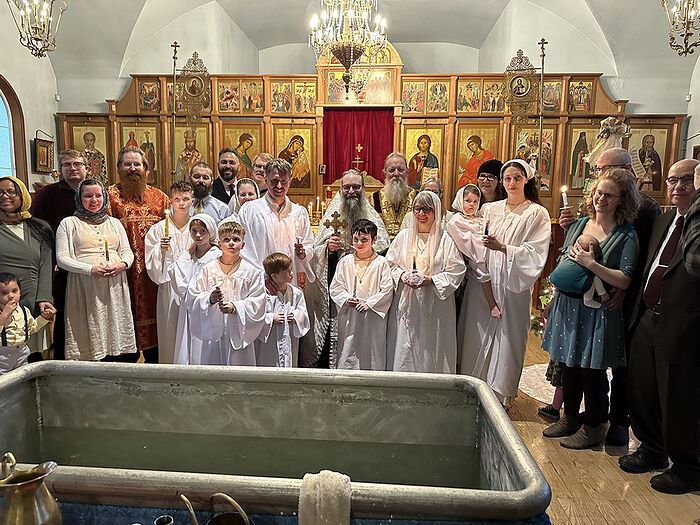
Newly illumined Orthodox Christians – Is this the future? Source
For Discussion
For readers who visit Handwritings, I would like to pose three questions:
Does your personal experience confirm or disconfirm Tom Wadsworth’s analysis of church decline?
Does your personal experience of Orthodox worship confirm or disconfirm Jared Smith’s positive assessment of Orthodoxy?
Do you think that Orthodoxy can help reverse church decline in America? How do you see that happening?
Abp. Elpidophoros has accomplished a trifecta. On June 11, the archbishop of the Greek Church in the Americas once again cast pearls before swine by celebrating the divine mysteries in the synagogue of Satan, St. Bartholomew’s Episcopal Church in Manhattan. The same parish, grand in its bastard Byzantine architecture, is the epicenter of the abominable homosexual and transgender movement to queer Manhattan. Here are three remarks that fell trippingly from Elpi’s lips during the liturgy and this author’s initial reactions to them. Elpi is a prevaricator, or a damned liar, if you prefer.
St. Bart’s, Manhattan festooned with the old rainbow flag.
Elpi the Prevaricator makes bold to say, “Such connectedness with others is often feared in many Christian communities today, as if contact with those of differing perspectives might somehow pollute one’s faith.” Fiddlesticks! We all distinctly recall that it was Elpidophoros, archbishop of the GOA, who meanly refused to grant religious exemptions to the faithful who could not, for conscience’ sake, submit themselves to inoculation with an experimental serum during the pandemic. So much for Elpi’s own ability to listen to differing perspectives.
Elpi the Prevaricator boasts, “Thus, the Ecumenical Patriarch models for the Orthodox Christian Church, and for all people of good will, what it means to love your neighbor, even as you claim to love God.” What a patent lie! Bartholomew betrayed the Ukrainian Orthodox Church by unilaterally proclaiming the founding of a phony replacement entity in that cradle of Slavic Orthodoxy. Black Bart’s ultra vires meddling led to the disenfranchisement of the UOC in her motherland and the persecution of her clergy and people, and the theft of her property. History will not be kind to that schismatic, Black Bart of Istanbul.
Elpi the Prevaricator exaggerates: “The Patriarch welcomes all at the Phanar, the Sacred Center of worldwide Orthodoxy.” Not so. Orthodoxy doesn’t have a headquarters like the Vatican. Constantinople’s Phanar is a mere shadow of its former grandeur, but even at the apogee of its trajectory, it never was the “sacred center of Orthodoxy”. The hierarchical authority of the Church has always been shared by the several patriarchates and metropolises. Thank God for the decentralization, especially now when Orthodoxy groans at the heresies and schisms caused by Bartholomew and Elpidophoros.
The U.S. government is making itself felt in Orthodox internal politics.
(The following article is so good that Handwritings’ editor has decided to lift it wholesale from its original publication, The American Conservative. All credit for this fine piece is attributed to its author, Michael Warren Davis. Photos and captions are not from the original text.)
Everyone knows that the Moscow Patriarchate is in bed with the Kremlin. Few realize that the Ecumenical Patriarchate of Constantinople is deeply beholden to the United States government.
This ignorance is surprising, given that many Greek Orthodox leaders are quite proud of the fact. In 1942, Athenagoras Spyrou—the Archbishop of America for the Greek Orthodox Church—wrote to an agent of the Office of Strategic Services. “I have three Bishops, three hundred priests, and a large and far-flung organization,” Athenagoras wrote. “Every one under my order is under yours. You may command them for any service you require. There will be no questions asked and your directions will be executed faithfully.”
In 1947, the OSS was rechristened as the Central Intelligence Agency, or CIA. One year later, Athenagoras was elected Ecumenical Patriarch of Constantinople, the spiritual leader of Eastern Orthodoxy.
One might point out that, when Athenagoras reached out to the OSS, his native Greece was under Nazi occupation. It is understandable that a Greek bishop in America would support the American war effort. But it was more than that. Athenagoras was a strong supporter of American exceptionalism and encouraged Washington’s militarist foreign policy. The U.S. Consul in Istanbul recounted a conversation with Athenagoras in 1951: “As usual, he talked at some length of his belief that the United States must remain in the Near East for several centuries to fulfill the mission which had been given it by God to give freedom, prosperity and happiness to all people.”
(These quotes, by the way, are pulled from a talk given by an Orthodox historian called Matthew Namee at Holy Cross Hellenic College, the Greek seminary in Boston. These are not malicious forgeries peddled by Russian propagandists—the Greek Orthodox are quite proud of their association with the American deep state.)
Athenagoras was not merely an Americanist. He was also known as a renovationist, as liberal Orthodox are known. In 1964, he met with Pope Paul VI in Jerusalem; together, they officially lift the mutual excommunications placed by their predecessors in 1054. This gesture sparked outrage across Orthodox world. Athenagoras was accused of compromising the Orthodox Faith for the sake of a paper union with Rome.
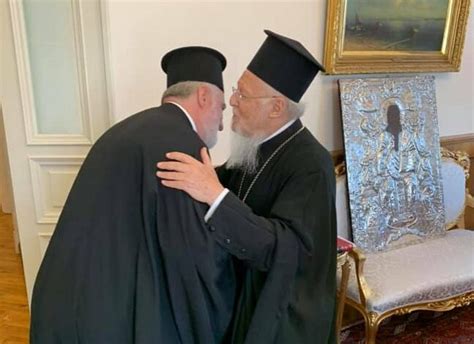
Bartholomew whispering sweet nothings into Elpidophoros’ ear.
The current Ecumenical Patriarch, Bartholomew, is cut from the same cloth as Athenagoras. He is very close to Pope Francis; the two share a passion for mass immigration and environmental activism. Also like Athenagoras, Bartholomew shares a close relationship with the U.S. government—a partnership that has proven mutually beneficial.
The Ecumenical Patriarch is the spiritual leader of Orthodoxy. However, he only has direct jurisdiction over a few thousand Orthodox Christians in Turkey. The rest of the Greek Orthodox world are autocephalous, or self-governing. This includes the Church of Greece, the Church of Cyprus, and the American metropolises (or dioceses). Many look to Bartholomew for leadership, but they are not directly under his authority. It is also worth noting that a large majority of Orthodox Christians around the world belong to the Russian Orthodox tradition. These churches do not look to Bartholomew for leadership in any meaningful way. Some, like the Patriarchate of Moscow, are in schism with Constantinople.
Bartholomew is not the “pope” of Orthodoxy—although he would like to be. Over the last few decades, the ecumenical patriarch has also worked to consolidate hard power over the various Greek Orthodox churches. This effort has proven most fruitful in the United States.
In 2014, Elpidophoros Lambriniadis, the current Archbishop of America and Bartholomew’s heir apparent, published a short essay called “First Without Equals.” Its name was a play on the phrase primus inter pares, or first among equals. This title originally referred to the Pope of Rome, but was transferred to Patriarch of Constantinople by the Orthodox following the Great Schism of 1054. Of course, the Schism itself was caused in no small part by a sense that the Roman Pontiffs failed to respect the rights and privileges of their fellow bishops, especially in the Christian East. Clearly, the Archbishop was signaling his desire to cultivate a more authoritarian, centralist ecclesiology within the Orthodox Church, a philosophy which has been dubbed Greek papism.
In 2022, during an interview with the Greek newspaper Ta Nea, Elpidophoros was asked if he expected to become the next Ecumenical Patriarch. Elpidophoros demurred, claiming that “the succession will be decided by God.” This, too, is a radical departure from Orthodox tradition. In fact, it goes beyond Greek papism. Even the Roman Catholic Church explicitly denies that the Pope is chosen by God.
Nevertheless, the United States government officially supports the doctrine of Greek papism, as will be shown. Strengthening the Ecumenical Patriarchate’s position within global Orthodoxy serves two purposes. First, it necessarily subtracts from the influence of Constantinople’s rival, the Moscow Patriarchate. Washington regards Russian Orthodoxy as a tool for Kremlin propaganda and, therefore, a legitimate target for counterintelligence operations. Secondly, the renovationist Ecumenical Patriarchs are willing partners in Washington’s campaign to spread liberal, democratic values across the globe.
Consider, for example, the schism in the Ukrainian Church. In 1990, the Patriarchate of Moscow granted self-governing status to the Ukrainian Orthodox Church (UOC). It was not, however, given full autocephaly. However, a group of Ukrainian nationalists led by then-president Minister Petro Poroshenko organized an “independent” Orthodox Church of Ukraine (OCU). With the support of Western media, these nationalists successfully branded the canonical UOC as the “Russian Church.”
In 2018, when asked about the Orthodox Church of Ukraine’s bid for autocephaly, Kurt Volker—then Special Representative of the United States Department of State for Ukraine—appeared to wave the question off. He insisted that the U.S. government does not take a position on such matters and would respect the decision of Bartholomew and his synod.
Make no mistake: By declaring that the decision belongs to the Ecumenical Patriarchate, the U.S. government is taking a position. First of all, autocephaly cannot be granted unilaterally by any patriarch or bishop. Second, if the decision belonged to anyone, it would be the Patriarch of Moscow, the spiritual leader of Slavic Orthodoxy. Even the great Kallistos Ware denounced the Ecumenical Patriarchate for meddling in the Ukrainian Church:
Though I am a metropolitan of the Ecumenical Patriarchate, I am not at all happy about the position taken by Patriarch Bartholomew. With all due respect to my Patriarch, I am bound to say that I agree with the view expressed by the Patriarchate of Moscow that Ukraine belongs to the Russian Church. After all, the Metropolia of Kiev by an agreement of 1676 was transferred from the omophorion of the Ecumenical Patriarchate to that of the Patriarchate of Moscow. So, for 330 years Ukraine has been part of the Russian Church.
Third, just days before Volker gave his interview, Joe Biden—then only the former vice president—flew to Ukraine to express his support for the OCU. As soon as Bartholomew ruled in favor of the OCU church, Secretary of State Mike Pompeo expressed the Trump administration’s firm support for his decision. Since Russia’s invasion of Ukraine, our government has implicitly supported Ukrainian president Vladimir Zelensky’s policy of seizing property(including church buildings) from the UOC and transferring them to the OCU. In one particularly egregious episode, a nationalist mob attacked a UOC church in the middle of a funeral, dispersed the worshippers and beat the celebrant-priest so badly he had to be hospitalized. The kicker? It was a funeral for a Ukrainian soldier who died fighting against Russia.
This one detail cannot be emphasized enough: Whatever the media claims, the canonical UOC is not an arm of Russian influence. Its members are not “pro-Russia”; much less are they Russian collaborators. They, too, are giving their lives to defend their homeland against Russian aggression. But that doesn’t matter to Washington or Constantinople. By supporting the separatists, Bartholomew is undermining Moscow’s influence within global Orthodoxy. And that’s good for the Russophobes in our foreign-policy establishment.
In 2019, the State Department gave $100,000 to the Orthodox Times, a news site strongly aligned with the Ecumenical Patriarchate. The purpose? “To counter entities spreading fake news and misguiding believers in Orthodox communities”—in other words, Russian disinformation.
It’s ironic that Trump’s State Department pursued this pro-Constantinople agenda given that the Ecumenical Patriarchate is openly and proudly aligned with the Democratic Party. The Greek Orthodox Archdiocese of America boasts:
President Truman often emphasized the pro-American convictions of Patriarch Athenagoras and the importance and influence of the Ecumenical Patriarchate, along with the Greek Orthodox community in the U.S., as vital to American foreign policy objectives. Indeed, Truman saw the Patriarchate and Athenagoras as crucial to bolstering the pro-Western resolve of both Greece and Turkey, as well as to promoting stability in the Middle East.
In 2020, Patriarch Bartholomew wrote to congratulate his old friend Biden for defeating Donald Trump in the presidential election. “You can only imagine my great joy and pride for your successful election as the 46th president of your distinguished nation, the United States of America.” Archbishop Elpidophoros, in that same interview with Ta Nea, also offered a thinly-veiled endorsement of Joe Biden:
In America, the issue of abortion has been completely politicized…. It is as if the only qualification for being a good Christian or a good politician depends on one’s stance on the issue of abortion. All other principles and doctrines of Christianity do not matter; you can be a crook, a liar, a swindler, a warmonger, violent, or a misogynist, but if you are against abortion, then you are a politician suitable enough for “pious people” to support.
As Rod Dreher pointed out, this little-noticed interview contains quite a few shocking revelations. For instance, Elpidophoros is not simply concerned that abortion has been “politicized”: he is openly pro-choice. “Women bear the full burden in giving birth and raising their children, while men, otherwise directly involved in the pregnancy, do not bear the same burden,” he told Ta Nea. “Therefore, we must support women’s right to make reproductive decisions of their own free will.” Elpidophoros also discusses how proud he was to support the protests which erupted after the death of George Floyd, as well as the infamous “gay baptism.”
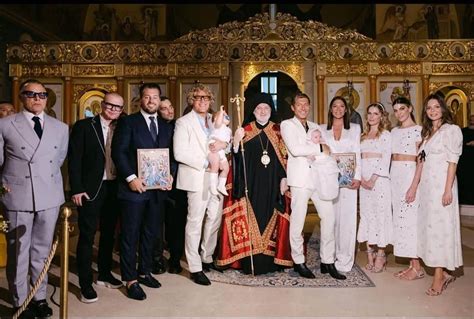
For those who aren’t up on their Orthodox church politics: In 2022, Elpidophoros baptized the sons of two wealthy Greek-Americans, Evangelo Bousis and Peter Dundas. (The children were conceived through surrogacy.) The baptism was performed in Vouliagmeni, a suburb of Athens. This set off a firestorm in world Orthodoxy for two reasons. Firstly, it is wrong to baptize a child if there is little to no chance of their being raised according to the Church’s teachings. The parents are making a commitment to their child to the Christian faith without giving them the tools to fulfill that commitment. Second, visiting clergy (including bishops) must receive permission from the local metropolitan before publicly celebrating the sacraments within their jurisdiction. In this case, the local metropolitan was Antonios of Glyfada. Elpidophoros requested and was granted permission to baptize the children of an American couple, but did not inform Antonios that the parents were a same-sex couple.
Elpidophoros was condemned by the Holy Synod of the Church of Greece as well as the monks of Mount Athos, but he didn’t care. The Archbishop was simply giving the Orthodox world a taste of how he’ll do things once he becomes Ecumenical Patriarch.
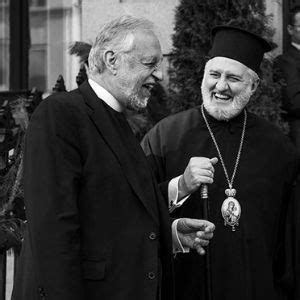
Karloutsos yucking it up with Elpidophoros. Rumor has it that, truth be told, they can’t stand each other.
There’s more. In 2019, Elpidophoros appointed Father Alexander Karloutsos as vicar-general for the Archdiocese of America. Father Alexander is, for all practical purposes, the Biden family’s pastor. He sits on the board of the Beau Biden Foundation and serves as a spiritual advisor to the President. In 2015, Father Alexander attended a (now infamous) dinner hosted by Hunter Biden at the Café Milano in Georgetown. The dinner was a private reception for several Eastern European oligarchs, including Yury Luzhkov, the profoundly corrupt former Mayor of Moscow. This was the night that Hunter introduced his father to Vadym Pozharskyi, an executive at Burisma, allegedly fulfilling the deal for which Baturina had paid Hunter $3.5 million the year before.
More troublingly, Father Alexander is also close to John Poulos, the Greek-Canadian founder of Dominion Voting Systems. Father Alexander has been credibly accused of serving as a go-between for Poulos and the Bidens during the 2020 election scandal. It is said that the priest relayed information between the two parties, but cannot be subpoenaed due to New York’s clergy privilege laws. Though all parties admit that Father Alexander was in frequent communication with both parties during that time, they also insist that he was simply offering them spiritual counsel. Undoubtedly both Poulos and Biden spent those difficult months in prayer and fasting.
As it happens, in 2018, Father Alexander also found himself at the center of an $80 million financial scandal, which was probed by the U.S. government. The federal government’s investigation to the matter was dropped shortly after it began, despite the fact that no explanation was ever unearthed. When President Biden awarded Father Alexander the Presidential Medal of Freedom last year, he jokingly warned, “I’m going to ruin your reputation by talking.”
Unfortunately, such allegations of corruption are fairly widespread in the Archdiocese of America. The Greek Orthodox Church is by far the wealthiest denomination in this country relative to its size. (A Roman Catholic priest can expect to make no more than $45,000 per year; a Greek Orthodox priest can earn upwards of $130,000.) There are many well-established second-generation families who still feel a deep loyalty to the Church even if they tend not to practice very faithfully.
In other words, the Archdiocese of America is in roughly the same position that the Catholic Church was under Kennedy. It is rich in capital and assets but largely beholden to secular, liberal donors. Hence why the Hellenic College Holy Cross, the Greek Orthodox seminary, refers to former congressman Michael Huffington as a “faithful Orthodox Christian” despite the fact that he’s a practicing homosexual who publicly dissents from the Church’s teaching on sexuality.
Happily, most Greek Orthodox jurisdictions are not renovationist; neither are they in the pocket of the American government or beholden to liberal, secular donors. In fact, when the Greek parliament voted to ratify same-sex marriage, the Church of Greece called the decision “demonic” and excommunicated several of the “immoral lawmakers” who voted for the bill.
But whatever our government may claim, it will promote Bartholomew and his successor, Elpidophoros, as “Greek Popes” in order to liberalize Greek Orthodoxy and counter Russian Orthodoxy. This is the policy of the U.S. government. There are State Department personnel (and taxpayer dollars) dedicated to achieving this exact goal. It is discussed—openly; gleefully—in the major institutions of the Ecumenical Patriarchate and the Archdiocese of America. And yet anyone who suggests that this is a gross betrayal of both the American people and the Orthodox faithful is immediately accused of being a “Russian asset.” Go figure.
EDITOR’S COMMENT: The author of this fine article, Michael Warren Davis, lays all the cards on the table vis à vis the infuriating duplicity of Greek Orthodoxy’s two jackals, Bartholomew and Elpidophoros, and Karloutsos, the hyena. We might ask ourselves whom we have to blame for promoting those three men’s betrayal of our Faith and their unjustified enmity against Russian Orthodoxy.
Why, no one else but our very own CIA and the Biden administration!
A vote to reëlect Biden and his Democrats this fall will be a vote to support the corruption which is American foreign policy for Ukraine and a vote to deepen the rift between Moscow and Istanbul, aka Constantinople. You many American Greeks who intend to defy righteousness and do just that had best take a time to fast and pray before you vote, knowing that heaven will hold you responsible for your 2024 ballot.






 Handwritings on the Wall