A Step Too Far

Sarah Mullaly – Archbishop of Canterbury

The appointment of Dame Sarah Mullaly to the historic See of Canterbury in October 2025 has sent shock waves throughout the Anglican Communion. The chair of the Global Anglican Future Conference (GAFCON), Archbishop Laurent Mbanda of Rwanda, in an official communique noted that the decision “abandons global Anglicans.” There is a possibility that when GAFCON meets in Nigeria in March 2026, it will formally break from the Anglican Communion.

[Shortly after this article was posted, GAFCON announced its formal break with the Anglican Communion. See also the informative podcast by Ready to Harvest on the recent GAFCON communique.]

Without doubt, the nomination of a female priest to the highest office of the Anglican Communion is highly controversial. However, her appointment is not all that surprising in light of her high standing as Bishop of London. (The Bishop of London is the third-ranking member in the Anglican Communion after the Archbishop of Canterbury then the Archbishop of York.) It can be expected that the decision will have consequences extending beyond the Anglican Communion to other Christian traditions. How this might affect Orthodoxy is the focus of this blog posting.

Guarding Against False Ecumenism

Historically, the Patriarch of Constantinople has been referred to as the “Ecumenical Patriarch.” The term “ecumenical” means “universal” or “worldwide.” This usage has roots in the Pentarchy, that is, the five patriarchal sees—Rome, Constantinople, Alexandria, Antioch, and Jerusalem—that oversaw the Christian Church in the ancient Roman Empire. After the Great Schism of 1054, the Patriarch of Constantinople came to be seen as the spiritual leader and unifying figure for all Eastern Orthodox Christians. Unlike the Pope of Rome, the Patriarch of Constantinople does not claim universal supremacy but is “first among equals.” Any attempt to impute supremacy to the Patriarchate of Constantinople like the Papacy deviates from historic Orthodoxy and implies a potentially dangerous innovation. Historically, Orthodoxy has recognized the Bishop of Rome as first among equals and considers papal supremacy to be an unacceptable innovation.

Likewise, any attempt to redefine the Ecumenical Patriarchate along the lines of the modern ecumenism has dangerous implications for Orthodoxy. In the twentieth century, a Protestant movement emerged known as the ecumenical movement. Its stated goal was not just the uniting of various Protestant denominations, but also Roman Catholicism and Eastern Orthodoxy. Roman Catholicism in 1964 embraced this new meaning of “ecumenical” in the decree “Unitatis redintegratio.” In that same year, Pope Paul VI and Patriarch Athenagoras met at the Mount of Olives in Jerusalem for prayer and exchanged the kiss of peace ostensibly in an attempt to end the Schism of 1054.
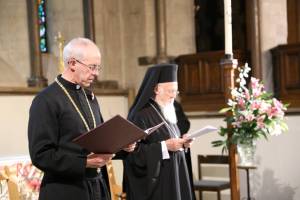
Welby and Bartholomew Praying – 2015

The current Patriarch of Constantinople, Bartholomew, has continued to follow the new meaning of “ecumenical” in his meetings with the Pope of Rome and also with the Archbishop of Canterbury. Bartholomew first met Justin Welby, Mullaly’s predecessor, in 2014. After his enthronement as the Archbishop of Canterbury, Welby visited Patriarch Bartholomew in Constantinople. Then in 2015, Welby reciprocated by hosting Bartholomew at Lambeth Palace. In 2015, Welby and Bartholomew held a joint prayer vigil for refugees. These meetings are far from casual, informal encounters. They are carefully choreographed events full of symbolic gestures much like international diplomatic events at the United Nations’ General Assembly. The glamor of these high-profile ecclesiastical affairs can tempt church leaders to make unwarranted concessions all in the name of Christian unity—hence, the need to guard against false ecumenism.

The Future of Anglican-Orthodox Relations

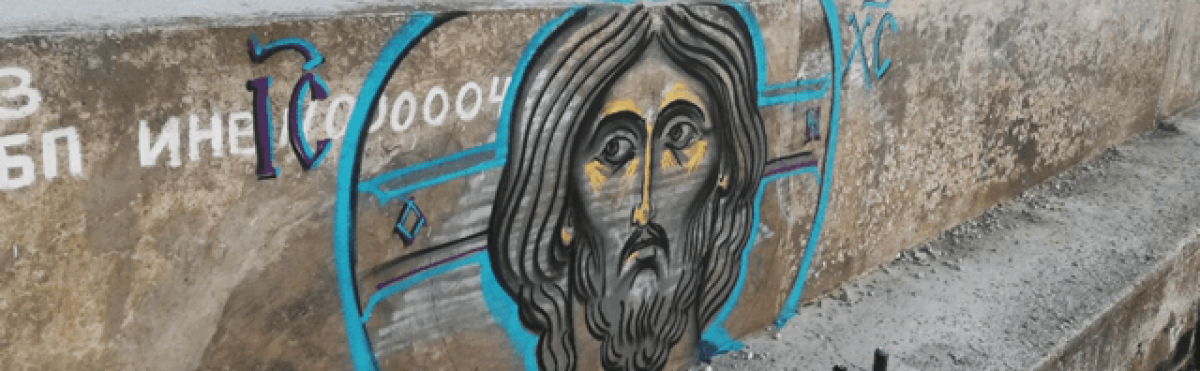
Saint Justin Popovich

Orthodoxy is far from united on ecumenism. Where some are eager to engage the non-Orthodox, others take a more wary posture. This reluctance stems from their desire to safeguard the Orthodox Faith from innovation and heresy. (For an Orthodox approach to ecumenism that avoids the errors of Western ecumenism see Phillip Calington’s discussion of Saint Justin Popovich’s approach to ecumenism.)

Unlike Western Christianity which has distilled their theology in carefully written documents and precisely worded confessions, Orthodoxy preserves its theology in its Liturgy, the episcopacy, the Ecumenical Councils, and the patristic consensus. One unwritten Tradition has been the all-male episcopacy. Unlike Western Christianity, the notion of women’s ordination has been a non-issue: We’re Orthodox; We don’t change. Where Western Christians often take reason and logic as the starting point for theologizing, in Orthodoxy we understand our faith and practice to be a sacred deposit received from the Apostles and preserved unchanged until the Second Coming. Thus, the Orthodox Church does not feel the need to adjust her faith and practice to contemporary culture. This also means that Orthodox Christians are not obliged to provide a theological rationale for a practice grounded in Apostolic Tradition; however, they are obliged to show that the practice or teaching can be traced back to the early Church. This gives Orthodoxy a stability that is sadly lacking in the West. When one examines the faith and practice of Anglicanism from the 1950s to 2025, one cannot help but be struck by the massive changes in Anglicanism. While it is debatable whether women’s ordination was the start of Anglicanism’s decline into liberalism, it is clear that women’s ordination is not unrelated to the overall liberalization of Anglicanism.

Thus, Sarah Mullaly’s elevation to the See of Canterbury will be highly consequential for Anglican-Orthodox relations. Any indication by Bartholomew of his acceptance of the validity of Mullay’s elevation would imply an acceptance of women’s ordination. Bartholomew’s acceptance of Mullaly’s elevation to the See of Canterbury could happen by his: (1) attending her enthronement service, (2) extending an official invitation to come to Constantinople like Welby’s visit in 2014, or (3) be an official guest to the Lambeth House like the hospitality Welby extended in 2015. Another possibility is an official announcement or personal communication that signals acceptance of Mullaly’s elevation. Of concern to the Orthodox faithful is whether Patriarch Bartholomew will go a step too far and embrace women’s ordination, whether implicitly or explicitly. Such an ecumenical gesture could inadvertently damage Constantinople’s claim to valid apostolic succession.

Orthodoxy’s opposition to women’s ordination is far from a clear-cut, black-and-white issue. Historically, there has been a female diaconate in Orthodoxy; however, the ordination of women did not extend to the presbyterate or episcopacy—both these offices are essential to the Eucharistic sacrifice. Orthodoxy’s opposition is grounded in Orthodox metaphysics, not in mere cultural conservatism. Alexander Schmemann points to the dogmatic underpinnings of the Orthodox opposition to women’s ordination.

I cannot discuss the problem itself because to do so would necessitate the elucidation of our approach — not to women and to priesthood only — but, above all to God in his Triune Life, to Creation, Fall and Redemption, to the Church and the mystery of her life, to the deification of man and the consummation of all things in Christ. (Schmemann in Harvey 2008)

In other words, women’s ordination would go far beyond a modification of ecclesial structures and lead to a wrecking of the dogmatic underpinnings of Orthodox ecclesiology.

Short of all this it would remain incomprehensible, I am sure, why the ordination of women to priesthood is tantamount for us to a radical and irreparable mutilation of the entire faith, the rejection of the whole Scripture, and, needless to say, the end of “dialogues.” (Schmemann in Harvey 2008)

Where in the West ordination is understood in functional terms and gender difference is viewed as mere surface externality (women are capable of ritual actions just as well as men), in Orthodoxy gender differences carry with it profound implications for anthropology, ecclesiology, soteriology, and cosmology. Differences in gender entail more than differences in external form of the human body. Being rooted in the imago dei, differences in gender point to the profound difference in the existential orientation of men and women towards the world, towards each other, and towards God. Where Western modernity has  become untethered from order of creation described in Genesis, Orthodoxy with its adherence to the sacramental worldview and to the Incarnation of the Eternal Logos has continued to honor the male-female distinction established by the divine Creator.

In these unsettled times, what is needed are Orthodox Christians with a solid, unshakable faith who speak boldly with humility and charity, and who avoid unnecessary confrontations. Orthodox Christians need to have in mind the wise admonition in the Epistle of James:

So then, my beloved brethren, let every man be swift to hear, slow to speak, slow to wrath: for the wrath of man does not produce the righteousness of God. (James 1:19-20; OSB)

Orthodox Christians are called to avoid hastiness, whether in thought or in speech. Mullaly’s elevation to the highest office in the Anglican Communion involves several steps. She was nominated to the office of Archbishop of Canterbury in October 2025. A confirmation of election will be held in January 2026 (Maqbool). The date of her enthronement has yet to be announced. Those who worry about overzealous Orthodox ecumenical enthusiasm should approach the matter soberly and not rush to pass judgment. At the same time, they should be alert for any ecumenical engagements that put Holy Orthodoxy at risk. The Orthodox laity have the solemn obligation, as do the clergy and hierarchs, to safeguard against heresy and innovation.

Should Sarah Mullaly’s elevation to the See of Canterbury become official,  many Orthodox Christians will consider this a step too far. In the past, many Orthodox Christians have viewed Canterbury’s claim to apostolic succession with considerable skepticism. The issue for them was not the validity of Anglican orders, but from their failure to keep the Faith. However, the elevation of a woman to this historic office leaves no room for doubt—Canterbury can no longer claim apostolic succession for it has parted ways with historic Christianity. Anglican-Orthodox dialogue has reached an impasse—a situation in which no progress is possible.  Ecumenical engagement is premised upon the assumption that the participating parties can find common ground in faith and practice. (To use a medical analogy, there comes a time when any further attempt to resuscitate the patient is futile and the attending physician is obliged to pronounce the patient dead and note the time of death.)

Evangelicals Received Into Orthodoxy – Halifax, England 2025 (Source)

If the basis for commonality is shattered, then a different approach to Christian unity must be taken. Instead of mutual recognition, the alternative is reception. In the reception model of Christian unity, non-Orthodox faith communities seek to be received into Holy Orthodoxy after they have carefully studied and embraced Apostolic Tradition.

We see this taking place in the recent conversion of an entire Evangelical parish in England to Orthodoxy in 2025. (Source) There are reports of Anglican parishes converting to Orthodoxy, although specific details are hard to locate. There have been instances of Anglican parishes converting to Roman Catholicism. In 2011, some 600 laity and 20 clergy became Roman Catholic through the ordinariate established by Pope Benedict XVI. (BBC 2011)

Helping Hands

The Faith for all Ages

Anglicanism’s crisis extends far beyond women’s ordination. It includes the abandonment of historic Christian doctrines. David Gilchrist recounts how he converted from Evangelicalism to Anglicanism in the belief that that in the Church of England he had found the historic apostolic Faith. However, his confidence was shattered by the elevation to the episcopacy a priest who denied the historic, bodily resurrection of Christ. This crisis eventually led him to convert to Orthodoxy.

Orthodox readers should avoid triumphalist gloating and instead regard Anglicans troubled over Mullaly’s elevation with compassion. Anglicanism has a rich heritage and many devout Anglicans will be loath to relinquish this venerable patrimony. Nonetheless, some have taken this radical step. If they desire to convert to Orthodoxy, it will be a costly decision. However, if Orthodoxy and the Tradition it presents is the Pearl of Great Price (Matthew 13:45-46), then becoming Orthodox will be deeply rewarding. To become Orthodox does not entail the rejection of Anglicanism, but rather its fulfillment. It is important to remember that England was Orthodox before it was Roman Catholic or Anglican. Prior to the Great Schism of 1054, all Christians were part of the one holy catholic and apostolic Church confessed in the Nicene Creed.

Icon – First Ecumenical Council (325)

Becoming Orthodox does not mean becoming Greek. It means a return to the Ancient Faith that extends across the entire ecumene embracing both the West and the East. Irenaeus of Lyons, the second century Church Father, wrote:

As I have already observed, the Church, having received this preaching and this faith, although scattered throughout the whole world, yet, as if occupying but one house, carefully preserves it. She also believes these points [of doctrine] just as if she had but one soul, and one and the same heart, and she proclaims them, and teaches them, and hands them down, with perfect harmony, as if she possessed only one mouth. (Against Heresies 1.10.2; New Advent)

Troubled Anglicans need not despair. The universal Church  described by Irenaeus of Lyons can still be found today. It has continued to present day in the Orthodox Church.

My advice to troubled Anglicans is that they attend a Sunday service at a local Orthodox parish and experience the ancient worship. My other piece of advice is that they compare present-day Orthodoxy with the ancient Church and see if the Ancient Faith has been preserved to the present day in Orthodoxy. Unlike so much of Western Christianity, they will find that Orthodoxy has been able to withstand the temptations and pressures to accommodate modern culture. In Holy Orthodoxy, they will find shelter from the raging storms of modernity. The Orthodox Church is the Ark of Salvation and her Captain, Jesus Christ, cries out:

Come to Me, all you who labor and are heavy laden, and I will give you rest. (Matthew 11:28; OSB)

Athenagoras

References

Aleteia. 2023. “12 Christian leaders to join Pope in ecumenical prayer on vigil of Synod.” 9 September 2023. https://aleteia.org/2023/09/09/12-christian-leaders-to-join-pope-in-ecumenical-prayer-on-vigil-of-synod/

The Archbishop of Canterbury. 2015. “Archbishop and Patriarch Bartholomew hold prayer vigil for refugees.” ArchbishopofCanterbury.org 11 March 2015. https://www.archbishopofcanterbury.org/news/archbishop-and-patriarch-bartholomew-hold-prayer-vigil-refugees

BBC. 2011. “Dissident Anglicans leave Church of England.” BBC.com 9 March 2011. https://www.bbc.com/news/uk-12685062

Encyclopedia Britannica. “ecumenism.” https://www.britannica.com/topic/ecumenism

Phillip Calington. 2016. “Speaking Painful Truth in Love: Orthodox Ecumenism and St. Justin Popovic.” Pravoslavie.ru 16 December 2016. https://www.pravoslavie.ru/99512.html

GAFCON. 2025. “Comunique: Solemn Summons to Global Bishops.” Gafcon.org, 14 September 2025. https://gafcon.org/communique-updates/solemn-summons-to-global-bishops/

GAFCON. 2025. “Communique: Canterbury Appointment Abandons Anglicans.” Gafcon.org, 3 October 2025. https://gafcon.org/communique-updates/canterbury-appointment-abandons-anglicans/

GAFCON. 2025. “Communique: The Future has Arrived.” Gafcon.org, 16 October 2025. https://gafcon.org/communique-updates/the-future-has-arrived/

David Gilchrist. 2020. “The Crisis in the Church of England and the Attraction of the Orthodox Church.” Journey to Orthodoxy, 17 August 2020. https://journeytoorthodoxy.com/2020/08/the-crisis-in-the-church-of-england-and-the-attraction-of-the-orthodox-church/

Greek Orthodox Archdiocese of North America. “Historic Meeting of Pope Paul VI, Ecumenical Patriarch Athenagoras.” 25 January 2014. https://www.goarch.org/-/historic-meeting-of-pope-paul-vi-ecumenical-patriarch-athenagoras

Geoff Harvey. 2008. “Ordination of Women by Father Alexander Schmemann.” TheGoodShepherd.org 16 April 2008. https://www.thegoodshepherd.org.au/blog/ordination-of-women-by-father-alexander-schmemann

Aleem Maqbool and Paul Gribben. 2025. “Sarah Mullally named as new Archbishop of Canterbury.” BBC. 3 October 2025. https://www.bbc.com/news/articles/c2lxyxqzxkdo

Francis Martin. 2023. “Archbishop Welby joins Pope Francis and global church leaders for prayer vigil in Rome.” 2 October 2023. Church Times. https://www.churchtimes.co.uk/articles/2023/6-october/news/uk/archbishop-welby-joins-pope-francis-and-global-church-leaders-for-prayer-vigil-in-rome

Orthodox Christianity. 2025. “Evangelical church in Halifax, England preparing to join Orthodox Church.” 17 February 2025. https://orthochristian.com/167338.html

OrthodoxWiki. 2014. “Ordination of Women.” Last edited 5 September 2014. https://orthodoxwiki.org/Ordination_of_Women

OrthodoxWiki. 2012. “Primus Inter Pares.” Last edited 18 November 2012.
https://orthodoxwiki.org/Primus_inter_pares

Ready to Harvest. 2025. YouTube podcast: “BREAKING: Global Anglicanism Split in Two Today.” [ 7:09] Ready to Harvest 16 October 2025.

Vatican. 2021. “Press Release: Pope Francis, Ecumenical Patriarch Bartholomew and the Archbishop of Canterbury join together for the first time in urgent appeal for the future of the planet, 07.09.2021” https://press.vatican.va/content/salastampa/it/bollettino/pubblico/2021/09/07/0543/01168.html

Elpidophoros the Prevaricator

Abp. Elpidophoros has accomplished a trifecta. On June 11, the archbishop of the Greek Church in the Americas once again cast pearls before swine by celebrating the divine mysteries in the synagogue of Satan, St. Bartholomew’s Episcopal Church in Manhattan. The same parish, grand in its bastard Byzantine architecture, is the epicenter of the abominable homosexual and transgender movement to queer Manhattan. Here are three remarks that fell trippingly from Elpi’s lips during the liturgy and this author’s initial reactions to them. Elpi is a prevaricator, or a damned liar, if you prefer.

St. Bart’s, Manhattan festooned with the old rainbow flag.

Elpi the Prevaricator makes bold to say, “Such connectedness with others is often feared in many Christian communities today, as if contact with those of differing perspectives might somehow pollute one’s faith.” Fiddlesticks! We all distinctly recall that it was Elpidophoros, archbishop of the GOA, who meanly refused to grant religious exemptions to the faithful who could not, for conscience’ sake, submit themselves to inoculation with an experimental serum during the pandemic. So much for Elpi’s own ability to listen to differing perspectives.

Elpi the Prevaricator boasts, “Thus, the Ecumenical Patriarch models for the Orthodox Christian Church, and for all people of good will, what it means to love your neighbor, even as you claim to love God.” What a patent lie! Bartholomew betrayed the Ukrainian Orthodox Church by unilaterally proclaiming the founding of a phony replacement entity in that cradle of Slavic Orthodoxy. Black Bart’s ultra vires meddling led to the disenfranchisement of the UOC in her motherland and the persecution of her clergy and people, and the theft of her property. History will not be kind to that schismatic, Black Bart of Istanbul.

Elpi the Prevaricator exaggerates: “The Patriarch welcomes all at the Phanar, the Sacred Center of worldwide Orthodoxy.” Not so. Orthodoxy doesn’t have a headquarters like the Vatican. Constantinople’s Phanar is a mere shadow of its former grandeur, but even at the apogee of its trajectory, it never was the “sacred center of Orthodoxy”. The hierarchical authority of the Church has always been shared by the several patriarchates and metropolises. Thank God for the decentralization, especially now when Orthodoxy groans at the heresies and schisms caused by Bartholomew and Elpidophoros.

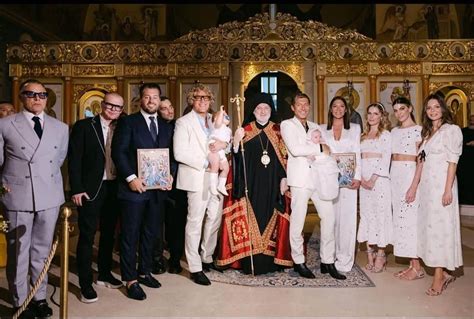
Elpi at the “big, fat Greek gay baptism”

The CIA’s Man in Constantinople

The U.S. government is making itself felt in Orthodox internal politics.

(The following article is so good that Handwritings’ editor has decided to lift it wholesale from its original publication, The American Conservative. All credit for this fine piece is attributed to its author, Michael Warren Davis. Photos and captions are not from the original text.)

Everyone knows that the Moscow Patriarchate is in bed with the Kremlin. Few realize that the Ecumenical Patriarchate of Constantinople is deeply beholden to the United States government. 

This ignorance is surprising, given that many Greek Orthodox leaders are quite proud of the fact. In 1942, Athenagoras Spyrou—the Archbishop of America for the Greek Orthodox Church—wrote to an agent of the Office of Strategic Services. “I have three Bishops, three hundred priests, and a large and far-flung organization,” Athenagoras wrote. “Every one under my order is under yours. You may command them for any service you require. There will be no questions asked and your directions will be executed faithfully.” 

In 1947, the OSS was rechristened as the Central Intelligence Agencyor CIA. One year later, Athenagoras was elected Ecumenical Patriarch of Constantinople, the spiritual leader of Eastern Orthodoxy. 

One might point out that, when Athenagoras reached out to the OSS, his native Greece was under Nazi occupation. It is understandable that a Greek bishop in America would support the American war effort. But it was more than that. Athenagoras was a strong supporter of American exceptionalism and encouraged Washington’s militarist foreign policy. The U.S. Consul in Istanbul recounted a conversation with Athenagoras in 1951: “As usual, he talked at some length of his belief that the United States must remain in the Near East for several centuries to fulfill the mission which had been given it by God to give freedom, prosperity and happiness to all people.”

(These quotes, by the way, are pulled from a talk given by an Orthodox historian called Matthew Namee at Holy Cross Hellenic College, the Greek seminary in Boston. These are not malicious forgeries peddled by Russian propagandists—the Greek Orthodox are quite proud of their association with the American deep state.)

Athenagoras was not merely an Americanist. He was also known as a renovationist, as liberal Orthodox are known. In 1964, he met with Pope Paul VI in Jerusalem; together, they officially lift the mutual excommunications placed by their predecessors in 1054. This gesture sparked outrage across Orthodox world. Athenagoras was accused of compromising the Orthodox Faith for the sake of a paper union with Rome.

Bartholomew whispering sweet nothings into Elpidophoros’ ear.

The current Ecumenical Patriarch, Bartholomew, is cut from the same cloth as Athenagoras. He is very close to Pope Francis; the two share a passion for mass immigration and environmental activism. Also like Athenagoras, Bartholomew shares a close relationship with the U.S. government—a partnership that has proven mutually beneficial.

The Ecumenical Patriarch is the spiritual leader of Orthodoxy. However, he only has direct jurisdiction over a few thousand Orthodox Christians in Turkey. The rest of the Greek Orthodox world are autocephalous, or self-governing. This includes the Church of Greece, the Church of Cyprus, and the American metropolises (or dioceses). Many look to Bartholomew for leadership, but they are not directly under his authority. It is also worth noting that a large majority of Orthodox Christians around the world belong to the Russian Orthodox tradition. These churches do not look to Bartholomew for leadership in any meaningful way. Some, like the Patriarchate of Moscow, are in schism with Constantinople.

Bartholomew is not the “pope” of Orthodoxy—although he would like to be. Over the last few decades, the ecumenical patriarch has also worked to consolidate hard power over the various Greek Orthodox churches. This effort has proven most fruitful in the United States. 

In 2014, Elpidophoros Lambriniadis, the current Archbishop of America and Bartholomew’s heir apparent, published a short essay called “First Without Equals.” Its name was a play on the phrase primus inter pares, or first among equals. This title originally referred to the Pope of Rome, but was transferred to Patriarch of Constantinople by the Orthodox following the Great Schism of 1054. Of course, the Schism itself was caused in no small part by a sense that the Roman Pontiffs failed to respect the rights and privileges of their fellow bishops, especially in the Christian East. Clearly, the Archbishop was signaling his desire to cultivate a more authoritarian, centralist ecclesiology within the Orthodox Church, a philosophy which has been dubbed Greek papism

In 2022, during an interview with the Greek newspaper Ta Nea, Elpidophoros was asked if he expected to become the next Ecumenical Patriarch. Elpidophoros demurred, claiming that “the succession will be decided by God.” This, too, is a radical departure from Orthodox tradition. In fact, it goes beyond Greek papism. Even the Roman Catholic Church explicitly denies that the Pope is chosen by God.

Nevertheless, the United States government officially supports the doctrine of Greek papism, as will be shown. Strengthening the Ecumenical Patriarchate’s position within global Orthodoxy serves two purposes. First, it necessarily subtracts from the influence of Constantinople’s rival, the Moscow Patriarchate. Washington regards Russian Orthodoxy as a tool for Kremlin propaganda and, therefore, a legitimate target for counterintelligence operations. Secondly, the renovationist Ecumenical Patriarchs are willing partners in Washington’s campaign to spread liberal, democratic values across the globe. 

Consider, for example, the schism in the Ukrainian Church. In 1990, the Patriarchate of Moscow granted self-governing status to the Ukrainian Orthodox Church (UOC). It was not, however, given full autocephaly. However, a group of Ukrainian nationalists led by then-president Minister Petro Poroshenko organized an “independent” Orthodox Church of Ukraine (OCU). With the support of Western media, these nationalists successfully branded the canonical UOC as the “Russian Church.”

In 2018, when asked about the Orthodox Church of Ukraine’s bid for autocephaly, Kurt Volker—then Special Representative of the United States Department of State for Ukraine—appeared to wave the question off. He insisted that the U.S. government does not take a position on such matters and would respect the decision of Bartholomew and his synod. 

Make no mistake: By declaring that the decision belongs to the Ecumenical Patriarchate, the U.S. government is taking a position. First of all, autocephaly cannot be granted unilaterally by any patriarch or bishop. Second, if the decision belonged to anyone, it would be the Patriarch of Moscow, the spiritual leader of Slavic Orthodoxy. Even the great Kallistos Ware denounced the Ecumenical Patriarchate for meddling in the Ukrainian Church:

Though I am a metropolitan of the Ecumenical Patriarchate, I am not at all happy about the position taken by Patriarch Bartholomew. With all due respect to my Patriarch, I am bound to say that I agree with the view expressed by the Patriarchate of Moscow that Ukraine belongs to the Russian Church. After all, the Metropolia of Kiev by an agreement of 1676 was transferred from the omophorion of the Ecumenical Patriarchate to that of the Patriarchate of Moscow. So, for 330 years Ukraine has been part of the Russian Church.

Third, just days before Volker gave his interview, Joe Biden—then only the former vice president—flew to Ukraine to express his support for the OCU. As soon as Bartholomew ruled in favor of the OCU church, Secretary of State Mike Pompeo expressed the Trump administration’s firm support for his decision. Since Russia’s invasion of Ukraine, our government has implicitly supported Ukrainian president Vladimir Zelensky’s policy of seizing property(including church buildings) from the UOC and transferring them to the OCU. In one particularly egregious episode, a nationalist mob attacked a UOC church in the middle of a funeral, dispersed the worshippers and beat the celebrant-priest so badly he had to be hospitalized. The kicker? It was a funeral for a Ukrainian soldier who died fighting against Russia.

This one detail cannot be emphasized enough: Whatever the media claims, the canonical UOC is not an arm of Russian influence. Its members are not “pro-Russia”; much less are they Russian collaborators. They, too, are giving their lives to defend their homeland against Russian aggression. But that doesn’t matter to Washington or Constantinople. By supporting the separatists, Bartholomew is undermining Moscow’s influence within global Orthodoxy. And that’s good for the Russophobes in our foreign-policy establishment.

In 2019, the State Department gave $100,000 to the Orthodox Times, a news site strongly aligned with the Ecumenical Patriarchate. The purpose? “To counter entities spreading fake news and misguiding believers in Orthodox communities”—in other words, Russian disinformation. 

It’s ironic that Trump’s State Department pursued this pro-Constantinople agenda given that the Ecumenical Patriarchate is openly and proudly aligned with the Democratic Party. The Greek Orthodox Archdiocese of America boasts: 

President Truman often emphasized the pro-American convictions of Patriarch Athenagoras and the importance and influence of the Ecumenical Patriarchate, along with the Greek Orthodox community in the U.S., as vital to American foreign policy objectives. Indeed, Truman saw the Patriarchate and Athenagoras as crucial to bolstering the pro-Western resolve of both Greece and Turkey, as well as to promoting stability in the Middle East.

In 2020, Patriarch Bartholomew wrote to congratulate his old friend Biden for defeating Donald Trump in the presidential election. “You can only imagine my great joy and pride for your successful election as the 46th president of your distinguished nation, the United States of America.” Archbishop Elpidophoros, in that same interview with Ta Nea, also offered a thinly-veiled endorsement of Joe Biden:

In America, the issue of abortion has been completely politicized…. It is as if the only qualification for being a good Christian or a good politician depends on one’s stance on the issue of abortion. All other principles and doctrines of Christianity do not matter; you can be a crook, a liar, a swindler, a warmonger, violent, or a misogynist, but if you are against abortion, then you are a politician suitable enough for “pious people” to support.

As Rod Dreher pointed out, this little-noticed interview contains quite a few shocking revelations. For instance, Elpidophoros is not simply concerned that abortion has been “politicized”: he is openly pro-choice. “Women bear the full burden in giving birth and raising their children, while men, otherwise directly involved in the pregnancy, do not bear the same burden,” he told Ta Nea. “Therefore, we must support women’s right to make reproductive decisions of their own free will.” Elpidophoros also discusses how proud he was to support the protests which erupted after the death of George Floyd, as well as the infamous “gay baptism.”

For those who aren’t up on their Orthodox church politics: In 2022, Elpidophoros baptized the sons of two wealthy Greek-Americans, Evangelo Bousis and Peter Dundas. (The children were conceived through surrogacy.) The baptism was performed in Vouliagmeni, a suburb of Athens. This set off a firestorm in world Orthodoxy for two reasons. Firstly, it is wrong to baptize a child if there is little to no chance of their being raised according to the Church’s teachings. The parents are making a commitment to their child to the Christian faith without giving them the tools to fulfill that commitment. Second, visiting clergy (including bishops) must receive permission from the local metropolitan before publicly celebrating the sacraments within their jurisdiction. In this case, the local metropolitan was Antonios of Glyfada. Elpidophoros requested and was granted permission to baptize the children of an American couple, but did not inform Antonios that the parents were a same-sex couple. 

Elpidophoros was condemned by the Holy Synod of the Church of Greece as well as the monks of Mount Athos, but he didn’t care. The Archbishop was simply giving the Orthodox world a taste of how he’ll do things once he becomes Ecumenical Patriarch. 

Karloutsos yucking it up with Elpidophoros. Rumor has it that, truth be told, they can’t stand each other.

There’s more. In 2019, Elpidophoros appointed Father Alexander Karloutsos as vicar-general for the Archdiocese of America. Father Alexander is, for all practical purposes, the Biden family’s pastor. He sits on the board of the Beau Biden Foundation and serves as a spiritual advisor to the President. In 2015, Father Alexander attended a (now infamous) dinner hosted by Hunter Biden at the Café Milano in Georgetown. The dinner was a private reception for several Eastern European oligarchs, including Yury Luzhkov, the profoundly corrupt former Mayor of Moscow. This was the night that Hunter introduced his father to Vadym Pozharskyi, an executive at Burisma, allegedly fulfilling the deal for which Baturina had paid Hunter $3.5 million the year before.

More troublingly, Father Alexander is also close to John Poulos, the Greek-Canadian founder of Dominion Voting Systems. Father Alexander has been credibly accused of serving as a go-between for Poulos and the Bidens during the 2020 election scandal. It is said that the priest relayed information between the two parties, but cannot be subpoenaed due to New York’s clergy privilege laws. Though all parties admit that Father Alexander was in frequent communication with both parties during that time, they also insist that he was simply offering them spiritual counsel. Undoubtedly both Poulos and Biden spent those difficult months in prayer and fasting.

As it happens, in 2018, Father Alexander also found himself at the center of an $80 million financial scandal, which was probed by the U.S. government. The federal government’s investigation to the matter was dropped shortly after it began, despite the fact that no explanation was ever unearthed. When President Biden awarded Father Alexander the Presidential Medal of Freedom last year, he jokingly warned, “I’m going to ruin your reputation by talking.”

Unfortunately, such allegations of corruption are fairly widespread in the Archdiocese of America. The Greek Orthodox Church is by far the wealthiest denomination in this country relative to its size. (A Roman Catholic priest can expect to make no more than $45,000 per year; a Greek Orthodox priest can earn upwards of $130,000.) There are many well-established second-generation families who still feel a deep loyalty to the Church even if they tend not to practice very faithfully. 

In other words, the Archdiocese of America is in roughly the same position that the Catholic Church was under Kennedy. It is rich in capital and assets but largely beholden to secular, liberal donors. Hence why the Hellenic College Holy Cross, the Greek Orthodox seminary, refers to former congressman Michael Huffington as a “faithful Orthodox Christian” despite the fact that he’s a practicing homosexual who publicly dissents from the Church’s teaching on sexuality.

Happily, most Greek Orthodox jurisdictions are not renovationist; neither are they in the pocket of the American government or beholden to liberal, secular donors. In fact, when the Greek parliament voted to ratify same-sex marriage, the Church of Greece called the decision “demonic” and excommunicated several of the “immoral lawmakers” who voted for the bill. 

But whatever our government may claim, it will promote Bartholomew and his successor, Elpidophoros, as “Greek Popes” in order to liberalize Greek Orthodoxy and counter Russian Orthodoxy. This is the policy of the U.S. government. There are State Department personnel (and taxpayer dollars) dedicated to achieving this exact goal. It is discussed—openly; gleefully—in the major institutions of the Ecumenical Patriarchate and the Archdiocese of America. And yet anyone who suggests that this is a gross betrayal of both the American people and the Orthodox faithful is immediately accused of being a “Russian asset.” Go figure.

EDITOR’S COMMENT: The author of this fine article, Michael Warren Davis, lays all the cards on the table vis à vis the infuriating duplicity of Greek Orthodoxy’s two jackals, Bartholomew and Elpidophoros, and Karloutsos, the hyena. We might ask ourselves whom we have to blame for promoting those three men’s betrayal of our Faith and their unjustified enmity against Russian Orthodoxy.

Why, no one else but our very own CIA and the Biden administration!

A vote to reëlect Biden and his Democrats this fall will be a vote to support the corruption which is American foreign policy for Ukraine and a vote to deepen the rift between Moscow and Istanbul, aka Constantinople. You many American Greeks who intend to defy righteousness and do just that had best take a time to fast and pray before you vote, knowing that heaven will hold you responsible for your 2024 ballot.