What a boring topic for an American! Respect your elders? That notion runs counter to the hubris of our youth-centered popular culture. To be honest, I wasn’t particularly respectful of my elders when I was young, but that was a long time ago, so my memory is fuzzy. I do remember being a teacher’s pet in second grade, though.
I went off to live and work in Japan for many years right after college. Oh, how things were different there! The deference granted older people in a Confucian society was quite noticeable. Accurately explained, it is the deference shown to those with seniority, not necessarily those who are just older. Even the young buck in a company was given a modicum of authority over an older person who had been hired at a later date. However, given the glacial uniformity in which Japanese society moves…or did move…those with seniority in any organization were normally older in years since birth as well.
My wife and I received an invitation recently from a young couple for whom we had performed a certain service. It was gracious of them to invite us to dinner at their new home. The wife is a trust fund baby, so they had the financial wherewithal to move up in our expensive urban real estate market. The couple are cheerful and bright and absolutely full of themselves. They are the kind who have little self-restraint in the midst of a conversation. My wife or I might start to say something at the dinner table, but one or the other of the couple would think of something apparently worthy of interrupting what we were trying to say. The conversation inevitably steered back to their affairs and was loaded with boasting about their accomplishments, which are actually few since they are still young, besides all of the gadgets that they have bought on Amazon. My wife and I were the ones who had been invited to dinner, so it would have been rude of us to overpower them and wrest back control of the conversation, and my wife is Japanese, so we remained silent and nodded appropriately as they droned on about themselves. All the while I thought that this sort of conversational domination would not have occurred in the Japan that we remember.
Inevitably, when you are smart and aware of current events and you run off at the mouth, you are apt to delve into politics. The couple were typical liberals from a typically liberal region, who were now living in another typically liberal city. Since they are young and wealthy, and have for their short lives lived in liberal hot houses, they don’t consider their views to be at all out of the ordinary.
To them, abortion rights are a matter of course. Half of all company presidents should be women. The government should raise the minimum wage. And, of course, Donald Trump is a felon. There should be no debate about any of these things as far as they are concerned. I must admit that they allowed me to ask some pointed questions to raise faint objection to the onslaught. When I responded with silence or mild incredulity to their energetic bloviation, they admitted that I was allowed to have a contrary opinion. That was alright. After all, they are liberals. Beyond that, they had not a modicum of the kind of deference that would have been granted an elder in a Japanese household. How could I expect them to be deferent, since their short life experience has been so limited and so trivial?
The whole evening was an ascetic exercise in self-restraint for me. And, the cooking wasn’t very good, to boot. This will sound curmudgeonly, but I don’t plan to invite them for dinner, nor do I plan to accept another invitation from them, should it come. Why not? Beside the dysfunction in conversation that I have described, there is another reason. The expressions of differences in opinion regarding politics are no longer academic exercises, as far as I am concerned. The major problems that we deal with today have immoral causes, and offenses against morals contribute to the breakdown of our society as a whole. As one example, the abandonment by so many fathers of their families, especially amongst the black population, is due to the ravages of the sexual revolution and the replacement of nurturing fathers by the nanny state. This gives indirect cause to violent crime, an even more devastating problem. The depopulation of native Americans – anyone born and raised in our country, not just Indians – is largely due to the proliferation of artificial birth control and easy access to abortion. These are but three examples.
Those are life and death issues for our society, and I would be disingenuous if I simply considered them to be a matter of opinion. Godless progressivism is a national scourge that must be opposed and retarded, if not utterly destroyed. Our American society is slowly committing suicide, and the atheists who promote the pernicious policies of the progressive cause have the gun pointed at our collective temple. Young liberals who don’t understand the threat of their mindset would do well to be quiet and listen to older conservatives who have the experience to speak with a greater degree of wisdom.
Post Script: Pres. Joe Biden was born a month after my eldest brother of blessèd memory, who would have turned 80 this month. In my last article, I demonstrated little respect for our elderly president, so you may consider me to be a hypocrite. If so, I suppose I am guilty as charged. I am not sure that I would show the proper respect for our president if I were to meet him in person, so offended am I at what he has done to destroy our country. I solicit your prayers.
(I wrote this article a year ago this month, but didn’t publish it. Now that I’ve reread it, I’ve decided to “run it up the flagpole to see if anyone salutes”.)
An Anglican friend of mine recently commented that he was looking forward to the year 2054. Puzzled, I asked, “Why 2054?” He explained that 2054 would mark one thousand years since 1054 when the Great Schism took place. He went on to explain that he and others were hoping that by 2054 Roman Catholic, Anglican, and Orthodox Christians would all be reunited. I responded by saying that while the Great Schism of 1054 was a great tragedy and that the reunion of Christians would be laudable, there remain significant differences between Anglicanism and Orthodoxy. This article is an expansion on that brief remark.
The FilioquePhrase
The Nicene Creed was meant to be the universal creed for all Christians, yet Anglicans, Roman Catholics, and mainline Protestants use an altered version of the Nicene Creed. When they recite the Nicene Creed, they insert “and the Son” into the passage about the Holy Spirit.
The “Filioque” is a Latin phrase meaning “and the Son.” It was first added to the Nicene Creed at the Third Council of Toledo (589) at the direction of King Reccared. The interpolation was made to signify Spain’s rejection of Arianism and its embrace of the Catholic Faith. Many, however, found the Filioque objectionable. Even a pope objected—Leo III went so far as to have two silver shields made to display the unaltered Nicene Creed in Greek and Latin. The Filioque remained confined to the West and was never part of the patristic consensus. The situation changed when a pope added the Filioque to the Nicene Creed. In 1014, Pope Benedict VIII inserted the Filioque on the occasion of the coronation of Henry II as Emperor of the Holy Roman Empire. With this, the Filioque became normative for Roman Catholics and was elevated to the status of dogma. This was done despite the absence of an Ecumenical Council. This unilateral action by a pope would lead to the Great Schism of 1054.
The popularity of the Filioque among Western Christians is due in large part to their theology being based upon Augustine of Hippo. Augustine’s understanding of the Trinity included his notion of the double procession of the Holy Spirit. Orthodoxy find this teaching theologically suspect due to the implicit demotion of the Holy Spirit within the Trinity. Theologically, Anglicanism has more in common with Roman Catholicism than with the undivided Church of the first millennium and the patristic consensus. Beyond dropping the Filioque, it would also help if Anglicans, especially their clergy, were to become familiar with the teachings of the Cappadocian Fathers: Basil the Great, Gregory of Nyssa, and Gregory of Nazianzus, on the Trinity.
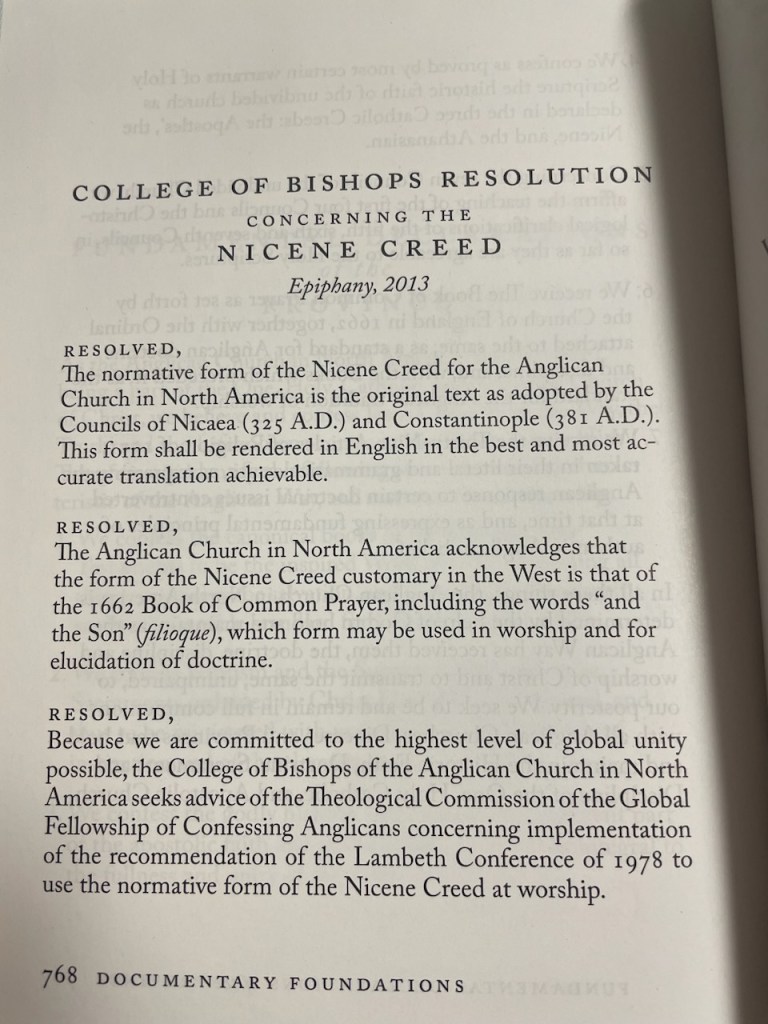
From my Anglican friend – ACNA’s official position on the Filioque (Thanks Dan!)
From time to time, I’ll visit my Anglican friends’ church. Upon entering, I’ll be given a printed order of service. After sitting down, I usually look over the songs and sermon title. Then I’ll turn to the Nicene Creed and see if they have dropped the Filioque phrase. From what I have seen so far, nothing has changed. My Anglican friends who are attracted to Orthodoxy tell me that they agree that the Filioque should not have been inserted into the Nicene Creed and that they prefer the more traditional version used by the Orthodox Church. Recently, one of them sent me a camera shot of the 2013 College of Bishops’ Resolution that affirmed the Nicene Creed of 325 and the Constantinopolitan Creed of 381 are to be considered normative for ACNA (Anglican Churches of North America).
However, that document went to note that the western form of the Nicene Creed, which contains the Filioque “may be used in worship and for elucidation of doctrine.” The resolution concludes with a request for advice on how to implement the resolution. But so far, no substantive change has taken place.
The efforts made by Anglicans to unite with Orthodoxy strikes me as timid and half-hearted. In this article, I offer some perspectives and advice about the prospects for union between Anglicans and Orthodoxy. I want to take a receptive and optimistic approach rather than a harsh, judgmental approach. However, this optimism must be tempered with realism and pragmatism.
Three Premises of Orthodoxy
Any discussion of union between Anglicanism and Orthodoxy must start with a proper understanding of Orthodoxy’s adherence to Tradition with a capital “T.” What defines Orthodoxy is the safeguarding of Tradition without change. Orthodoxy rejects the Filioque because it was unilaterally inserted by the Bishop of Rome without the endorsement of an Ecumenical Council. For this reason, Orthodoxy considers the Filioque to be an unwarranted innovation. Another essential point is that Orthodox theology is expressed primarily in its Liturgy, not in theological texts or in synodal resolutions. One further point is that the Seven Ecumenical Councils constitute the normative theological framework for Orthodoxy. Any successful union between Orthodoxy and Anglicanism will require that Anglicans accept all Seven Ecumenical Councils, even Nicea II (787) which calls for the veneration of icons.
I enjoy being with my Anglican friends because we have much in common. Like me, many of my Anglican friends are Evangelicals drawn to the Ancient Faith and the ancient liturgies. When I visit their church services, rather than scrutinize what their pastor has to say in his sermon, I pay close attention to their order of worship. My three suggestions presented below are quite simple and can be implemented the following Sunday.
1. Drop the Filioque Phrase
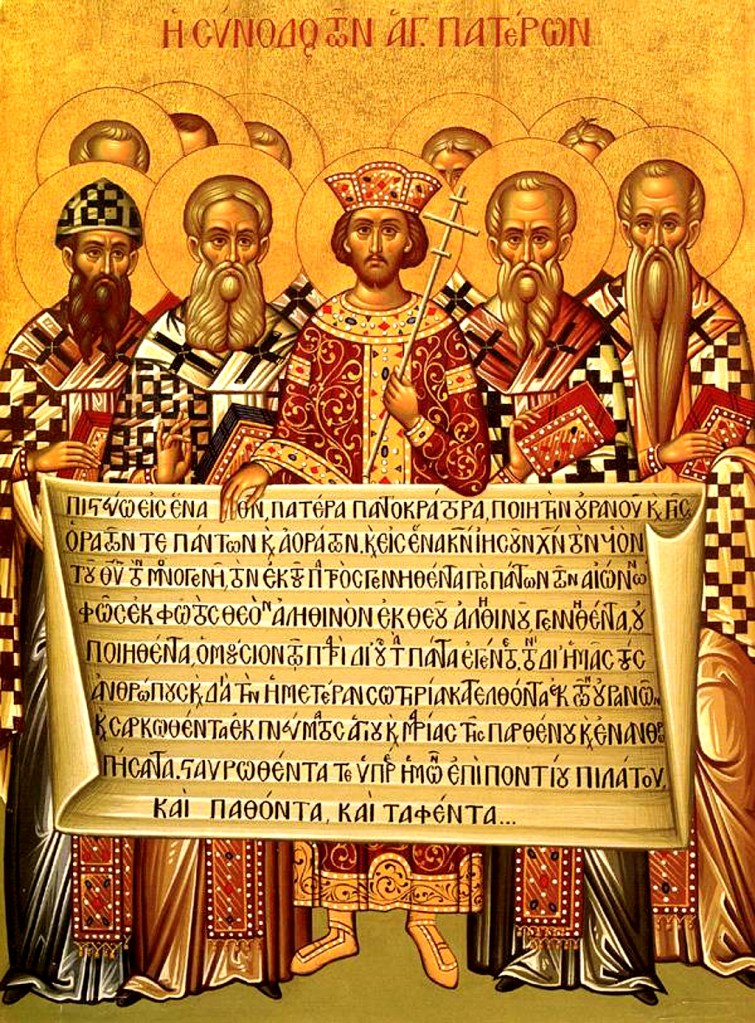
Icon depicting Constantine I with the Bishops of First Ecumenical Council.
I look forward to the day when I visit my Anglican friends’ church and upon examining the Nicene Creed, I find it to be identical to that used in my Orthodox parish. While it would help if the pastor were to state he has problems with the Filioque, the essential thing is that the printed order of worship leaves out altogether the Filioque. Linguistic devices such as asterisks and parentheses are to be avoided as these would be unacceptable to Orthodoxy. If Anglicans find this recommendation too difficult to accept, I will not be offended. I will recognize that they and their faith tradition have decided to walk apart from the Orthodox Church.
2. Include the Hymn “More Honorable Than the Cherubim”
While Anglicans and many mainline Protestants claim to accept the first four Ecumenical Councils: Nicea I, Constantinople I, Ephesus, and Chalcedon, they are de facto Nestorian. (Nestorianism is the heresy that refuses to acknowledge that the Virgin Mary gave birth to the God-Man Jesus. This is implied by the refusal to address Mary as the “Mother of God.” By only affirming that Mary gave birth to a human Jesus, Nestorians split Jesus’ humanity from his divinity resulting in a heretical Christology.) Rather than pass a resolution affirming the statements made at the Third and Fourth Ecumenical Councils that the Virgin Mary is the Theotokos: God-Bearer or Mother of God, it is far more important that the Virgin Mary be acknowledged as the Theotokos in the order of worship. On a few occasions, I told my Anglican deacon friend who has the responsibility of putting together the worship bulletin: “All you have to do is insert the hymn “More honorable than the cherubim” into your worship bulletin. It’s that simple!” That last sentence is said tongue in cheek because I know that for him it is far from a simple matter.
It is truly meet to bless thee, O Theotokos,
ever blessed and most blameless and the Mother of our God:
More honourable than the Cherubim,
and more glorious beyond compare than the Seraphim,
who without corruption gave birth to God the Word,
This hymn—known as the Megalynarion—is sung at every Orthodox Liturgy. It is sung immediately after the consecration of the bread and wine into the body and blood of Christ in the Eucharist. Every Orthodox Christian knows this hymn. It is not a nice add-on but rather an affirmation of a core doctrine: the Incarnation of God the Son for our salvation. This is an issue that rarely come up in our discussion, but it is an issue that must be faced if Anglicans truly desire unity with Orthodoxy.
3. Bring Icons into the Church
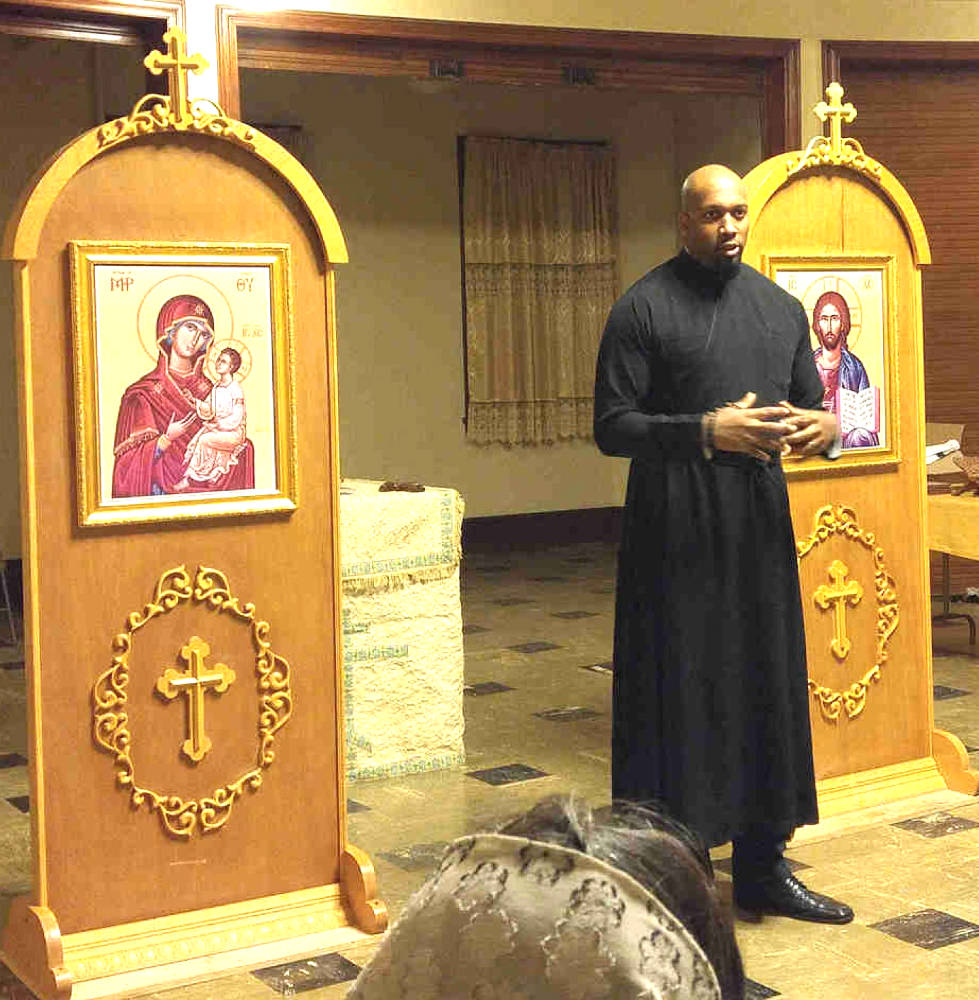
St. Simon of Cyrene Orthodox Mission in New Brunswick NJ (Source)
I have been pleasantly surprised to learn that many of my Anglican friends affirm that the Eucharist is to be the focal point of Sunday worship and that they believe in the real presence of Christ’s body and blood in the Eucharist. (Whether Anglicans have a valid Eucharist and episcopacy are issues I reserve for another occasion.) However, I am struck by the absence of icons when I visit their church services. I see an altar for the celebration of the Eucharist; I see vested clergy; I see strong similarities between their order of worship and the Liturgy of Saint John Chrysostom used at the local Orthodox parish I attend; but I am struck by the absence of icons. Icons are the hallmark of any Orthodox church. No matter where you go, you will find icons of Christ and the Virgin Mary in an Orthodox church. This is because the Seventh Ecumenical Council (Nicea II, 787) decreed that icons are a normative part of Christianity. Icons have been described as windows to heaven. They possess a sacramental quality that links the visible material world we inhabit with the invisible Kingdom of God. The presence of icons in a church would signify the hearty acceptance of the Seventh Ecumenical Council.
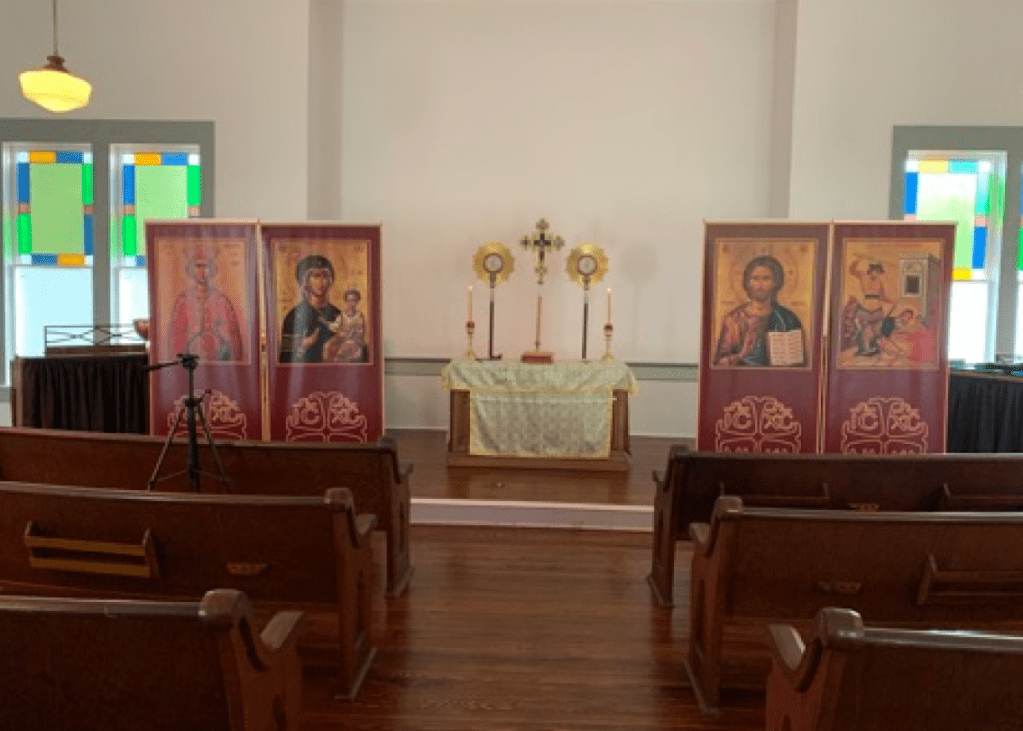
Starting off small. St. Stephen Orthodox Mission – Stephenville, TN (Source)
If my Anglican friends seriously desire union with Orthodoxy, my suggestion is that they order two 8.5” by 11” icons: the Pantocrator icon of Christ and the icon of the Virgin Mary holding the Christ Child; and that they place the two icons in front between the altar and the congregation. One key element would be the clergy and the members of the congregation venerating the icons. Usually when Orthodox Christians venerate an icon, they will bow down and kiss it. This may be too much for many Anglicans. My suggestion is that as the clergy process into the church, they bow at the waist to the icons to show reverence. Another suggestion is that members of the congregation bow or genuflect to the icons as they come forward to receive Holy Communion. The important thing to keep in mind is that one is not reverencing the picture but rather the person depicted in the picture.
Implementing these suggestions is not all that expensive, but it would be quite a challenge on grounds of theology and conscience. I recognize the serious difficulties contained in this suggestion for my Anglican friends, but I want to make clear to them that if they are truly desirous of union with Orthodoxy that the acceptance of icons and the veneration of icons are essential, non-negotiable items. Icons are an integral part of Christian worship. Churches without icons and worship services without the veneration of Jesus Christ and the saints constitute a break from historic Christianity. If my Anglican friends were to accept icons and venerate icons in their Sunday worship, they will have taken a giant step towards union with Orthodoxy and with the Ancient Church.
Anglicans’ Distance from the Seven Ecumenical Councils
Any fruitful engagement between Anglicans and Orthodoxy must be grounded in the Seven Ecumenical Councils. It may come as a shock but my Anglican friends must face the fact that their faith tradition has diverged significantly from the Seven Ecumenical Councils.
Anglicans depart from the First and Second Ecumenical Councils (Nicea I, 325 and Constantinople I, 381) when they recite the “Nicene Creed” which dates back to 1014.
In their Sunday worship, my Anglican friends implicitly reject the Third Ecumenical Council (Ephesus 431) and the Fourth Ecumenical Council (Chalcedon 451) when they omit the hymn “More Honorable than the Cherubim” which explicitly calls Mary the Theotokos (Mother of God).
Many Anglicans, especially those of low church or of Reformed persuasion, are unabashedly iconoclasts. They unequivocally reject the Seventh Ecumenical Council (Nicea II 787). This is where Anglicanism most sharply diverges from Orthodoxy.
Here we see Anglicans rejecting 5 out of 7 Ecumenical Councils. Thus, the gap between conservative Anglicans and Orthodoxy is wider than most suspect.
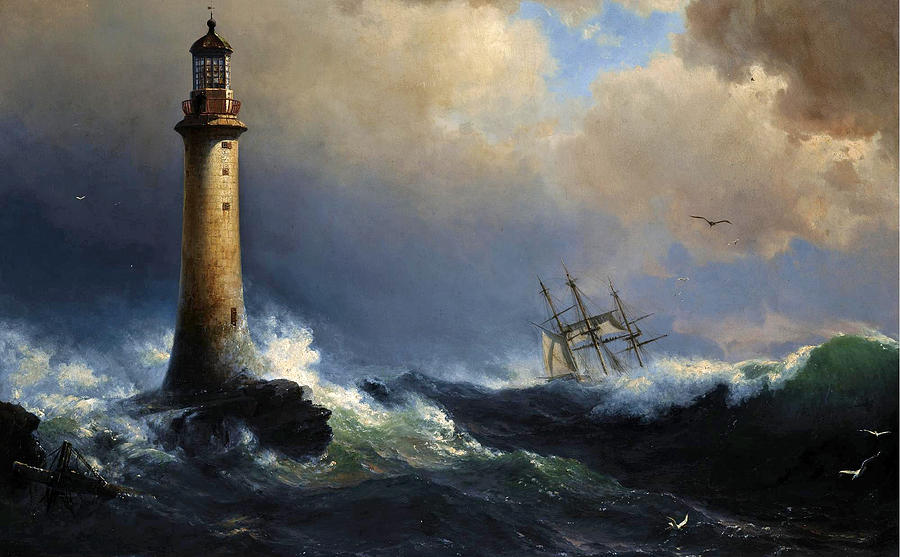
The ship in the storm and the lighthouse. How to bridge the gap? (Image source)
Closing the gap can be done, but it won’t be easy. If conservative Anglicans—those affiliated with ACNA and GAFCON—were to implement these three steps collectively, then rapprochement between the two traditions can be considered a real possibility.
Closing Questions
Let me frank and say this: Orthodoxy is a hard road to travel. Nonetheless, it is worth the cost because Orthodoxy is the true Faith. We are not going to change or compromise on Tradition. If you want to reunite with the Ancient Church, with the Church Fathers, and with the Ecumenical Councils, we will help you. If you are not ready, we will wait. If you decide to continue to walk a different path, we will recognize your freedom to choose such.
Anglicanism has from its inception had something of an identity crisis: It does not know whether it is Catholic or Protestant. From time to time, I’ll ask my Anglican friends: “What are you? Are you Catholic? Or are you Protestant?” In the meantime, my recommendation for my Anglican friends is that they continue to study the early Church Fathers, the Seven Ecumenical Councils, the lives of the saints, and church history. Study the history of Anglicanism and compare it against the early Church prior to the 1054 Great Schism. The quest for unity with Orthodoxy should be motivated by a desire for unity with the undivided Church of the first millennium.
I close with two questions:
Question 1 – Are there signs that Anglican churches in ACNA or GAFCON are taking the three steps I presented?
Question 2 – If there are few signs of ACNA or GAFCON embracing the ancient forms of worship, why wait until 2054? Why not visit the local Orthodox parish in your area and investigate becoming a catechumen?
Many Orthodox Christians have watched with dismay as the Episcopal Church and the Church of England declined in numbers and embraced bizarre doctrines. The Church of England’s recent move to embrace same-sex marriage and transgenderism, which mark a break from historic Christian morality, has further compounded their grief. It looks as though Christianity in England has moved irreversibly from its historic Christian roots, but there is a bright spot in the present situation.
The YouTube channel “Ready to Harvest” uploaded a video with the foreboding title: “The End of the Church of England [11:05].” Much of what the video has to say about the troubles of the Church of England is not new to those who follow conservative Anglican websites like VirtueOnline and AnglicanInk. But what is new and what we wish to bring to our readers’ attention is the fact that Orthodoxy in England is alive and well. As a matter of fact, it is doing very well! At the 4:40 mark, a chart is displayed showing that the Orthodox Church in a three-decade span from 1990 to 2019 has grown from 185,000 to 475,000. It has more than doubled! Orthodoxy is doing much better than Pentecostalism, Methodism, and Presbyterianism. It may be that the future of Christianity in England lies in Orthodoxy.
The explanation for this growth has been attributed to the Orthodox Church’s not adapting theology to contemporary culture, but instead offering a “full-fat” faith that embraces the supernatural. Orthodoxy’s theological conservatism and its so-called “ultra-liturgical” worship is not rooted in cultural conservatism but rather in its adherence to Apostolic Tradition. We are mindful of the Apostle Paul’s admonition to the Christians in Thessalonica to hold tight to Tradition whether “by word of mouth or by letter,” i.e., Oral Tradition or Written Tradition (Scripture). (2 Thessalonians 2:15)
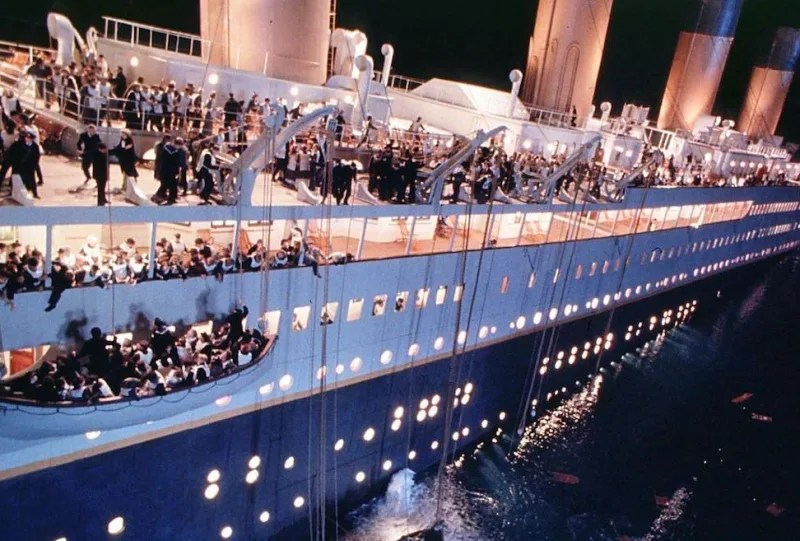
The present-day Church of England is like the “unsinkable” Titanic which is listing and slowly slipping into the cold ocean waters. Many passengers are getting nervous and worried, despite the soothing words of the dignified and smiling captain. As this venerable religious institution slide into apostasy, it is time for Orthodox Christians to let their Episcopal and Anglican friends and family members know about the Ark of Salvation (the Orthodox Church).
“Dear one, I think there’s something amiss with our unsinkable ship. What think you?”
In light of the Church of England’s and The Episcopal Church’s slide into apostasy, it looks as though ecumenical engagement by Patriarch Bartholomew and Archbishop Elpidophoros is futile. We humbly suggest that our Orthodox hierarchs instead engage in ecumenical dialogue with ACNA (Anglican Church in North America) and GAFCON (Global Anglican Future Conference). These Anglican bodies still hold to many of the historic Christian doctrines; and among its members and clergy, there is growing interest in the early Church and the Orthodox Church. These two factors form the basis for potentially fruitful ecumenical engagement.
Not all ecumenical dialogue is bad, but such dialogue must be grounded in the Ancient Faith as defined by the Seven Ecumenical Councils. This is the kind of ecumenism that Orthodox Christians should encourage. The Orthodox Church is not sectarian but Catholic—universal and embracing the fullness of Tradition. Apostolic Tradition is a precious heritage that links us to the Apostles. Tradition is not something to be hoarded but presented to all who seeking the true Faith and right worship of the Trinity: Father, Son, and Holy Spirit.
Icon of the Church as the Ark of Salvation. Source: Uncut Mountain Supply. Support this ministry by ordering a copy of this icon.
Now a bishop must be above reproach… he must be well thought of by outsiders, or he may fall into reproach and the snare of the devil.
(I Tim. 3:2,7 RSV)
The inimitable archbishop of the Greek Orthodox Archdiocese has done it again. Elpidophoros used the occasion of Bartholomew’s name day, June 10, to make the provocative move of returning to St. Bartholomew’s Episcopal Church in Manhattan for another service.
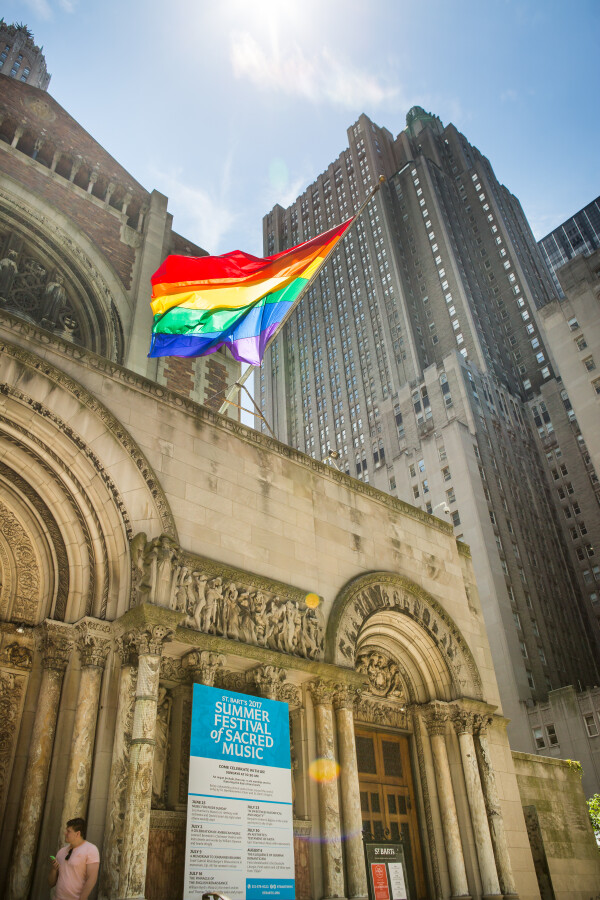
St. Bart’s has updated their pride flag since this photograph was taken in 2017.
Now we have the transcript of the little non-homily that he gave at the vespers service there, about which I have some things to say. First of all, the clericalism that spills trippingly from the archbishop’s lips leaves a bad taste in my mouth. Elpidophoros lays the obsequious praise on thick when he says,
“His All-Holiness is the very definition of ecumenicity,” and, “The Ecumenical Patriarch is a spiritual father for all people, whether they realize it or not.”
I write this on Father’s Day. Allow me to use this occasion to say unequivocally that, if Bartholomew is to be termed a father, he has failed miserably in his role.
Take Ukraine, for example. Bartholomew has betrayed the Ukrainian Orthodox Church (UOC) by creating a phony copy of a church by a similar name at the behest of corrupt political leaders in Ukraine and the United States. Now that the war with Russia is on, Bartholomew has nothing to say in protest against the monstrous treatment that the OCU and Pres. Zelensky have dished out to Met. Onuphry, Abp. Pavel, and the monks and seminarians of the Kievan Caves Lavra. UOC clergy and their parishes throughout Ukraine have been placed in the crucible of terrible suffering for Christ. If Bartholomew is a spiritual father, as Elpidophoros claims, he has behaved like a father who has abandoned his children. He needs to be held responsible for it.
Saints of the lavra
Must it be reiterated to a hierarch that we Orthodox refuse to accept the contention that the “Ecumenical Patriarch” is “a spiritual father for all people”? “All people“, you say? An Eastern Pope is he? Elpidophoros is certainly a stubborn man. He just will not drop the heretical notion of primus sine paribus. No, sir, that patriarch – no patriarch – is first without equal, regardless of the personage who occupies that throne or any throne. An incumbent Patriarch of Constantinople may be an unparalleled saint like St. John Chrysostom, but his preeminence among bishops is only one of honor, not one of authority. It was Rome’s own claim to universal and immediate authority throughout the Church that ironically led Rome astray from the Church, where it remains to this day.
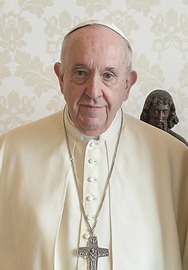
Pope Francis
“The Roman Pontiff, by reason of his office as Vicar of Christ, and as pastor of the entire Church has full, supreme, and universal power over the whole Church, a power which he can always exercise unhindered.”
(Catechism of the Catholic Church, Para. No. 882)
This papist claim is rejected by the Orthodox Church, which maintains an ecclesiastical polity of conciliarity. All ruling bishops are equals who render honor to their several patriarchs, but do not relinquish authority over their own dioceses. When they need to make decisions binding upon the wider Church they meet in councils
“His All-Holiness acts like a spiritual wheel in the world – holding the traditions fast in the hub of the Holy Mother Church. But he reaches out as well through spokes that extend in love and compassion to all people. No one is ever beneath or unworthy of the love of God.”
Elpidophoros
Met. Onuphry, UOC
Yeah, tell that to Metropolitan Onuphry, whom Bartholomew has betrayed. No one is unworthy of love except perhaps the people of the Ukrainian Orthodox Church, which “His All-Holiness” has abandoned like a deadbeat father! Elpidophoros’ obsequious praise rings hollow when one realizes that he is partly responsible for the current suffering in Ukraine. It’s outrageous.
“Being in this church, borrowed from another Christian tradition, is a sign of our expansive and embracing love for all people. It is a symbolic act that many will try to interpret through their own filters of grievance, prejudice, and lack of basic human kindness.”
Elpidophoros
If Elpidophoros did not know what he was doing the first time he rented all-gay St. Bart’s Episcopal Church two years ago, he certainly must have known this time. St. Bart’s is a buzzing hive of the Woke Gospel of Sexual Deviancy. It is not the behavior of a bishop who is above reproach to purposely leave his own cathedral behind and make a not-so-subtle gesture of solidarity with the flaming heretics at St. Bart’s. Elpidophoros’ very presence there officiating at a vespers service was in-your-face scandalous behavior. He could just as well have conducted the service at the cathedral on 79th Street or down in the Battery at St. Nicholas Shrine, but he was deliberately making a gesture to the faithful of the Greek Orthodox Church and other Orthodox in this country. What gesture, you say? Elpidophoros was raising his proverbial middle finger at us. We know it, and he knows that we know it, but he did it despite of it all. A lot of people are justifiably angry at him.
Ouch!
And, ye fathers, provoke not your children to wrath: but bring them up in the nurture and admonition of the Lord
Ephesians 6:4 KJV
That’s a note for spiritual fathers, as well. Don’t provoke us with deliberate acts of spite and veiled words of scorn.
“Because of this vision, His All-Holiness has stood – an immovable rock of faith and piety – against the Russian invasion of Ukraine and the complicity of the Russian Orthodox Church in its shameful support for this unconscionable war of aggression.”
Elpidophoros
War-torn Ukraine
If HAH Bartholomew had not taken sides against the Russians and created a bogus ecclesial structure before the special military operation began, Ukraine might not be in this mess. Certainly the Ukrainian Orthodox Church would not be, since the Ukrainian government would not have a counterfeit church to claim as the legitimate one. Elpidophoros might be able to proclaim the love of Christ for the Russian Orthodox, too. Both he and his boss may be in for an historically rude awakening if Russian wins this war and occupies Ukraine. The vaunted Ecumenical Patriarchate may be taken down a peg then.
“But more than his long and glorious tenure, he (Bart.) has opened the Mother Church’s embrace to the world, by engaging world leaders at every level. And now, with World Orthodoxy on the brink of fragmentation, he has stood firm for the truth of the Gospel.”
Elpidophoros
Oh, please! World Orthodoxy is indeed on the brink of fragmentation, and Bartholomew’s antagonism to Russia and his ultra vires meddling in the affairs of Ukraine have been the direct cause of the split. Perhaps Bartholomew considers himself to be a true disciple of Jesus Christ who proclaimed that he had not come to bring peace, but a sword. (Note the sardonic tone.)
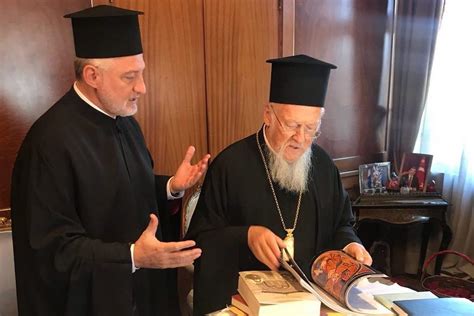
Elpi and Bart
Elpidophoros’ first visit in 2021 to St. Bart’s Episcopal Church was shocking; this second visit is absolutely exasperating. Unconscionable. I know that I speak for many other people when I express my disgust at his chutzpah, a quality of character that is not normally associated with of a bishop who is above reproach. It’s astounding that Elpidophoros has not been deposed for his repeatedly outrageous behavior. How far has the Greek Orthodox Church sunk that they continue to tolerate this man? How long will the other American hierarchs put up with his heresies?
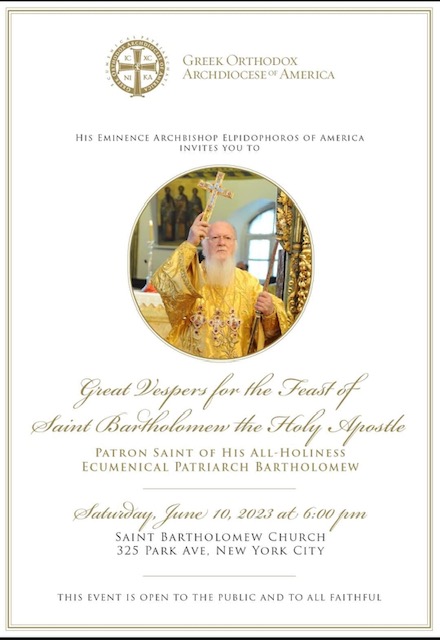
Elpidophoros, the one and only archbishop of the Greek Orthodox Archdiocese, is back at St. Bart’s. Yes, it’s true. Elpi is returning to the grand byzantine structure to officiate at Great Vespers on Saturday, June 10.
Symbolism and virtue signaling are part of the clerical syllabary. Without speaking a word, a bishop uses familiar non-verbal communication to indicate the authority of his office and the policies that he plans to execute. Nothing else need be said in addition to the obvious symbols displayed at the juxtaposition of Abp. Elpidophoros, St. Bartholomew’s Episcopal Church and the Feast of St. Bartholomew.
Patriarch Bartholomew, the Narcissist, appears to give his blessing to this travesty on his name day.
Nevertheless, I am going to say them anyway because Elpidophoros’ plans for tomorrow amount to insult added to injury. This isn’t the first time that the archbishop will have gone out of his way to pray in this most unorthodox Protestant parish. He went to St. Bart’s in June of 2021, not for Vespers, but to celebrate the Divine Liturgy! Even then it was clear to all that St. Bart’s stood for the “queering of Manhattan”. Their website promoted such perverse sexual policies, and the gay flag of many colors snapped smartly outside the west door to the church. It was no mystery that the parish had been captured by the deceptively “progressive movement”.
Even if Elpidophoros had passed under the rainbow flag in a tee shirt, it would have raised eyebrows. But on that occasion, he boldly entered the church, vested in his archiepiscopal finery, and celebrated at the same high altar that is used weekly by heretics and scoundrels. The message communicated by this brazen act was this: We identify with you and concur with your policies. I don’t think that I am reading too much into the symbolism.
St. Bart’s Pride Flag now has a transsexual chevron, evidence of ever-deepening depravity.
That act by Elpidophoros caused a firestorm of protest. We need to pause and remind ourselves that the objections raised by many who were scandalized were not raised on the basis of some novel teaching favored by the masses. On the ontrary, they were made in support of the Orthodox Church’s own teachings against sexual sin. The people said the very things that the archbishop himself should have been saying! Why had he turned the tables on us? Why were the laity put in the uncomfortable place where they felt the need to guard the Faith against its own hierarchy?
One would think that Elpi would have learned from his gross error in judgement two years ago. But no, he certainly did not. He’s back at it again, going to the same parish on the same occasion to do the same thing. This sort of recalcitrant action indicates one of two things: either 1. Elpi is stupid; or 2. Elpi just doesn’t give a damn what the Church teaches about sex and he’s out to overturn the age-old norms. I’ve met his eminence, so I doubt whether he is stupid, but having spoken with him one on one, I suspect he doesn’t give a damn. He has a counterargument for every conventional opinion, whether it be on this subject or on the Ukrainian situation or on issues of GOA polity.
What we’re seeing here is this, folks. Elpi is raising his archepiscopal middle finger to the GOA and to all of the Orthodox paying attention. Remember that your silence will amount to tacit approval.










 Handwritings on the Wall