Dark Clouds with  a Bright Silver Lining


YouTube’s algorithm can produce interesting results. It recently recommended two sharply contrasting podcasts. One was a sober analysis of church decline in rural Illinois by a self-described “old geezer” Christian; the other was an “audit” by a young Gen-Z atheist who raved about his visit to an Orthodox Liturgy. That afternoon I found myself going back and forth between feeling pessimistic, and feeling hopeful as I watched the two videos.

The purpose of this article is to stimulate discussion about the current religious situation in the United States. Do we indeed have a church attendance crisis in America? Does Christianity have a future in America? Can Orthodoxy help reverse church decline in America?


The Coming Church Attendance Crisis” [54:12]


Tom Wadsworth, a former pastor and independent scholar, presents the findings of his survey research which he conducted in his hometown of Dixon, Illinois, from 1983 to 2023. His research deserves our attention because of its solid data and meticulous methodology. One surprising finding is that Gallup polls significantly overestimate the percentage of Americans who attend church/religious services. Where Gallup polls report that 31% of Americans attend church services (based on self-description), Wadsworth estimates that the actual percentage may be around 13% (based on head counts) (see 18:15-24:54; see 24:12). Wadsworth notes that if church attendance is 13% for a conservative, rural area, like Dixon, Illinois, then the rate of church attendance is likely to be even lower in major urban areas like Chicago, Orlando, New York, etc. In other words, the problem of church decline may be even worse than we think it is.

Wadsworth introduces the concept of “critical mass”—the minimum size or amount of something required to start or maintain a venture. For churches to survive they need a certain number of congregants and income to survive. Which begs the question: What are the critical thresholds needed for a church to survive? Wadsworth hypothesizes that if a church has: (1) 40 in attendance on average and (2) 60% of its attendees are 65+ in age, then that church is likely to close its doors in ten to twenty years (28:16). This numbers-driven approach is pragmatic and helps generate a realistic assessment of a congregation’s vitality. These two findings—actual attendance rates and critical mass needed for church growth—are what makes Wadsworth’s presentation noteworthy. Here he breaks new ground. While Wadsworth’s discussion of ten factors contributing to church decline (31:17-42:06) is also worth considering, this is familiar ground that has been discussed by others. Among the reasons he gives for church decline are the recent public pastor scandals, the pandemic lockdown, the polarizing effects of the religious right, the 9/11 effect—the ejection of religious fanaticism, youths rejecting the Evangelicalism of their parents, the effects of social media on socialization, the declining birth rate, and the fact that secular culture is now in fashion, etc.

Overall, this author finds Wadsworth’s discussion of possible causes for church decline to be full of insights. However, I do have a few quibbles with him. The youth’s rejection of their parents’ Evangelicalism is not so much a causal factor as it is a description of an aspect of the overall decline. Based on anecdotes I have read on the Internet; I am inclined to agree with his identifying the Religious Right as a contributing factor. However, one must also take into account the drift of the historic mainline denominations towards secularism and liberalism. The drift away from historic orthodoxy in the mainline denominations has resulted in liberal theology devoid of belief in the supernatural, i.e., watered down Christianity. As a former atheist, I find mainline Protestantism lacking the robustness and vitality of historic supernatural Christianity. Another factor I believe that Wadsworth’s analysis overlooks is the impact of rising divorce rates. I suspect that children of divorce find it harder to feel at home in churches that hold the intact nuclear family to be the norm; divorcees, single parents, never-married singles, and those with confused sexual identities will feel unwanted and marginalized.

An Atheist visits an ORTHODOX Church (and has a surprisingly nice time)” [25:20]

Jared Smith, creator of Heliocentric, visited an Antiochian Orthodox parish and rated it as “exceptional,” a “Knock ‘em dead! Home run out of the park!” experience. Unlike Tom Wadsworth’s careful analysis, Jared Smith’s report consists more of comparisons between what he saw at one Orthodox parish against other churches he had visited. He notes that a lot of thought and care had gone into the interior of All Saints Antiochian Orthodox Church and that the church was built for reverence. He contrasts this against the ugliness of the four bare walls of “the run-of-the-mill box church” or “a CVS church” (2:45-3:05).

Jared described how the greeter welcomed him warmly but did not pounce on him as in other churches. Then, as the greeter was explaining the church service, the priest entered the foyer, censing the room. The greeter paused, turned to the priest, and bowed in respect (5:36). For Jared Smith, that was impressive because it showed that in the Orthodox Liturgy, God is the center of the show, not you. I found his criticism of Protestantism’s audience-centered approach to worship quite insightful. It suggests that among the Gen-Z cohort there is a hunger for reverence that is not being met by Protestantism’s contemporary worship service. Jared Smith was surprised that he was invited to meet with the priest one-on-one (7:52). His  experience has been that pastors only meet with loyal church members, not with outsiders. Sadly, it seems that personal contact with the pastor has become a rare exception, especially with huge mega churches (18:20, 20:27). I was surprised by Smith’s observation of icons in the Orthodox church. The icons of the saints reminded him that we are not alone but surrounded by a great cloud of witnesses (11:05). This contrasts sharply with the Baptists’ emphasis on Jesus and you—and you alone.

Part of Jared’s church review was the coffee hour (16:14 ff.). He was surprised that the priest stayed around after the Liturgy, taught adult religious education class, talked with people after the class, then to Jared’s surprise, invited him to his house for coffee. For Jared, the one-on-one personal contact was a far more effective way of doing outreach than the didactic lecture approach favored by Protestant Evangelicals. He also noted that the priest did not attempt to argue him out of his atheism, but accepted him.

What I find striking is that Jared Smith is the demographic polar opposite of Tom Wadsworth. Jared is in his late 20s, a former Evangelical, a graduate of Wheaton College, etc. His glowing description of Orthodoxy represents a bright silver lining in an otherwise gloomy situation described by Tom Wadsworth.

Jared Smith’s positive assessment of Orthodoxy seems to be part of a broader trend. The New York Post in December 2024 published an article: “Young men leaving traditional churches for ‘masculine Orthodox Christianity in droves.” This article has caught the attention of many and has generated considerable discussions among Protestants. If Orthodoxy can appeal to Gen-Zs like Jared Smith, then it is possible that the problem of church decline can be arrested and possibly reversed.



What Does the Future Hold?

The overall religious picture for the United States looks grim. It is like a long, extended drought drying up the landscape with plants and trees everywhere slowly dying off. This religious drought has been going on for several decades now. Surprisingly, there are a few spots of greenery popping up here and there. One of these spiritual oases is Eastern Orthodoxy. The recent influx of young men flocking to Orthodoxy can be seen as something like a rain shower that potentially signals a change in season.

We could be witnessing Orthodoxy’s transition from being seen as an exotic transplant to a well-regarded alternative to Protestantism and Roman Catholicism. For that to happen, American Orthodoxy will need to experience solid church growth. In addition to welcoming inquirers, we will need to give attention to the nurture of cradle Orthodox. Orthodoxy will thrive if the children of recent converts along with the  grandchildren of immigrants are nurtured into a living faith in Christ. Both the recently-baptized convert and the recently-baptized infant whose ancestors embraced Orthodoxy centuries ago, are the future of Orthodoxy. For Orthodoxy to reverse the problem of church decline, we will need, not just thriving current parishes, but also new mission parishes planted in the same urban areas as well as in areas that have zero Orthodox parishes. For that to happen, we will need a wave of men to be ordained to the priesthood and the diaconate. And, we will need bishops that support the evangelization of America. We need a vibrant American Orthodoxy that presents the Ancient Faith to a post-Christian America.


Entering into the Harvest

And, let us not forget to pray. Jesus exhorted his followers:

The harvest is truly plentiful, but the laborers are few. Therefore pray the Lord of the harvest to send out laborers into His harvest. (Matthew 9:38, OSB)

The time of harvest has come. If you see new people at your local parish, that means that there is work to do. Let us welcome the visitors who seem lost in the Liturgy by giving them a helping hand. Let us invite them to join us for coffee after the Liturgy. If you see someone standing alone during coffee hour, introduce yourself to them. Getting the cold shoulder during the coffee hour can leave a bad impression after experiencing the Liturgy. Many first-time visitors are fearful of rejection, so be ready to put them at ease. Be ready to listen to them and to answer their questions, and be ready to share your faith story with the inquirer. Tell them how the Lord has been good to you. Let us keep in mind the words of Jesus:

Go home to your friends, and tell them what great things the Lord has done for you, and how He has had compassion on you. (Mark 5:19, OSB)
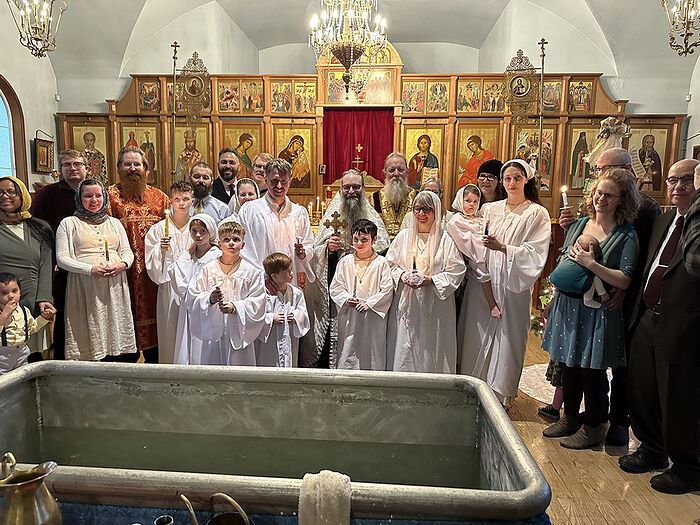
Newly illumined Orthodox Christians – Is this the future? Source


For Discussion

For readers who visit Handwritings, I would like to pose three questions:


Does your personal experience confirm or disconfirm Tom Wadsworth’s analysis of church decline?


Does your personal experience of Orthodox worship confirm or disconfirm Jared Smith’s positive assessment of Orthodoxy?


Do you think that Orthodoxy can help reverse church decline in America? How do you see that happening?
A Common Date for Easter = Church Unity?

Avoiding a Premature Union

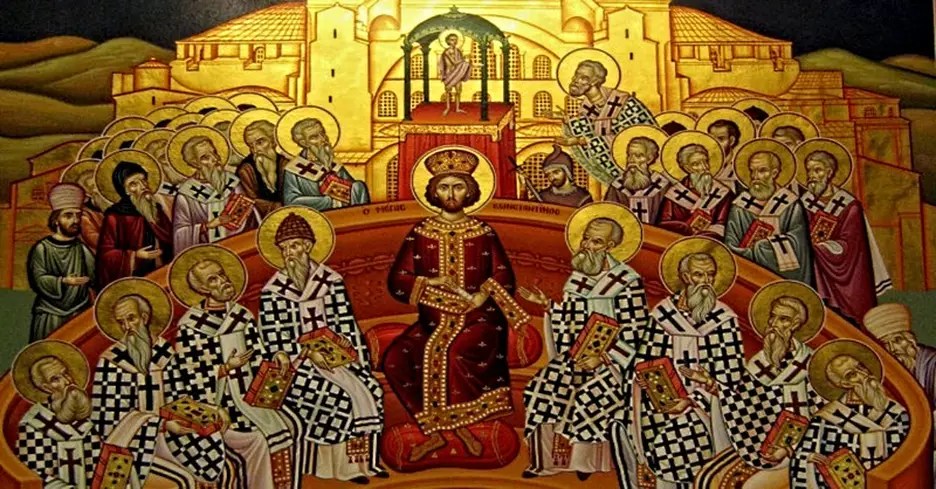
Icon – Council of Nicea (325)

The new year 2025 promises to be an interesting one for Orthodoxy. It marks the 1,700th anniversary of the First Ecumenical Council (Nicea I). By coincidence, Western and Eastern Easter falls on the same Sunday in 2025, April 20. Pope Francis sees the coinciding of the two as an auspicious occasion for bringing Roman Catholicism and Orthodoxy together. In his address to the delegation of the group “Pasqua Together 2025,” the Pope urged that an agreement be reached on a common Easter for all Christians.  

Orthodox Christians pray for the “unity of all” in every Sunday Liturgy, however, we are also mindful of the need to avoid rushing into premature unity. As Orthodox Christians, we seek always to be faithful to Holy Tradition. Among the sources of Holy Tradition are the Seven Ecumenical Councils. The first Ecumenical Council, Nicea I, in addition to promulgating the Nicene Creed, also issued a canon regarding the date when Pascha (Easter) was to be celebrated. For Orthodox Christians, the Seven Ecumenical Councils are not merely ancient fossils to be exhumed from the history books, but a living reality for us. Orthodoxy regards the Seven Ecumenical Councils to be inspired of Holy Spirit, infallible, and therefore divinely authoritative. The other Christian traditions, Roman Catholicism and Protestantism, may have their own ways of doing theology, but we Orthodox seek to be faithful to the Ancient Faith taught by the Apostles and passed on through the bishops, the successors to the Apostles.

While Orthodoxy has representation at the World Council of Churches, calendar reform is primarily an in-house matter. Some Orthodox hierarchs have suggested the need for calendar reform, however, such a move–especially that involving Pascha (Easter)–would require agreement among all Orthodox jurisdictions. This would entail the convening of a pan-Orthodox synod. Especially important would be the need for agreement among the various jurisdictions, especially the Patriarchate of Constantinople and the Patriarchate of Moscow. Given the current strained relations between the two jurisdictions, calendar reform seems a remote possibility.

When it comes to healing schism, it is helpful to look to a time when there was unity then to locate the time or occasion when the two traditions diverged. (See Severance and Graves.) Both Roman Catholicism and Orthodoxy are in agreement as regards the authority and inspiration of the First Ecumenical Council. The divergence in Easter dates occurred when Roman Catholicism in the sixteenth century abandoned the Julian calendar and adopted the Gregorian calendar. In 1582, Pope Gregory XII issued the papal bull Inter gravissimas, which ordered the change in church calendar. (There is an interesting note in the NPNF (Nicene and Post-Nicene Fathers) series on the Ecumenical Councils (vol. 14 p. 108) that in 1825 the entirety of Roman Catholicism fell under the anathema by celebrating Easter on the same date as the Jewish Passover!)  Orthodoxy has continued to the present day to rely on the Julian calendar, which dates to 46 BCE.

Based upon the historical facts, it seems that the quickest way to put an end the problem of divergent Easter dates is for Pope Francis to repeal Inter gravissimas (1582) and issue a decree that all churches under his jurisdiction revert to the Julian calendar in the calculation of Easter per the canons of the Nicea I (325). By doing so, Pope Francis would be facilitating Roman Catholicism’s return to its roots in the Seven Ecumenical Councils and laying the groundwork for the reunification of Roman Catholicism with Eastern Orthodoxy.

There are other issues separating Roman Catholics from Eastern Orthodox, among them the filioque phrase. We urge Pope Francis, if he truly desires to accomplish church unity, to renounce and remove all innovations that separate Roman Catholicism from Eastern Orthodoxy.

References

Pope Francis. 2024. “ADDRESS OF THE HOLY FATHER TO THE DELEGATION OF THE GROUP “PASQUA TOGETHER 2025.” Holy See Press Office, 19 September 2024.

Dan Graves. n.d. “#109 – Council of Nicea.” Christian History Institute.

Archbishop Job of Telmessos. 2021. “We need to establish common date of Easter in order to remain faithful to decisions of Council Nicaea.” Orthodox Times 31 March 2021.

Diane Severance and Dan Graves. 2023. “The Council of Nicea: Ruling on Easter Day in 325 A.D.Christianity.com

Jacob Stein. EWTN Vatican. 2024. “Pope Francis Calls for Unified Easter Celebrations.” September 27.

Devin Watkins. 2024. “Pope Francis: Easter belongs to Christ, not our calendars.” Vatican News, 19 September 2024.

World Council of Churches. 2007. “Frequently asked questions about the date of Easter.

Nervous in the Service

I am going to admit my lack of faith. An Orthodox believer who practices the peace of God ought to be perfectly calm, I know. But I am no saint, so I am nervous.

It looks as though the candidate whom I support in his bid for the presidency has a good chance to nab a victory, but the polls are so close that it would be a fool’s errand to say that it is in the bag for him. A slim advantage in any swing state that falls within the margin of error does not allay one’s concern that the numbers may add up to Harris’ advantage.

She is the candidate who was thrust forward by the marionette masters of the incumbent party who realized late in the game that the original candidate was just as senile and indolent as we had all suspected since the campaign of 2020. But they have the home team advantage. That advantage is reinforced by the mass media who, with a few exceptions, are owned by left-leaning oligarchs. Let us hope that the refusal of three newspapers of record to endorse Harris is an indication that they know more than we do and are acting accordingly. Jeff Bezos may be thinking ahead to January and hedging his bets, sensing that it is prudent to refrain from antagonizing the candidate who may soon be in a position to make life difficult for the owner of Washington’s own newspaper.

Caption required?

Apart from these factors, the ideological left have long since marched through the institutions of education, entertainment, and even religion. America’s own Greek Orthodox Archdiocese under Elpidophoros is in bed with the Democrats.

Kamala’s campaign is flush with cash from wealthy donors like that dubious character, Bill Gates. Old Bill has been indicted in Holland over his promotion of the Covid vaccines, which are useless at best and murderous at worst. Gates is certainly keen to see Harris waltz into the Oval Office so that he can duck any indictment stateside, so he slipped her campaign a cool $50 mil.

It is still October and a cursèd Halloween surprise is not beyond the pale of possibility. Women who practice witchcraft are busy putting hexes on Donald Trump in an attempt to thrust a stick between the spokes of his bicycle as he glides toward the finish line. It is said that their conjurings have come to naught due to an inexplicable Force that fouls their plans in the metaphysical world. It seems to be the case that the prayers of myriad believers are being heard.

Donald Trump is no saint. We all know that, do we not? Beside that, not every decision that he made as the 45th president passed the smell test. Jim Jatras, one Orthodox intellectual whom I have recently had the privilege to get to know, thinks that Trump still has not learned his lesson. He will make similar mistakes, despite being granted a second chance.

I know a lot less than Jim about the Machiavellian nature of Washington’s denizens, so I can be excused for being cautiously optimistic that Trump will perform better as 47th president than he did as 45th. But first he needs to win that second term. That is what makes me nervous. Ballot drop boxes have been burned in Oregon, the secretary of state in Colorado has given away the codes to her computerized voting machines, and hundreds of ballots have found their way from the trunk of a sedan with Rhode Island plates into drop boxes in Pennsylvania. 2020 redux? Dear God, I hope not!

What if Trump wins in spite of the cheating committed by the opposing camp. Will the vice president of the country and president of the Senate certify the electors’ votes? Let us hope that she acts with the same integrity that a previous Senate president and himself candidate for the presidency, Richard Nixon, did in January of 1961. His decision to reject calls for a recount and certify that election gave the nation John F. Kennedy, despite the shenanigans that went on while ballots were being counted in Chicago and Texas, and despite the razor-thin margin here in Hawai’i.

In any case, let us pray that both candidates be protected by divine providence from bodily harm, and that a godly tranquility will descend upon the electorate, no matter which way the pendulum swings on November 5.

Elpidophoros the Prevaricator

Abp. Elpidophoros has accomplished a trifecta. On June 11, the archbishop of the Greek Church in the Americas once again cast pearls before swine by celebrating the divine mysteries in the synagogue of Satan, St. Bartholomew’s Episcopal Church in Manhattan. The same parish, grand in its bastard Byzantine architecture, is the epicenter of the abominable homosexual and transgender movement to queer Manhattan. Here are three remarks that fell trippingly from Elpi’s lips during the liturgy and this author’s initial reactions to them. Elpi is a prevaricator, or a damned liar, if you prefer.

St. Bart’s, Manhattan festooned with the old rainbow flag.

Elpi the Prevaricator makes bold to say, “Such connectedness with others is often feared in many Christian communities today, as if contact with those of differing perspectives might somehow pollute one’s faith.” Fiddlesticks! We all distinctly recall that it was Elpidophoros, archbishop of the GOA, who meanly refused to grant religious exemptions to the faithful who could not, for conscience’ sake, submit themselves to inoculation with an experimental serum during the pandemic. So much for Elpi’s own ability to listen to differing perspectives.

Elpi the Prevaricator boasts, “Thus, the Ecumenical Patriarch models for the Orthodox Christian Church, and for all people of good will, what it means to love your neighbor, even as you claim to love God.” What a patent lie! Bartholomew betrayed the Ukrainian Orthodox Church by unilaterally proclaiming the founding of a phony replacement entity in that cradle of Slavic Orthodoxy. Black Bart’s ultra vires meddling led to the disenfranchisement of the UOC in her motherland and the persecution of her clergy and people, and the theft of her property. History will not be kind to that schismatic, Black Bart of Istanbul.

Elpi the Prevaricator exaggerates: “The Patriarch welcomes all at the Phanar, the Sacred Center of worldwide Orthodoxy.” Not so. Orthodoxy doesn’t have a headquarters like the Vatican. Constantinople’s Phanar is a mere shadow of its former grandeur, but even at the apogee of its trajectory, it never was the “sacred center of Orthodoxy”. The hierarchical authority of the Church has always been shared by the several patriarchates and metropolises. Thank God for the decentralization, especially now when Orthodoxy groans at the heresies and schisms caused by Bartholomew and Elpidophoros.

Elpi at the “big, fat Greek gay baptism”

There is No Alternative

The godless minions of the Democrat Party have played their latest hand in the game of Lawfare quite successfully. Never before has a president of the United States been convicted of a crime, but now the vindictive Democrats have made one for the Guinness Book of World Records. The kangaroo court in Manhattan has taken one of the most bogus lawsuits to date and conducted a shamefully flawed trial that will go down in the annals of legal history. For all intents and purposes, America is now a banana republic. The only way to turn this around is for the voting public to cast their ballots for Donald Trump in November, if for no other reason than to spite the demonic powers that have nigh on overthrown the rule of law in our beloved country.