A Step Too Far

Sarah Mullaly – Archbishop of Canterbury

The appointment of Dame Sarah Mullaly to the historic See of Canterbury in October 2025 has sent shock waves throughout the Anglican Communion. The chair of the Global Anglican Future Conference (GAFCON), Archbishop Laurent Mbanda of Rwanda, in an official communique noted that the decision “abandons global Anglicans.” There is a possibility that when GAFCON meets in Nigeria in March 2026, it will formally break from the Anglican Communion.

[Shortly after this article was posted, GAFCON announced its formal break with the Anglican Communion. See also the informative podcast by Ready to Harvest on the recent GAFCON communique.]

Without doubt, the nomination of a female priest to the highest office of the Anglican Communion is highly controversial. However, her appointment is not all that surprising in light of her high standing as Bishop of London. (The Bishop of London is the third-ranking member in the Anglican Communion after the Archbishop of Canterbury then the Archbishop of York.) It can be expected that the decision will have consequences extending beyond the Anglican Communion to other Christian traditions. How this might affect Orthodoxy is the focus of this blog posting.

Guarding Against False Ecumenism

Historically, the Patriarch of Constantinople has been referred to as the “Ecumenical Patriarch.” The term “ecumenical” means “universal” or “worldwide.” This usage has roots in the Pentarchy, that is, the five patriarchal sees—Rome, Constantinople, Alexandria, Antioch, and Jerusalem—that oversaw the Christian Church in the ancient Roman Empire. After the Great Schism of 1054, the Patriarch of Constantinople came to be seen as the spiritual leader and unifying figure for all Eastern Orthodox Christians. Unlike the Pope of Rome, the Patriarch of Constantinople does not claim universal supremacy but is “first among equals.” Any attempt to impute supremacy to the Patriarchate of Constantinople like the Papacy deviates from historic Orthodoxy and implies a potentially dangerous innovation. Historically, Orthodoxy has recognized the Bishop of Rome as first among equals and considers papal supremacy to be an unacceptable innovation.

Likewise, any attempt to redefine the Ecumenical Patriarchate along the lines of the modern ecumenism has dangerous implications for Orthodoxy. In the twentieth century, a Protestant movement emerged known as the ecumenical movement. Its stated goal was not just the uniting of various Protestant denominations, but also Roman Catholicism and Eastern Orthodoxy. Roman Catholicism in 1964 embraced this new meaning of “ecumenical” in the decree “Unitatis redintegratio.” In that same year, Pope Paul VI and Patriarch Athenagoras met at the Mount of Olives in Jerusalem for prayer and exchanged the kiss of peace ostensibly in an attempt to end the Schism of 1054.
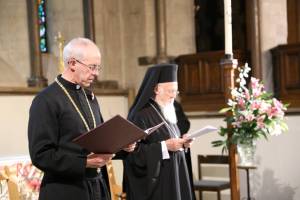
Welby and Bartholomew Praying – 2015

The current Patriarch of Constantinople, Bartholomew, has continued to follow the new meaning of “ecumenical” in his meetings with the Pope of Rome and also with the Archbishop of Canterbury. Bartholomew first met Justin Welby, Mullaly’s predecessor, in 2014. After his enthronement as the Archbishop of Canterbury, Welby visited Patriarch Bartholomew in Constantinople. Then in 2015, Welby reciprocated by hosting Bartholomew at Lambeth Palace. In 2015, Welby and Bartholomew held a joint prayer vigil for refugees. These meetings are far from casual, informal encounters. They are carefully choreographed events full of symbolic gestures much like international diplomatic events at the United Nations’ General Assembly. The glamor of these high-profile ecclesiastical affairs can tempt church leaders to make unwarranted concessions all in the name of Christian unity—hence, the need to guard against false ecumenism.

The Future of Anglican-Orthodox Relations

Saint Justin Popovich

Orthodoxy is far from united on ecumenism. Where some are eager to engage the non-Orthodox, others take a more wary posture. This reluctance stems from their desire to safeguard the Orthodox Faith from innovation and heresy. (For an Orthodox approach to ecumenism that avoids the errors of Western ecumenism see Phillip Calington’s discussion of Saint Justin Popovich’s approach to ecumenism.)

Unlike Western Christianity which has distilled their theology in carefully written documents and precisely worded confessions, Orthodoxy preserves its theology in its Liturgy, the episcopacy, the Ecumenical Councils, and the patristic consensus. One unwritten Tradition has been the all-male episcopacy. Unlike Western Christianity, the notion of women’s ordination has been a non-issue: We’re Orthodox; We don’t change. Where Western Christians often take reason and logic as the starting point for theologizing, in Orthodoxy we understand our faith and practice to be a sacred deposit received from the Apostles and preserved unchanged until the Second Coming. Thus, the Orthodox Church does not feel the need to adjust her faith and practice to contemporary culture. This also means that Orthodox Christians are not obliged to provide a theological rationale for a practice grounded in Apostolic Tradition; however, they are obliged to show that the practice or teaching can be traced back to the early Church. This gives Orthodoxy a stability that is sadly lacking in the West. When one examines the faith and practice of Anglicanism from the 1950s to 2025, one cannot help but be struck by the massive changes in Anglicanism. While it is debatable whether women’s ordination was the start of Anglicanism’s decline into liberalism, it is clear that women’s ordination is not unrelated to the overall liberalization of Anglicanism.

Thus, Sarah Mullaly’s elevation to the See of Canterbury will be highly consequential for Anglican-Orthodox relations. Any indication by Bartholomew of his acceptance of the validity of Mullay’s elevation would imply an acceptance of women’s ordination. Bartholomew’s acceptance of Mullaly’s elevation to the See of Canterbury could happen by his: (1) attending her enthronement service, (2) extending an official invitation to come to Constantinople like Welby’s visit in 2014, or (3) be an official guest to the Lambeth House like the hospitality Welby extended in 2015. Another possibility is an official announcement or personal communication that signals acceptance of Mullaly’s elevation. Of concern to the Orthodox faithful is whether Patriarch Bartholomew will go a step too far and embrace women’s ordination, whether implicitly or explicitly. Such an ecumenical gesture could inadvertently damage Constantinople’s claim to valid apostolic succession.

Orthodoxy’s opposition to women’s ordination is far from a clear-cut, black-and-white issue. Historically, there has been a female diaconate in Orthodoxy; however, the ordination of women did not extend to the presbyterate or episcopacy—both these offices are essential to the Eucharistic sacrifice. Orthodoxy’s opposition is grounded in Orthodox metaphysics, not in mere cultural conservatism. Alexander Schmemann points to the dogmatic underpinnings of the Orthodox opposition to women’s ordination.

I cannot discuss the problem itself because to do so would necessitate the elucidation of our approach — not to women and to priesthood only — but, above all to God in his Triune Life, to Creation, Fall and Redemption, to the Church and the mystery of her life, to the deification of man and the consummation of all things in Christ. (Schmemann in Harvey 2008)

In other words, women’s ordination would go far beyond a modification of ecclesial structures and lead to a wrecking of the dogmatic underpinnings of Orthodox ecclesiology.

Short of all this it would remain incomprehensible, I am sure, why the ordination of women to priesthood is tantamount for us to a radical and irreparable mutilation of the entire faith, the rejection of the whole Scripture, and, needless to say, the end of “dialogues.” (Schmemann in Harvey 2008)

Where in the West ordination is understood in functional terms and gender difference is viewed as mere surface externality (women are capable of ritual actions just as well as men), in Orthodoxy gender differences carry with it profound implications for anthropology, ecclesiology, soteriology, and cosmology. Differences in gender entail more than differences in external form of the human body. Being rooted in the imago dei, differences in gender point to the profound difference in the existential orientation of men and women towards the world, towards each other, and towards God. Where Western modernity has  become untethered from order of creation described in Genesis, Orthodoxy with its adherence to the sacramental worldview and to the Incarnation of the Eternal Logos has continued to honor the male-female distinction established by the divine Creator.

In these unsettled times, what is needed are Orthodox Christians with a solid, unshakable faith who speak boldly with humility and charity, and who avoid unnecessary confrontations. Orthodox Christians need to have in mind the wise admonition in the Epistle of James:

So then, my beloved brethren, let every man be swift to hear, slow to speak, slow to wrath: for the wrath of man does not produce the righteousness of God. (James 1:19-20; OSB)

Orthodox Christians are called to avoid hastiness, whether in thought or in speech. Mullaly’s elevation to the highest office in the Anglican Communion involves several steps. She was nominated to the office of Archbishop of Canterbury in October 2025. A confirmation of election will be held in January 2026 (Maqbool). The date of her enthronement has yet to be announced. Those who worry about overzealous Orthodox ecumenical enthusiasm should approach the matter soberly and not rush to pass judgment. At the same time, they should be alert for any ecumenical engagements that put Holy Orthodoxy at risk. The Orthodox laity have the solemn obligation, as do the clergy and hierarchs, to safeguard against heresy and innovation.

Should Sarah Mullaly’s elevation to the See of Canterbury become official,  many Orthodox Christians will consider this a step too far. In the past, many Orthodox Christians have viewed Canterbury’s claim to apostolic succession with considerable skepticism. The issue for them was not the validity of Anglican orders, but from their failure to keep the Faith. However, the elevation of a woman to this historic office leaves no room for doubt—Canterbury can no longer claim apostolic succession for it has parted ways with historic Christianity. Anglican-Orthodox dialogue has reached an impasse—a situation in which no progress is possible.  Ecumenical engagement is premised upon the assumption that the participating parties can find common ground in faith and practice. (To use a medical analogy, there comes a time when any further attempt to resuscitate the patient is futile and the attending physician is obliged to pronounce the patient dead and note the time of death.)

Evangelicals Received Into Orthodoxy – Halifax, England 2025 (Source)

If the basis for commonality is shattered, then a different approach to Christian unity must be taken. Instead of mutual recognition, the alternative is reception. In the reception model of Christian unity, non-Orthodox faith communities seek to be received into Holy Orthodoxy after they have carefully studied and embraced Apostolic Tradition.

We see this taking place in the recent conversion of an entire Evangelical parish in England to Orthodoxy in 2025. (Source) There are reports of Anglican parishes converting to Orthodoxy, although specific details are hard to locate. There have been instances of Anglican parishes converting to Roman Catholicism. In 2011, some 600 laity and 20 clergy became Roman Catholic through the ordinariate established by Pope Benedict XVI. (BBC 2011)

Helping Hands

The Faith for all Ages

Anglicanism’s crisis extends far beyond women’s ordination. It includes the abandonment of historic Christian doctrines. David Gilchrist recounts how he converted from Evangelicalism to Anglicanism in the belief that that in the Church of England he had found the historic apostolic Faith. However, his confidence was shattered by the elevation to the episcopacy a priest who denied the historic, bodily resurrection of Christ. This crisis eventually led him to convert to Orthodoxy.

Orthodox readers should avoid triumphalist gloating and instead regard Anglicans troubled over Mullaly’s elevation with compassion. Anglicanism has a rich heritage and many devout Anglicans will be loath to relinquish this venerable patrimony. Nonetheless, some have taken this radical step. If they desire to convert to Orthodoxy, it will be a costly decision. However, if Orthodoxy and the Tradition it presents is the Pearl of Great Price (Matthew 13:45-46), then becoming Orthodox will be deeply rewarding. To become Orthodox does not entail the rejection of Anglicanism, but rather its fulfillment. It is important to remember that England was Orthodox before it was Roman Catholic or Anglican. Prior to the Great Schism of 1054, all Christians were part of the one holy catholic and apostolic Church confessed in the Nicene Creed.

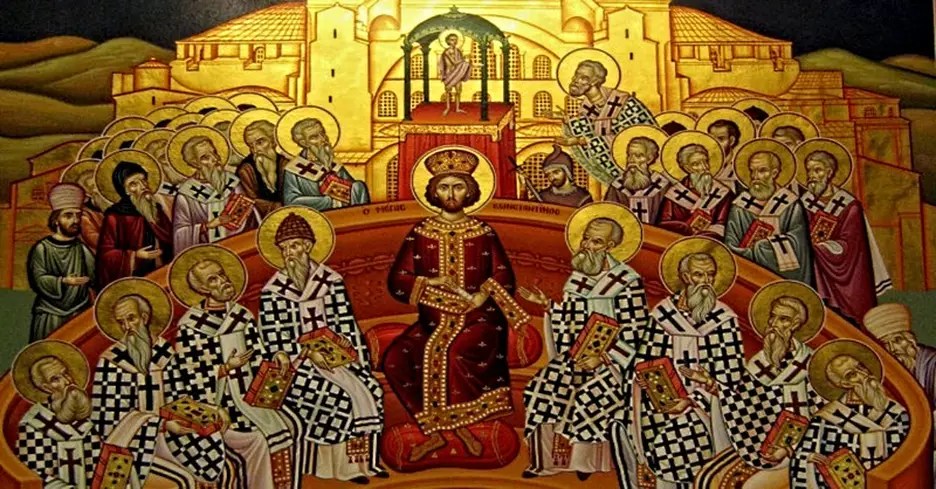
Icon – First Ecumenical Council (325)

Becoming Orthodox does not mean becoming Greek. It means a return to the Ancient Faith that extends across the entire ecumene embracing both the West and the East. Irenaeus of Lyons, the second century Church Father, wrote:

As I have already observed, the Church, having received this preaching and this faith, although scattered throughout the whole world, yet, as if occupying but one house, carefully preserves it. She also believes these points [of doctrine] just as if she had but one soul, and one and the same heart, and she proclaims them, and teaches them, and hands them down, with perfect harmony, as if she possessed only one mouth. (Against Heresies 1.10.2; New Advent)

Troubled Anglicans need not despair. The universal Church  described by Irenaeus of Lyons can still be found today. It has continued to present day in the Orthodox Church.

My advice to troubled Anglicans is that they attend a Sunday service at a local Orthodox parish and experience the ancient worship. My other piece of advice is that they compare present-day Orthodoxy with the ancient Church and see if the Ancient Faith has been preserved to the present day in Orthodoxy. Unlike so much of Western Christianity, they will find that Orthodoxy has been able to withstand the temptations and pressures to accommodate modern culture. In Holy Orthodoxy, they will find shelter from the raging storms of modernity. The Orthodox Church is the Ark of Salvation and her Captain, Jesus Christ, cries out:

Come to Me, all you who labor and are heavy laden, and I will give you rest. (Matthew 11:28; OSB)

Athenagoras

References

Aleteia. 2023. “12 Christian leaders to join Pope in ecumenical prayer on vigil of Synod.” 9 September 2023. https://aleteia.org/2023/09/09/12-christian-leaders-to-join-pope-in-ecumenical-prayer-on-vigil-of-synod/

The Archbishop of Canterbury. 2015. “Archbishop and Patriarch Bartholomew hold prayer vigil for refugees.” ArchbishopofCanterbury.org 11 March 2015. https://www.archbishopofcanterbury.org/news/archbishop-and-patriarch-bartholomew-hold-prayer-vigil-refugees

BBC. 2011. “Dissident Anglicans leave Church of England.” BBC.com 9 March 2011. https://www.bbc.com/news/uk-12685062

Encyclopedia Britannica. “ecumenism.” https://www.britannica.com/topic/ecumenism

Phillip Calington. 2016. “Speaking Painful Truth in Love: Orthodox Ecumenism and St. Justin Popovic.” Pravoslavie.ru 16 December 2016. https://www.pravoslavie.ru/99512.html

GAFCON. 2025. “Comunique: Solemn Summons to Global Bishops.” Gafcon.org, 14 September 2025. https://gafcon.org/communique-updates/solemn-summons-to-global-bishops/

GAFCON. 2025. “Communique: Canterbury Appointment Abandons Anglicans.” Gafcon.org, 3 October 2025. https://gafcon.org/communique-updates/canterbury-appointment-abandons-anglicans/

GAFCON. 2025. “Communique: The Future has Arrived.” Gafcon.org, 16 October 2025. https://gafcon.org/communique-updates/the-future-has-arrived/

David Gilchrist. 2020. “The Crisis in the Church of England and the Attraction of the Orthodox Church.” Journey to Orthodoxy, 17 August 2020. https://journeytoorthodoxy.com/2020/08/the-crisis-in-the-church-of-england-and-the-attraction-of-the-orthodox-church/

Greek Orthodox Archdiocese of North America. “Historic Meeting of Pope Paul VI, Ecumenical Patriarch Athenagoras.” 25 January 2014. https://www.goarch.org/-/historic-meeting-of-pope-paul-vi-ecumenical-patriarch-athenagoras

Geoff Harvey. 2008. “Ordination of Women by Father Alexander Schmemann.” TheGoodShepherd.org 16 April 2008. https://www.thegoodshepherd.org.au/blog/ordination-of-women-by-father-alexander-schmemann

Aleem Maqbool and Paul Gribben. 2025. “Sarah Mullally named as new Archbishop of Canterbury.” BBC. 3 October 2025. https://www.bbc.com/news/articles/c2lxyxqzxkdo

Francis Martin. 2023. “Archbishop Welby joins Pope Francis and global church leaders for prayer vigil in Rome.” 2 October 2023. Church Times. https://www.churchtimes.co.uk/articles/2023/6-october/news/uk/archbishop-welby-joins-pope-francis-and-global-church-leaders-for-prayer-vigil-in-rome

Orthodox Christianity. 2025. “Evangelical church in Halifax, England preparing to join Orthodox Church.” 17 February 2025. https://orthochristian.com/167338.html

OrthodoxWiki. 2014. “Ordination of Women.” Last edited 5 September 2014. https://orthodoxwiki.org/Ordination_of_Women

OrthodoxWiki. 2012. “Primus Inter Pares.” Last edited 18 November 2012.
https://orthodoxwiki.org/Primus_inter_pares

Ready to Harvest. 2025. YouTube podcast: “BREAKING: Global Anglicanism Split in Two Today.” [ 7:09] Ready to Harvest 16 October 2025.

Vatican. 2021. “Press Release: Pope Francis, Ecumenical Patriarch Bartholomew and the Archbishop of Canterbury join together for the first time in urgent appeal for the future of the planet, 07.09.2021” https://press.vatican.va/content/salastampa/it/bollettino/pubblico/2021/09/07/0543/01168.html

Dark Clouds with  a Bright Silver Lining


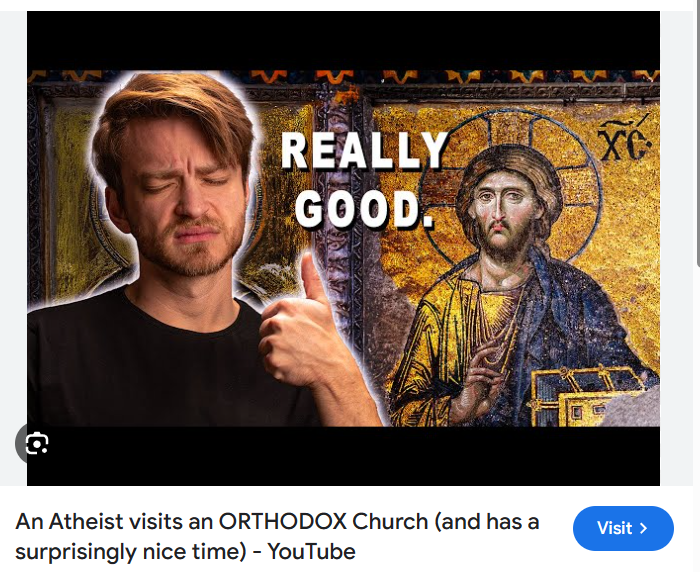
YouTube’s algorithm can produce interesting results. It recently recommended two sharply contrasting podcasts. One was a sober analysis of church decline in rural Illinois by a self-described “old geezer” Christian; the other was an “audit” by a young Gen-Z atheist who raved about his visit to an Orthodox Liturgy. That afternoon I found myself going back and forth between feeling pessimistic, and feeling hopeful as I watched the two videos.

The purpose of this article is to stimulate discussion about the current religious situation in the United States. Do we indeed have a church attendance crisis in America? Does Christianity have a future in America? Can Orthodoxy help reverse church decline in America?


The Coming Church Attendance Crisis” [54:12]


Tom Wadsworth, a former pastor and independent scholar, presents the findings of his survey research which he conducted in his hometown of Dixon, Illinois, from 1983 to 2023. His research deserves our attention because of its solid data and meticulous methodology. One surprising finding is that Gallup polls significantly overestimate the percentage of Americans who attend church/religious services. Where Gallup polls report that 31% of Americans attend church services (based on self-description), Wadsworth estimates that the actual percentage may be around 13% (based on head counts) (see 18:15-24:54; see 24:12). Wadsworth notes that if church attendance is 13% for a conservative, rural area, like Dixon, Illinois, then the rate of church attendance is likely to be even lower in major urban areas like Chicago, Orlando, New York, etc. In other words, the problem of church decline may be even worse than we think it is.

Wadsworth introduces the concept of “critical mass”—the minimum size or amount of something required to start or maintain a venture. For churches to survive they need a certain number of congregants and income to survive. Which begs the question: What are the critical thresholds needed for a church to survive? Wadsworth hypothesizes that if a church has: (1) 40 in attendance on average and (2) 60% of its attendees are 65+ in age, then that church is likely to close its doors in ten to twenty years (28:16). This numbers-driven approach is pragmatic and helps generate a realistic assessment of a congregation’s vitality. These two findings—actual attendance rates and critical mass needed for church growth—are what makes Wadsworth’s presentation noteworthy. Here he breaks new ground. While Wadsworth’s discussion of ten factors contributing to church decline (31:17-42:06) is also worth considering, this is familiar ground that has been discussed by others. Among the reasons he gives for church decline are the recent public pastor scandals, the pandemic lockdown, the polarizing effects of the religious right, the 9/11 effect—the ejection of religious fanaticism, youths rejecting the Evangelicalism of their parents, the effects of social media on socialization, the declining birth rate, and the fact that secular culture is now in fashion, etc.

Overall, this author finds Wadsworth’s discussion of possible causes for church decline to be full of insights. However, I do have a few quibbles with him. The youth’s rejection of their parents’ Evangelicalism is not so much a causal factor as it is a description of an aspect of the overall decline. Based on anecdotes I have read on the Internet; I am inclined to agree with his identifying the Religious Right as a contributing factor. However, one must also take into account the drift of the historic mainline denominations towards secularism and liberalism. The drift away from historic orthodoxy in the mainline denominations has resulted in liberal theology devoid of belief in the supernatural, i.e., watered down Christianity. As a former atheist, I find mainline Protestantism lacking the robustness and vitality of historic supernatural Christianity. Another factor I believe that Wadsworth’s analysis overlooks is the impact of rising divorce rates. I suspect that children of divorce find it harder to feel at home in churches that hold the intact nuclear family to be the norm; divorcees, single parents, never-married singles, and those with confused sexual identities will feel unwanted and marginalized.


An Atheist visits an ORTHODOX Church (and has a surprisingly nice time)” [25:20]

Jared Smith, creator of Heliocentric, visited an Antiochian Orthodox parish and rated it as “exceptional,” a “Knock ‘em dead! Home run out of the park!” experience. Unlike Tom Wadsworth’s careful analysis, Jared Smith’s report consists more of comparisons between what he saw at one Orthodox parish against other churches he had visited. He notes that a lot of thought and care had gone into the interior of All Saints Antiochian Orthodox Church and that the church was built for reverence. He contrasts this against the ugliness of the four bare walls of “the run-of-the-mill box church” or “a CVS church” (2:45-3:05).

Jared described how the greeter welcomed him warmly but did not pounce on him as in other churches. Then, as the greeter was explaining the church service, the priest entered the foyer, censing the room. The greeter paused, turned to the priest, and bowed in respect (5:36). For Jared Smith, that was impressive because it showed that in the Orthodox Liturgy, God is the center of the show, not you. I found his criticism of Protestantism’s audience-centered approach to worship quite insightful. It suggests that among the Gen-Z cohort there is a hunger for reverence that is not being met by Protestantism’s contemporary worship service. Jared Smith was surprised that he was invited to meet with the priest one-on-one (7:52). His  experience has been that pastors only meet with loyal church members, not with outsiders. Sadly, it seems that personal contact with the pastor has become a rare exception, especially with huge mega churches (18:20, 20:27). I was surprised by Smith’s observation of icons in the Orthodox church. The icons of the saints reminded him that we are not alone but surrounded by a great cloud of witnesses (11:05). This contrasts sharply with the Baptists’ emphasis on Jesus and you—and you alone.

Part of Jared’s church review was the coffee hour (16:14 ff.). He was surprised that the priest stayed around after the Liturgy, taught adult religious education class, talked with people after the class, then to Jared’s surprise, invited him to his house for coffee. For Jared, the one-on-one personal contact was a far more effective way of doing outreach than the didactic lecture approach favored by Protestant Evangelicals. He also noted that the priest did not attempt to argue him out of his atheism, but accepted him.

What I find striking is that Jared Smith is the demographic polar opposite of Tom Wadsworth. Jared is in his late 20s, a former Evangelical, a graduate of Wheaton College, etc. His glowing description of Orthodoxy represents a bright silver lining in an otherwise gloomy situation described by Tom Wadsworth.

Jared Smith’s positive assessment of Orthodoxy seems to be part of a broader trend. The New York Post in December 2024 published an article: “Young men leaving traditional churches for ‘masculine Orthodox Christianity in droves.” This article has caught the attention of many and has generated considerable discussions among Protestants. If Orthodoxy can appeal to Gen-Zs like Jared Smith, then it is possible that the problem of church decline can be arrested and possibly reversed.


What Does the Future Hold?

The overall religious picture for the United States looks grim. It is like a long, extended drought drying up the landscape with plants and trees everywhere slowly dying off. This religious drought has been going on for several decades now. Surprisingly, there are a few spots of greenery popping up here and there. One of these spiritual oases is Eastern Orthodoxy. The recent influx of young men flocking to Orthodoxy can be seen as something like a rain shower that potentially signals a change in season.

We could be witnessing Orthodoxy’s transition from being seen as an exotic transplant to a well-regarded alternative to Protestantism and Roman Catholicism. For that to happen, American Orthodoxy will need to experience solid church growth. In addition to welcoming inquirers, we will need to give attention to the nurture of cradle Orthodox. Orthodoxy will thrive if the children of recent converts along with the  grandchildren of immigrants are nurtured into a living faith in Christ. Both the recently-baptized convert and the recently-baptized infant whose ancestors embraced Orthodoxy centuries ago, are the future of Orthodoxy. For Orthodoxy to reverse the problem of church decline, we will need, not just thriving current parishes, but also new mission parishes planted in the same urban areas as well as in areas that have zero Orthodox parishes. For that to happen, we will need a wave of men to be ordained to the priesthood and the diaconate. And, we will need bishops that support the evangelization of America. We need a vibrant American Orthodoxy that presents the Ancient Faith to a post-Christian America.


Entering into the Harvest

And, let us not forget to pray. Jesus exhorted his followers:

The harvest is truly plentiful, but the laborers are few. Therefore pray the Lord of the harvest to send out laborers into His harvest. (Matthew 9:38, OSB)

The time of harvest has come. If you see new people at your local parish, that means that there is work to do. Let us welcome the visitors who seem lost in the Liturgy by giving them a helping hand. Let us invite them to join us for coffee after the Liturgy. If you see someone standing alone during coffee hour, introduce yourself to them. Getting the cold shoulder during the coffee hour can leave a bad impression after experiencing the Liturgy. Many first-time visitors are fearful of rejection, so be ready to put them at ease. Be ready to listen to them and to answer their questions, and be ready to share your faith story with the inquirer. Tell them how the Lord has been good to you. Let us keep in mind the words of Jesus:

Go home to your friends, and tell them what great things the Lord has done for you, and how He has had compassion on you. (Mark 5:19, OSB)

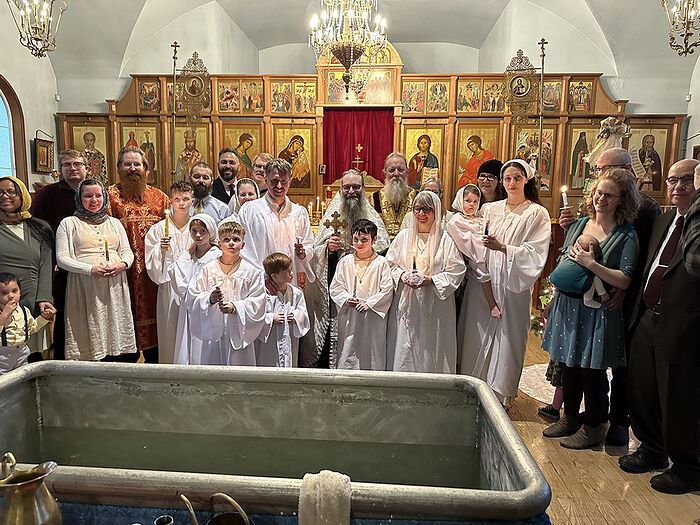
Newly illumined Orthodox Christians – Is this the future? Source


For Discussion

For readers who visit Handwritings, I would like to pose three questions:


Does your personal experience confirm or disconfirm Tom Wadsworth’s analysis of church decline?


Does your personal experience of Orthodox worship confirm or disconfirm Jared Smith’s positive assessment of Orthodoxy?


Do you think that Orthodoxy can help reverse church decline in America? How do you see that happening?

A Common Date for Easter = Church Unity?

Avoiding a Premature Union

Icon – Council of Nicea (325)

The new year 2025 promises to be an interesting one for Orthodoxy. It marks the 1,700th anniversary of the First Ecumenical Council (Nicea I). By coincidence, Western and Eastern Easter falls on the same Sunday in 2025, April 20. Pope Francis sees the coinciding of the two as an auspicious occasion for bringing Roman Catholicism and Orthodoxy together. In his address to the delegation of the group “Pasqua Together 2025,” the Pope urged that an agreement be reached on a common Easter for all Christians.  

Orthodox Christians pray for the “unity of all” in every Sunday Liturgy, however, we are also mindful of the need to avoid rushing into premature unity. As Orthodox Christians, we seek always to be faithful to Holy Tradition. Among the sources of Holy Tradition are the Seven Ecumenical Councils. The first Ecumenical Council, Nicea I, in addition to promulgating the Nicene Creed, also issued a canon regarding the date when Pascha (Easter) was to be celebrated. For Orthodox Christians, the Seven Ecumenical Councils are not merely ancient fossils to be exhumed from the history books, but a living reality for us. Orthodoxy regards the Seven Ecumenical Councils to be inspired of Holy Spirit, infallible, and therefore divinely authoritative. The other Christian traditions, Roman Catholicism and Protestantism, may have their own ways of doing theology, but we Orthodox seek to be faithful to the Ancient Faith taught by the Apostles and passed on through the bishops, the successors to the Apostles.

While Orthodoxy has representation at the World Council of Churches, calendar reform is primarily an in-house matter. Some Orthodox hierarchs have suggested the need for calendar reform, however, such a move–especially that involving Pascha (Easter)–would require agreement among all Orthodox jurisdictions. This would entail the convening of a pan-Orthodox synod. Especially important would be the need for agreement among the various jurisdictions, especially the Patriarchate of Constantinople and the Patriarchate of Moscow. Given the current strained relations between the two jurisdictions, calendar reform seems a remote possibility.

When it comes to healing schism, it is helpful to look to a time when there was unity then to locate the time or occasion when the two traditions diverged. (See Severance and Graves.) Both Roman Catholicism and Orthodoxy are in agreement as regards the authority and inspiration of the First Ecumenical Council. The divergence in Easter dates occurred when Roman Catholicism in the sixteenth century abandoned the Julian calendar and adopted the Gregorian calendar. In 1582, Pope Gregory XII issued the papal bull Inter gravissimas, which ordered the change in church calendar. (There is an interesting note in the NPNF (Nicene and Post-Nicene Fathers) series on the Ecumenical Councils (vol. 14 p. 108) that in 1825 the entirety of Roman Catholicism fell under the anathema by celebrating Easter on the same date as the Jewish Passover!)  Orthodoxy has continued to the present day to rely on the Julian calendar, which dates to 46 BCE.

Based upon the historical facts, it seems that the quickest way to put an end the problem of divergent Easter dates is for Pope Francis to repeal Inter gravissimas (1582) and issue a decree that all churches under his jurisdiction revert to the Julian calendar in the calculation of Easter per the canons of the Nicea I (325). By doing so, Pope Francis would be facilitating Roman Catholicism’s return to its roots in the Seven Ecumenical Councils and laying the groundwork for the reunification of Roman Catholicism with Eastern Orthodoxy.

There are other issues separating Roman Catholics from Eastern Orthodox, among them the filioque phrase. We urge Pope Francis, if he truly desires to accomplish church unity, to renounce and remove all innovations that separate Roman Catholicism from Eastern Orthodoxy.

References

Pope Francis. 2024. “ADDRESS OF THE HOLY FATHER TO THE DELEGATION OF THE GROUP “PASQUA TOGETHER 2025.” Holy See Press Office, 19 September 2024.

Dan Graves. n.d. “#109 – Council of Nicea.” Christian History Institute.

Archbishop Job of Telmessos. 2021. “We need to establish common date of Easter in order to remain faithful to decisions of Council Nicaea.” Orthodox Times 31 March 2021.

Diane Severance and Dan Graves. 2023. “The Council of Nicea: Ruling on Easter Day in 325 A.D.Christianity.com

Jacob Stein. EWTN Vatican. 2024. “Pope Francis Calls for Unified Easter Celebrations.” September 27.

Devin Watkins. 2024. “Pope Francis: Easter belongs to Christ, not our calendars.” Vatican News, 19 September 2024.

World Council of Churches. 2007. “Frequently asked questions about the date of Easter.

AVOIDING COSMETIC UNITY

Not Rushing to Premature Ecumenism

Patriarch Bartholomew 2024 (Source)

It is a widely known fact that Roman Catholicism and Orthodoxy celebrate Easter on different days. Some years they celebrate Easter one week apart. Some years, for example in 2024, their Easter celebration is more than a month apart. In 2024, Roman Catholics celebrated Easter on March 31, while the Orthodox will be celebrating Easter (aka Pascha) at Midnight May 4.

The disparity between Western Easter and Orthodox Easter has led some to deplore the differences and call for both traditions to agree on a common date. Recently, on 31 March 2024, Patriarch Bartholomew in his homily expressed his desire that beginning in 2025 both Roman Catholics and Orthodox would celebrate Easter on the same day.

But also from this position we extend a heartfelt greeting of love to all Christians around the world who celebrate Holy Easter today. We beseech the Lord of Glory that the forthcoming Easter celebration next year will not merely be a fortuitous occurrence, but rather the beginning of a unified date for its observance by both Eastern and Western Christianity.

This aspiration is particularly significant in light of the upcoming 1700th anniversary in 2025, marking the convening of the First Ecumenical Synod in Nicaea. Among its pivotal discussions was the matter of establishing a common timeframe for the Easter festivities. We are optimistic, as there is goodwill and willingness on both sides. Because, indeed, it is a scandal to celebrate separately the unique event of the one Resurrection of the One Lord! [Source, Emphasis added.]

Apparently, Patriarch Bartholomew is hoping that by 2025 both Roman Catholicism and Orthodoxy will have agreed on a common date for Easter and that after 2025 there will no longer be different dates for celebrating it. In addition, he reminds his listeners that 2025 will mark the 1700th anniversary of the First Ecumenical Council (325). Nicea I was a landmark event in which bishops came from all over the Roman Empire to proclaim their common faith in Jesus Christ, the incarnate Son of God who came to save humankind.

Rejecting Cosmetic Unity

All Orthodox Christians ought to seek the ending of the schism between Roman Catholicism and Orthodoxy. However, we are to guard against changing Holy Tradition for the sake of cosmetic unity.  To agree on a common date for Easter while overlooking significant issues arising from the Great Schism of 1054 would be rushing to premature ecumenism. It would be like a contractor painting over the cracks in the wall of a house after a devastating earthquake. To paint over the cracks and certify a severely damaged building as inhabitable is not only highly irresponsible, it is fraudulent behavior that verges on criminality.

The Great Schism of 1054 and its Aftermath

For the first millennium, Christian unity was manifested in such markers as the Eucharist, the canonical Scriptures, the Church Fathers, the Ecumenical Councils, the Nicene Creed, the episcopacy, and the Pentarchy. The Pentarchy was comprised of the five patriarchates of Rome, Constantinople, Alexandria, Antioch, and Jerusalem. Unlike Protestantism which believes that the unity of the Universal Church is an invisible, spiritual unity, Christians in the first millennium believed in a visible, tangible Universal Church.

Christian unity suffered a major setback when Pope Benedict VIII unilaterally inserted the Filioque phrase “and the Son” into the Niceno-Constantinopolitan Creed (381) in 1014. By 1054, the papal legate, Cardinal Humbert, excommunicated the patriarch of Constantinople, Michael Cerularius. This resulted in the mutual excommunications by both sides. While some have exaggerated the fracas of 1054, it serves as a reference point for when Rome and the Eastern churches went their separate ways. It is worth noting that it was not just Constantinople that rejected the Filioque, the other patriarchates: Alexandria, Antioch, and Jerusalem likewise objected to the Filioque.

The insertion of the Filioque was a highly significant move by the pope. First, it implied that the pope had an authority equivalent to the Ecumenical Councils (Nicea I {325} and Constantinople 1 {381}) to define the universal creed. This is contrary to Orthodox ecclesiology, which holds that the highest ecclesial authority resides in the ecumenical councils. When a council is convened, the bishops, as successors to the Apostles, gather together as representatives of the Church Catholic. Second, the insertion of the Filioque implied the pope’s universal supremacy over all Christians in matters of faith and practice. Papal supremacy is implicit in the Filioque. It would take several centuries until papal infallibility was explicitly promulgated by the First Vatican Council (1869-1870). Third, the Filioque has significant implications for the doctrine of the Trinity that many Orthodox would consider dubious or even heretical. For the Orthodox, it is significant that the Filioque does not have the general support of the Church Fathers.

Steps Towards Authentic Unity

Patriarch Bartholomew rightfully deplores the calendar differences between Roman Catholicism and Orthodoxy. However, it is significant that he has not said much about the need to resolve the issues stemming from the Schism of 1054. Until these issues are resolved, talk of a common Easter date is premature. Agreeing upon a common date for Easter without attending to the deeper matters of faith and practice would be more of a public relations (PR) stunt than a genuine healing of schism.

Below are some suggestions for steps that can be taken to reach genuine reunification between Roman Catholicism and Orthodoxy. Basically, it calls for both sides to return to their shared roots in Apostolic Tradition, e.g., the Seven Ecumenical Councils, the Church Fathers, and the historic liturgies.

1. Drop the Filioque

The first step towards reunification would be for Roman Catholicism to return to the original Niceno-Constantinopolitan Creed (381) as the normative creed for its Sunday Mass in all parishes worldwide. The suspension of the Filioque in the Sunday Mass worldwide would show that Pope Francis is serious about reunification with Orthodoxy. It has been the practice that when Roman Catholics and Orthodox come together to recite the Nicene Creed with the Filioque omitted for that occasion. Notwithstanding, such actions are more PR gestures than serious attempts to heal the schism between the two traditions. Genuine reunification entails the eschewing of innovation and the restoration of historic liturgical practices.

The second step would be for Pope Francis to announce that the unilateral insertion of the Filioque was a mistake and that saying the Filioque is to be suspended until a universal church council (including the historic Pentarchy and other autocephalous jurisdictions) rule on the Filioque. It is imperative that the Church Catholic come to an agreement on the Filioque, whether to adopt it or exclude it.

Many staunch Roman Catholics, in their interaction with Orthodox Christians, have said much in defense of the double-procession of the Holy Spirit, all the while misunderstanding the differences between the two traditions. Where many Roman Catholics approach the Filioque in terms of systematic theology, for the Orthodox, the Filioque controversy is fundamentally about liturgical theology: that is, our worship of the Triune God in the Liturgy. The insertion of the Filioque has serious implications for the way in which we understand the Trinity. So, while Roman Catholics and Orthodox Christians are reciting nearly identical versions of the Nicene Creed, they are articulating rather different understandings of the Trinity. This difference in wording is a far more serious matter than the discrepant Easter dates that troubles Patriarch Bartholomew.

2. Repudiate Papal Supremacy

For Roman Catholics to reunite with the Orthodox, the Bishop of Rome and the Vatican would need to formally repudiate papal supremacy and formally endorse the conciliar understanding of the Church Catholic. Historically, Orthodoxy has accepted papal primacy but rejected papal supremacy. To put it another way, Orthodoxy accepts the bishop of Rome as first among other bishops, but not as superior in rank or authority to the other bishops. Once the bishop of Rome has formally repudiated papal supremacy, the details of church administration and canon law can be worked out by both sides.

3. Formally Assess the Novus Ordo Mass

Almost a thousand years have passed since the Great Schism, since then Roman Catholicism has undergone many changes in its theology and worship. When an Eastern Orthodox Christian visits a Coptic Orthodox Liturgy, he will see and hear much that is familiar to his home parish. However, when he visits a Catholic Mass, especially a Novus Ordo Mass, he will be surprised and even shocked by how different the Novus Ordo Mass is from the Orthodox liturgy.

The Novus Ordo Mass (aka the Vatican II Mass, aka the Mass of Paul VI), which originated in the 1960s and the 1970s, is a striking departure from the historic liturgies. Many Catholics have complained about the lack of reverence and shocking innovations in the Novus Ordo Mass. Of concern to the Orthodox is the recent suppression of the traditional Latin Mass by Pope Francis. To Orthodox Christians, it appears that Roman Catholicism has abandoned its historic liturgical heritage for one based on modern innovation. Examples of liturgical innovation include: the inclusion of secular songs such as “You Got a Friend” or “Stairway to Heaven,” the introduction of lay Eucharistic ministers to distribute the consecrated Host, and the priest ceasing to pray ad orientem (facing East).

The ultimate goal of Catholic-Orthodox reunification is the Eucharist, but is that possible if the Novus Ordo Mass is incompatible with the ancient liturgies of Saint John Chrysostom and Saint Basil the Great? It is suggested that if the bishop of Rome were to implement the first two steps recommended above (i.e., suspend the use of the Filioque in Sunday worship and formally renounce papal supremacy), that the Orthodox hierarchs convene a pan-Orthodox synod that will examine the validity of the Novus Ordo Mass. The Novus Ordo Mass is not necessarily heretical, but it is a striking innovation that appears to diverge from historic Christian worship. This is an issue that cannot be ignored. A simpler approach would be for the Roman Catholic church to lay aside the Novus Ordo Mass and return to the historic Latin Mass, duly translated into the vernacular, as the normative form of Sunday worship worldwide.

These three suggestions are just initial steps that would demonstrate that Pope Francis and his fellow bishops do sincerely desire reunification with Orthodoxy. Until Pope Francis and the Vatican suspend the use of the Filioque from the Sunday Mass worldwide, all talk about reunification between the two traditions is premature. One has to wonder why Patriarch Bartholomew has not given greater attention to the Filioque in his pursuit of closer ties with Rome. It is incumbent upon the Orthodox laity to humbly request that our priests and bishops not succumb to premature ecumenism and that the local Orthodox clergy relay their concerns to their respective primates. A fundamental component of Orthodox ecclesiology is that the whole people of God, from the bishop down to the priest and deacons, and to the laity, are responsible for safeguarding Holy Tradition. It is the job of ordained clergy, bishops and priests, to safeguard Holy Tradition. The laity should speak out only if it appears that attempts are being made to tamper with Holy Tradition.

Avoiding False Unity

Patriarch Bartholomew has been a very vocal advocate for reunification with Rome. In late 2019, he informed the monks of Mount Athos that there are no dogmatic differences between Orthodoxy and Roman Catholicism, and that reunion is inevitable (See the website OrthodoxChristianity). However, his optimism may be premature. There is very little evidence that Pope Francis is seeking to undo the tragic legacy of the 1054 Schism. It is concerning that Patriarch Bartholomew has not taken a stronger stand on the Filioque and papal supremacy. Until then, the best stance for the Orthodox to take with respect to reunion with Roman Catholicism is to reiterate: We are Orthodox, and we hold to Holy Tradition without change.

The temptation for many enthusiastic ecumenists is to sweep under the rug the hugely significant issues that stand between Roman Catholics and Orthodox. However, doing that would entail the abandonment of Holy Tradition. If Roman Catholicism wishes to return to its patristic roots, we Orthodox should by all means help them return to Pre-Schism Christianity; but we cannot and must not pawn off the family heirloom for counterfeit unity.

It may be that this author protests too much. However, Patriarch Bartholomew’s recent  words are cause for concern. As we look to 2025, we should be alert for PR campaigns pressuring the Orthodox faithful into false unity with Roman Catholics. It is important that the Orthodox laity become familiar with the core beliefs and practices of Orthodoxy. A solid understanding of Holy Tradition is key to obeying the Apostle Paul’s admonition in 2 Thessalonians:

Therefore, brethren, stand fast and hold the traditions which you were taught, whether by word or epistle. (2 Thes. 2:15; emphasis added)

To be able to stand fast means to not easily be pushed around and to hold fast to something means that it cannot be easily yanked out of one’s grip. In this context, we need Orthodox Christians who are familiar with the Holy Tradition. If we are unfamiliar with the teachings and practices of Orthodoxy, we will be susceptible to being bamboozled by the polished rhetoric of ecumenical enthusiasts, whether Orthodox or Roman Catholic. We need a united front against the false ecumenists.

In opposing false ecumenism, we also need to guard against the spirit of spiritual pride and judgmentalism. We should seek to develop the Orthodox phronema (way of thinking) of humility and charity. And, we should seek the prayers of the great saints such as Irenaeus of Lyons, Vincent of Lérins, Mark of Ephesus, and Justin Popovich. Let us emulate the spirit of humble service exemplified by these saints.

I would like to close by quoting another Orthodox patriarch, Philaret of Moscow. In 1965, when the patriarch of Constantinople, Athenagoras, met with Pope Paul VI to lift the mutual excommunications of 1054, Philaret wrote to express his concerns.

No union of the Roman Church with us is possible until it renounces its new doctrines, and no communion in prayer can be restored with it without a decision of all churches, which, however, can hardly be possible before the liberation of the Church of Russia which at present has to live in catacombs. [Source.]

With the ending of the Cold War, the Russian Church has emerged from its catacombs. This has allowed the patriarchate of Moscow to play a more prominent role in the Orthodox world. Orthodoxy’s conciliar nature means that we are not totally dependent on Constantinople. If we suspect that one patriarchate is in danger of straying from Holy Tradition, we can turn to other patriarchates for guidance. While Catholic-Orthodox reunification is highly desirable, it is imperative that Constantinople not seek reunification with Rome without the consent and approval of Moscow and the other patriarchs and primates. True Church unity requires fidelity to Holy Tradition. The Apostle Paul wrote to Bishop Timothy:

Hold fast the pattern of sound words which you have heard from me, in faith and love which are in Christ Jesus. That good thing which was committed to you, keep by the Holy Spirit who dwells in us. (2 Tim. 1:13-14)

Let us heed the words of the Apostle Paul and emulate the example of Bishop Timothy.

Athenagoras

References

Britannica. “East-West Schism.

Father Lawrence Farley. “The Filioque Clause.” OCA.org 11 July 2012.

Konstantinos Menyktas, transl. “Ecumenical Patriarch: It’s a scandal to celebrate separately the one Resurrection of the One Lord.Orthodox Times, 1 April 2024.

Orthodox Christianity. “Patriarch Bartholomew Tells Athonites Reunion With Catholics Is Inevitable, Reports UOJ.” OrthodoxChristianity.com, 27 November 2019.

OrthodoxWiki. “Holy Tradition.”

Patriarch Philaret. “A Protest to Patriarch Athenagoras—On the Lifting of the Anathemas of 1054.” Orthodox Christian Information Center, December 2/15 1965.

Sylvia Poggioli. “The 1,000-Year-Old Schism That Pope Francis Seeks To Heal.” 21 May 2014. NPR. 

Wikipedia. “Filioque.”

Wikipedia. “First Vatican Council.”

Wikipedia. “History of the filioque controversy.”

Theomimesis. YouTube video: “Catholic and Orthodox Liturgy Compared.” [5:18]

Papal Supremacy and the Suppression of the Latin Mass

Latin Mass Source

On 16 July 2021, Pope Francis issued the motu proprio (apostolic letter) Traditionis Custodes, which imposed severe restrictions on the celebration of the Latin Mass. This policy has upset many conservative or traditional Roman Catholics. They are aggrieved because they very much prefer the Latin Mass to the Novus Ordo Mass aka the Vatican II Mass. Many took to social media protesting the Pope’s decision. But traditional Catholics may be unaware that the recent revival of the Latin Mass was in large part due to another motu proprio Summorum Pontificum issued by Pope Benedict XVI in 2007. In other words, what the pope gives, the pope can take back.

This points to a more fundamental theological problem underlying the brouhaha over the Latin Mass—the Pope’s power to regulate the liturgical life of the Church Catholic. The central issue here is papal supremacy. Papal supremacy means the pope has ultimate authority, not just over all Christians—even non-Catholics—worldwide, but also over the manner in which they are to worship.

This throws light onto one of the fundamental differences between Roman Catholicism and Eastern Orthodoxy. Orthodoxy rejects papal supremacy. In Orthodoxy, the authority of bishops and patriarchs, even the Bishop of Rome, is contingent upon fidelity to Apostolic Tradition. The bishop receives Holy Tradition from his predecessor and is expected to transmit Holy Tradition unchanged to his successor. In the Orthodox paradigm, the bishop is under Apostolic Tradition. In Roman Catholicism, however, the pope is over Apostolic Tradition. Thus, it is asserted that the Pope can unilaterally alter the form of worship for millions of Catholics worldwide.

The scope of the pope’s authority over Roman Catholicism is breathtaking. Following Vatican II, Pope Paul VI unilaterally replaced the Latin Mass with the Novus Ordo Mass aka the Vatican II Mass. Despite scattered protests and acts of resistance, the Novus Ordo Mass has become the de facto form for Sunday worship for millions of Catholics worldwide. Traditional Catholics are scandalized by the new expressions of worship—for example, the so-called “chicken-dance Mass”—taking place under the auspices of the Novus Ordo Mass and they yearn for the solemn reverence of the pre-Vatican II Mass. In contrast to these changes, Orthodoxy worldwide for over a millennium—actually for 1500 years—continues to use the Liturgy of Saint John Chrysostom, which dates to the 400s. This has given rise to the criticism from Roman Catholics that Orthodoxy is stagnant and ossified. To which the Orthodox reply is: Thank you for the unintended compliment!

Is Roman Catholicism Still Catholic?

Traditionis Custodes has troubling implications for Orthodox-Catholic reunion. By suppressing the Latin Mass, Pope Francis has further weakened Roman Catholicism’s historic ties with the Latin Christianity of the first millennium. Through the Latin Mass, Roman Catholicism was able to claim a liturgical link to historic Catholicism of the Middle Ages, as well as Latin Christianity of the first millennium. The Latin Mass linked Roman Catholics to renowned theologians such as Thomas Aquinas and Augustine of Hippo. However, with Traditionis Custodes their link with the past has been all but severed. Reunion has become all but impossible given Orthodoxy’s adherence to Apostolic Tradition and Rome’s continued drift from its historic roots.

According to the ancient theological principle lex orandi, lex credendi (the rule of prayer is the rule of faith) the way one worships God is interrelated with the way one understands God. With the adoption of the Novus Ordo Mass, Roman Catholicism has moved further away the historic Christian Faith towards a new kind of theology. This theological drift has taken on alarming proportion by the recent controversial declaration issued by the Vatican’s Dicastery for the Doctrine of the Faith in 2023: Fiducia Supplicans, which allows Roman Catholic clergy to give a blessing to couples not considered married according to church teaching, including same-sex couples. With the apparent jettisoning of traditional liturgical forms of worship in Traditionis Custodes and the implied revision of sexual ethics in Fiducia Supplicans, one has to wonder whether the Roman Catholic church still Catholic?

For traditional Roman Catholics the recent controversies raise troubling questions about the validity of the papacy. Can papal infallibility be regarded as valid in light of the recent controversial decisions that have diverged from historic Roman Catholicism? For many devout Catholics, to question the validity of the papacy would constitute another trauma added onto the other crises of faith taking place, but these questions must be faced head on. Roman Catholics who find themselves in this horrific situation need our sympathy and prayers, not triumphalist pressure to convert to Orthodoxy.

The Filioque Again

A lot of ink has been spilled on the Internet (metaphorically speaking) in defense of the Filioque phrase. “Filioque” is the Latin rendering of “and the Son.” (See Wikipedia article: “Filioque.”) Eastern Orthodoxy rejects the insertion of the phrase “and the Son” into the section of the Nicene Creed pertaining to the Holy Spirit. In my opinion as an Orthodox Christian, Roman Catholics and their Protestant counterparts who defend the Filioque by arguing that the inserted phrase makes theological sense have missed the point. The key issue underlying the controversy over the Filioque is: Does the Pope have the authority to unilaterally alter the Niceno-Constantinopolitan Creed of 381? The Orthodox position is that only the Church Catholic through an Ecumenical Council has the authority to revise the Nicene Creed. This is what happened in 381, at the Second Ecumenical Council.

The issue here is papal supremacy. Is the pope superior to Apostolic Tradition? Because Orthodoxy holds that the pope was wrong to unilaterally insert the Filioque into the Nicene Creed, the Orthodox position is that Rome must drop the Filioque and restore the original Niceno-Constantinopolitan Creed of 381 to all its Sunday worship. Until this is done, there can be no reunion between Roman Catholicism and Eastern Orthodoxy. (It should be noted that for all the attention given to the scandal of the 1054 incident, the papal alteration of the Creed took place in 1014.)

Safe Harbor from the Storm

A Word for Distressed Roman Catholics

The recent actions by Pope Francis have caused great distress for many former Protestants who sought refuge from the confusion and tumult in Evangelicalism and mainline Protestantism. My advice to distressed Roman Catholics, both cradle and convert, is for them to take a vacation by attending a nearby Orthodox Liturgy for the next several months. Lie low, spend time in prayer and quiet reflection. Enjoy the reverent atmosphere and the ancient hymns and prayers of the early Church. And enjoy the coffee hour after the Liturgy. Tell the Orthodox Christians that you need time for healing and that you are not ready to convert. Thoughtful mature Orthodox Christians will honor your desire to be left alone.

Grieving for a Lost Past

For better or for worse, Latin Christianity and its signature rite, the Latin Mass, is gone for good. Conservative and traditionalist Roman Catholics will need time to mourn their loss. Many will need time to process their feelings of anger, loss, sadness, and emptiness, while also giving thought about their future. It is important that they understand that Eastern Orthodoxy cannot be a replacement for the Latin Mass they have lost.

It is important for Orthodox Christians to realize that they too have suffered a great loss with the recent suppression of the Latin Mass. The Latin Mass and the Latin Fathers, e.g., Ambrose of Milan, Augustine of Hippo, Leo the Great, and Gregory the Great, are part of the Orthodox heritage. As Roman Catholicism drifts further and further from its historic roots, it now falls on the Orthodox to rescue and preserve these spiritual and theological treasures for future generations.

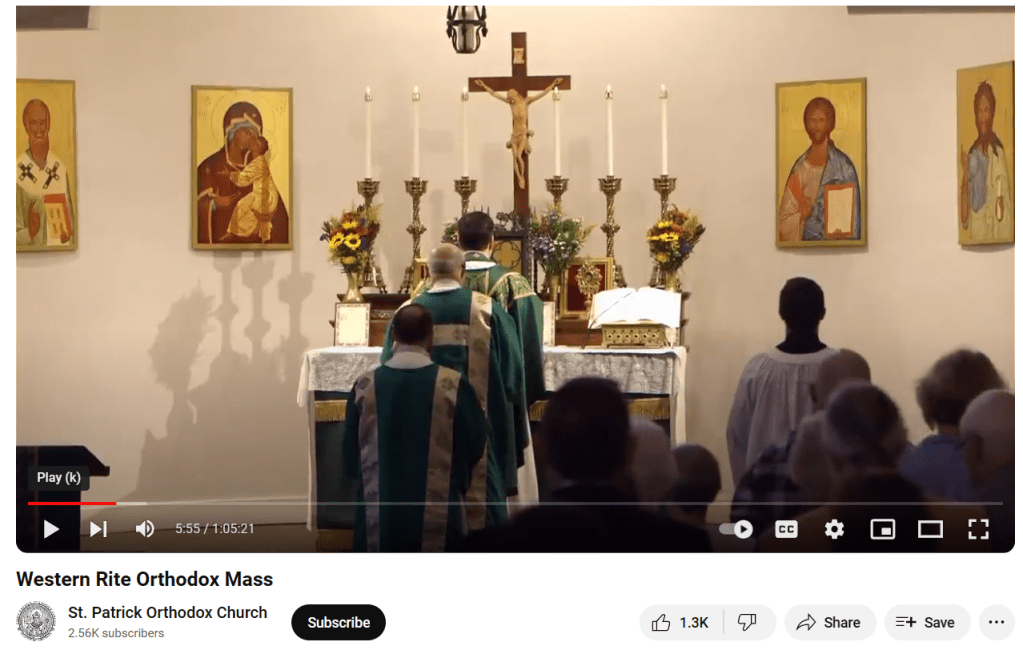
Western Rite Orthodox Mass at St. Patrick Orthodox Church, Bealeton, Virginia – Antiochian Orthodox Christian Archdiocese

Convert to Orthodoxy?

The Latin West and Orthodoxy, having been separated for a millennium, have diverged with respect to theological frameworks, devotional practices, and local customs. For distressed Roman Catholics who have lost their home, Orthodoxy can be their new home but moving into the new home will require adjustment. They cannot expect to carry their traditional Roman Catholicism into the Orthodox Church. One possibility for some is Western Rite Orthodoxy. The Western Rite is patterned after the Latin Mass but it is done in the local vernacular. So far as this author knows, there is no Latin Rite in Eastern Orthodoxy.

If traditionalist Roman Catholics desire to convert to Orthodoxy, we welcome you but you must want to become Orthodox. There is much in the Roman Catholic tradition that can be brought over into Orthodoxy, but there are elements of Roman Catholicism that are incompatible with Orthodoxy and so must be left at the door. To attempt to hold onto these problematic beliefs and practices as one seeks to become Orthodox is like a smuggler seeking to covertly transport contraband over the border. If you desire to become Orthodox, we will help you. However, if you wish to reshape Orthodoxy into something reminiscent of the Latin Rite you are longing for, we ask you to go elsewhere. We’re Orthodox, and we are not going to change.

Priest distributing the antidoron.

You are welcome to attend the Sunday Liturgy as an ecclesial refugee who needs a comforting corner for respite. We ask that you refrain from going up for Holy Communion as the Orthodox leadership have not yet changed the Church’s position on Roman Catholics receiving Holy Communion. Please don’t take this as a sign of rejection or judgment. To receive Holy Communion means that one shares the same Faith as the Orthodox Church and are under the pastoral care of an Orthodox bishop. However, after the Liturgy has been concluded you are welcome to come up and receive the antidoron (blessed bread) from the priest. The antidoron is given to the Orthodox and non-Orthodox as a sign of hospitality.

May God have mercy on us all in these troubled times.

Athenagoras

REFERENCES

Documents

Fiducia Supplicans. Vatican.va

Traditionis Custodes. Vatican.va

Summorum Pontificum. Vatican.va

Articles

Susan Benofy. “The Day the Mass Changed, How it Happened and Why — Part I.” In CatholicCulture.org

Fr. Stephen Freeman. “Belief and Practice.” Glory To God For All Things.com

Filioque” in Wikipedia.

Nicene Creed” in Britannica.com

YouTube Videos

YouTube video: “Shocking: Scandalous Chicken Dance Mass in Germany – Dr. Taylor Marshall” [48:23] 

YouTube video: “Western Rite Orthodox Mass” [1:05:21]

YouTube video: “Western Rite Orthodoxy Explained” [21:02]

Orthodoxy – Right worship for the ages of ages. Come and join us!